We deploy private shower trailer rentals for the crews, camps and communities that can't go home at night. Individual locking stalls, hot water sized for shift change, greywater handled completely. Delivered nationwide, serviced daily where the mission demands it.
Nobody puts showers on the first whiteboard. But by day three of any real operation, bathing is the thing everyone's asking about. We deploy private shower trailer rentals with hot water, individual locking stalls and managed greywater, so the question gets answered before it's asked. Fire camps. Shelters. Man camps and festival grounds. If people sleep there, we can keep them clean there.
Two dedicated shower trailers and three combos that fold bathing in with restrooms or laundry. Every accordion below opens to real photos, a layout drawing and the exact spec sheet our dispatch team plans from.
Dedicated shower units with individual private stalls, high output water heating and greywater capture. These carry the bathing load at camps and response operations.


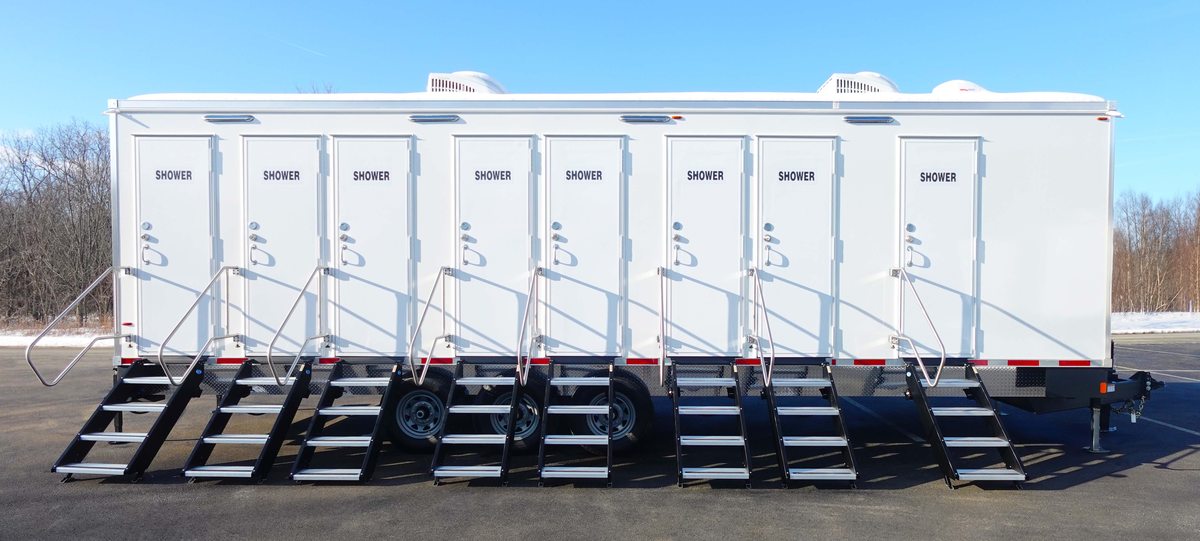
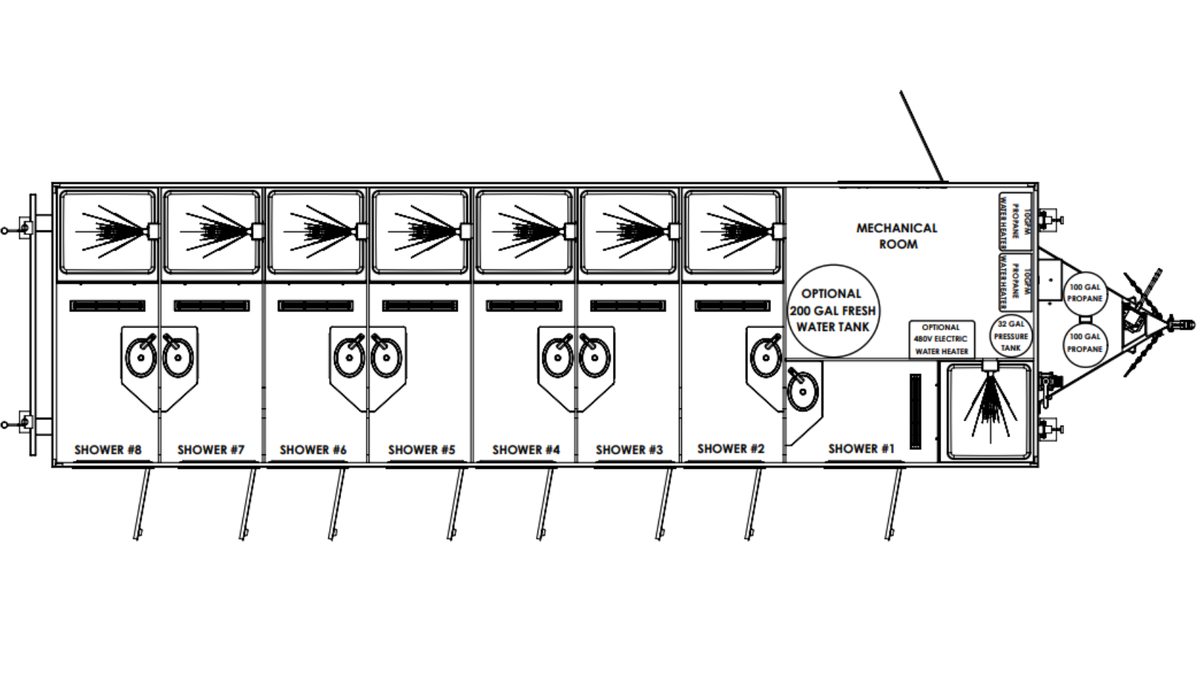
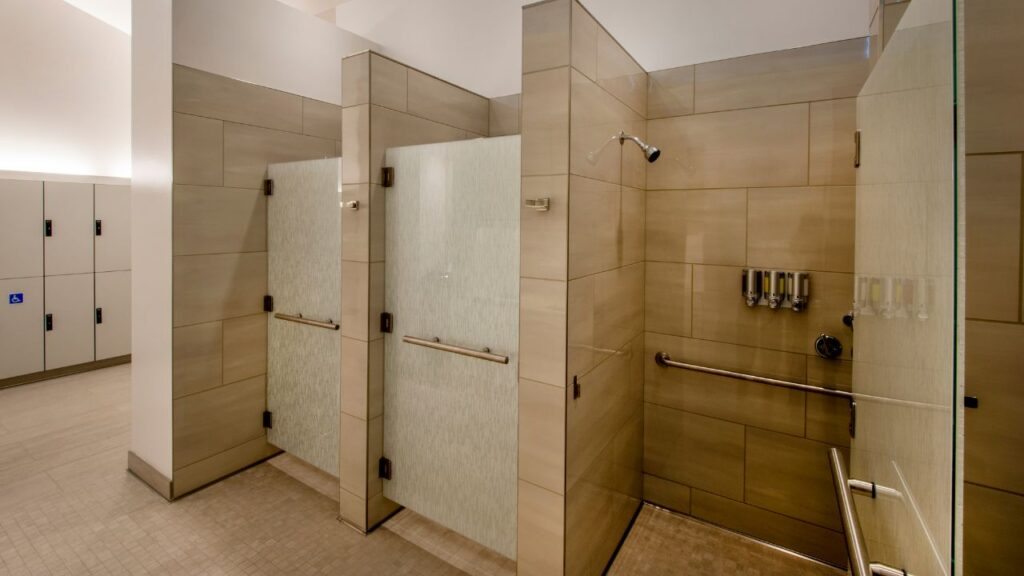
Eight private stalls, each behind its own exterior door with a bench, hooks and working ventilation inside. This is the unit fire camps and workforce housing run around the clock, and we spec it that way: continuous water heating, big greywater capture and hardware that survives a thousand showers a month. With disciplined flow it turns over 45 showers an hour, and closer to sixty when a crew boss runs the line. We've watched it reset an exhausted crew's morale in one evening. Pair two or three of these with laundry and bunkhouse trailers and the hygiene block of a 280 person camp is done. Inside each stall you get a real showerhead with pressure (not a trickle valve), a dry changing bench, hooks for gear and a light that works. The mechanical bay holds the heating plant and pumps where our service techs can reach them without shutting down the line. On multi week contracts we track water consumption per service visit, so the potable delivery schedule tightens to what the crew actually uses instead of a guess. Districts and agencies get the unit's spec sheet data, insurance certificates and service logs in whatever format the contract file demands.
| Stations | 8 private shower cabins + 4 exterior hand-wash sinks |
| Box Size | 8' 5" x 29' |
| Length w/ Tongue | 35' |
| Width w/ Stairs | 12' 4" |
| Height w/ AC | 11' 10" |
| Fresh Water | 200 gal |
| Waste Tank | 1,000 gal (septic-connect capable) |
| Power | Two 20-amp 110V or one 50-amp 220V circuit |
| AC Units | 2 |
| Certifications | CAL Fire approved |


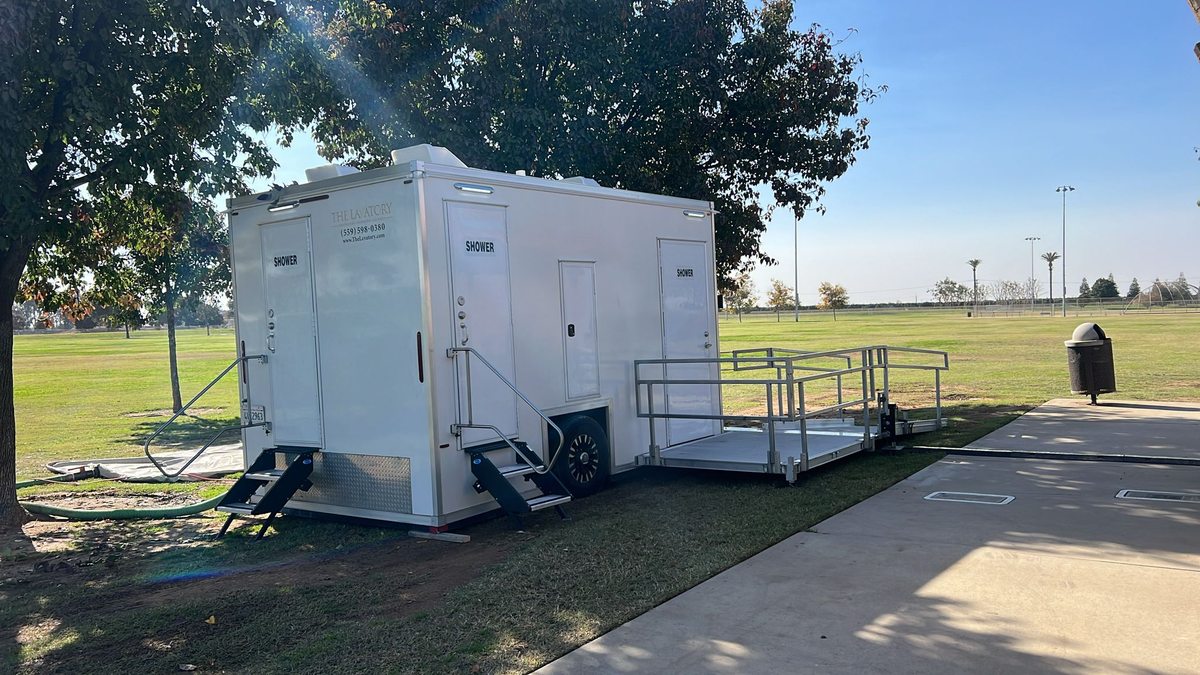
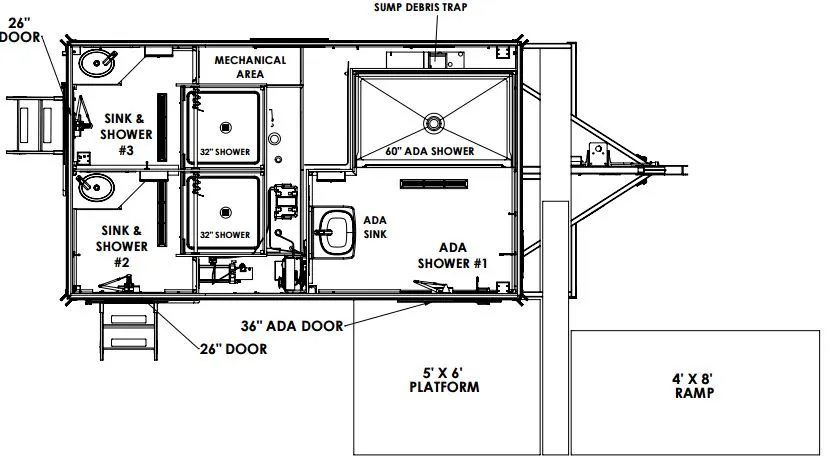
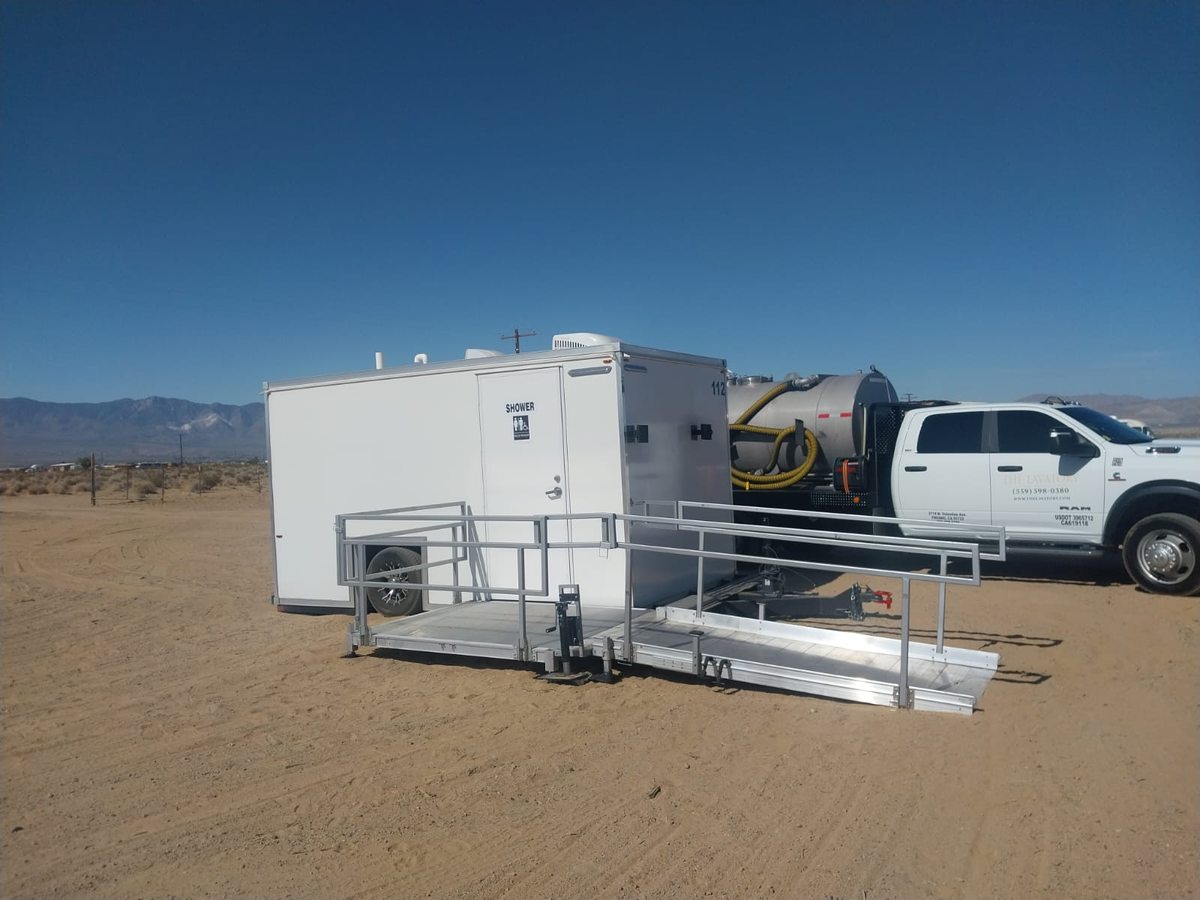
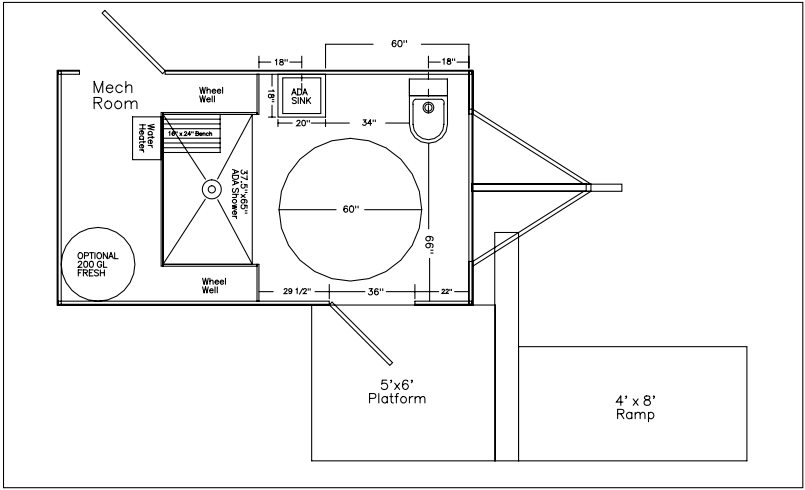
A wheelchair accessible shower suite with ramp entry, roll in threshold, fold down seat and grab bars, plus two standard private stalls on the same chassis. So one placement covers accessibility and general bathing at the same time. Shelters lean on this unit hard, and so do public agencies whose sites get inspected. The accessible suite is genuinely usable, not a checkbox. We install the ramp, verify the clearances and hand over documentation for your compliance file. And because it draws one water connection and one circuit, it drops into an existing camp plan without reworking utilities. The two standard stalls keep general traffic moving so the accessible suite stays available for the people who need it, which is exactly how inspectors want to see it run. We position the ramp on the approach side with the gentlest grade, then verify the landing clearances before the driver leaves. Sounds minor. It's also the difference between passing review Tuesday and re-staging the trailer Thursday.
| Stations | 2 unisex shower stations + 1 ADA unisex shower |
| Box Size | 8' 5" x 14.5' |
| Length w/ Ramp | 25' |
| Width w/ Stairs | 13' 6" |
| Height w/ AC | 12' 2" |
| Fresh Water | 105 gal |
| Waste Tank | 300 gal |
| Power | Two dedicated 120V-20 amp circuits |
| AC Units | 1 |
Combination trailers that put showers, restrooms and in one case laundry behind a single hookup. Small crews get full hygiene from one tow.


One accessible suite where a zero threshold shower shares the room with a toilet and sink, all behind a ramped entrance. It's the answer when a site needs an ADA bathing and restroom point and has room (or budget) for exactly one placement. Workforce housing operators put it near medical or admin. Shelter teams use it to serve residents with mobility needs properly instead of improvising. Utility draw matches a small restroom trailer, so adding it to an existing site plan is painless. Everything inside is genuinely roll in: no lip at the shower threshold, a fold down seat rated for real weight, grab bars through the wet zone and a sink set at accessible height. One unit, one ramp, full coverage.
| Stations | 1 combined shower + toilet ADA room |
| Box Size | 8' 5" x 14.5' |
| Length w/ Ramp | 25' |
| Width w/ Ramp | 13' 6" |
| Fresh Water | 105 gal |
| Waste Tank | 300 gal |
| Power | Two dedicated 120V-20 amp circuits |
| AC Units | 1 |


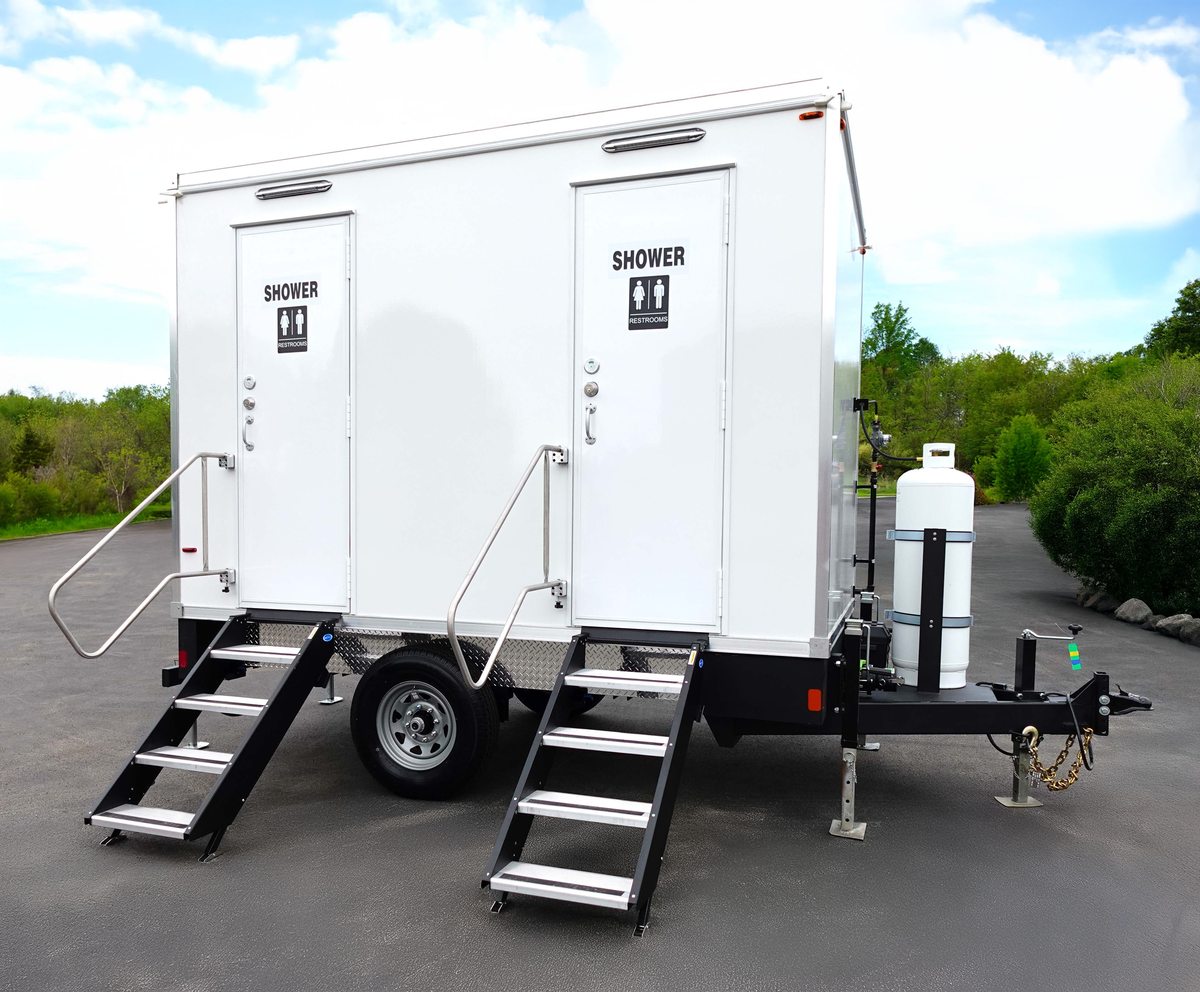
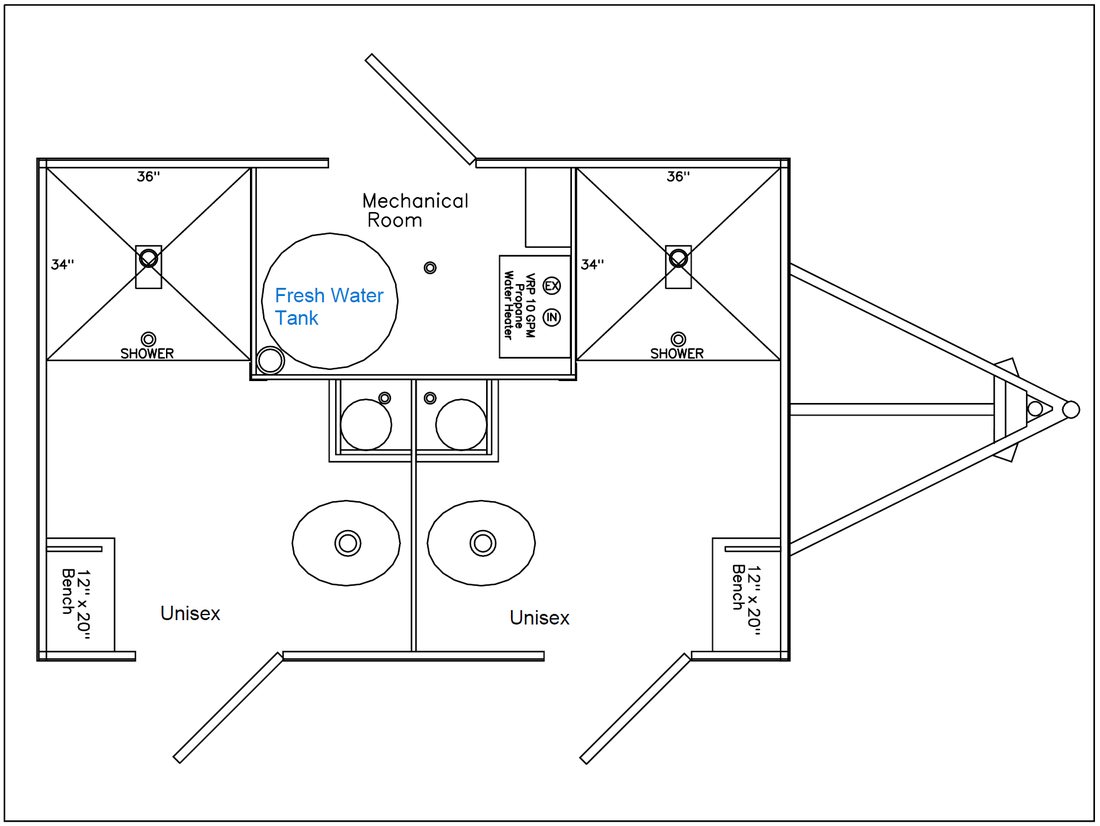
Two locking suites, each with its own shower, toilet and sink. For a crew of eight to fifteen on a site with no facilities, this single trailer is the difference between a functioning camp and a very long week. Hot water is engineered to carry back to back showers straight through a shift change. One water line and one power drop run the whole unit, and our crews manage pumping and greywater on the same service visit. Advance teams and gate positions at bigger deployments use it as their own self contained hygiene point. Because both suites lock independently, the unit also works split duty (one suite for day shift, one held clean for overnight staff). Our drivers set, level and test both suites before leaving, including running the water heater through a full cycle.
| Stations | 2 private bathrooms, each with 1 toilet, 1 sink, 1 shower |
| Box Size | 7' 7" x 11' |
| Length w/ Tongue | 17' |
| Width w/ Stairs | 11' 7" |
| Fresh Water | 105 gal |
| Waste Tank | 300 gal |
| Power | Two dedicated 120V-20 amp circuits |
| AC Units | 1 |


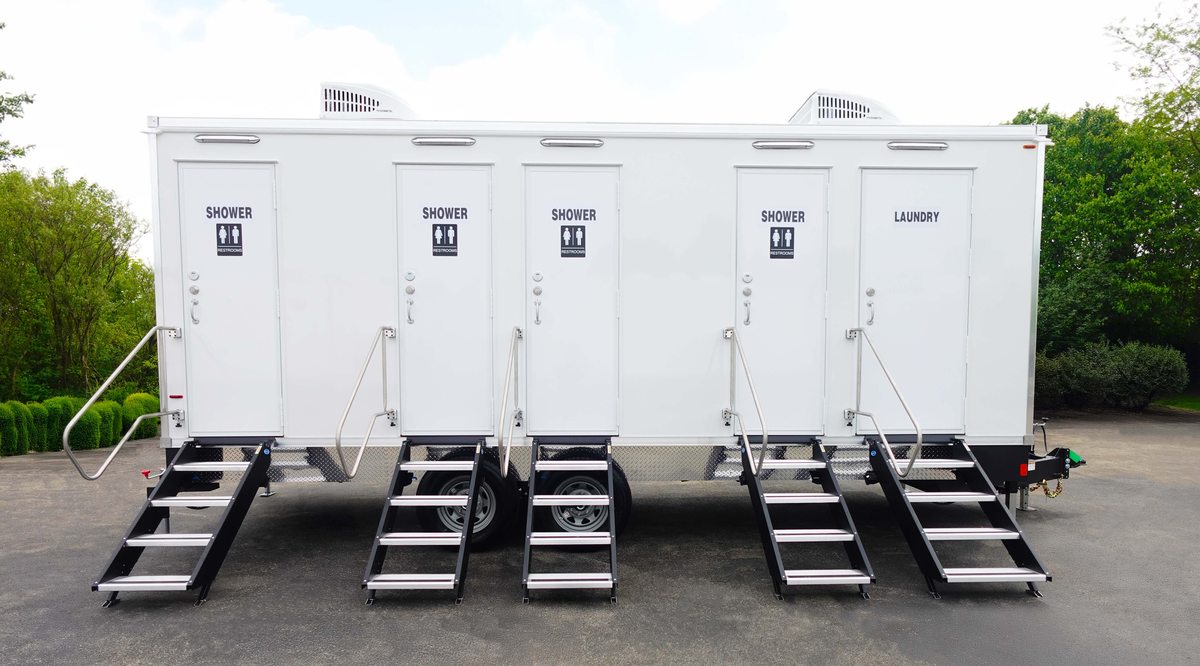
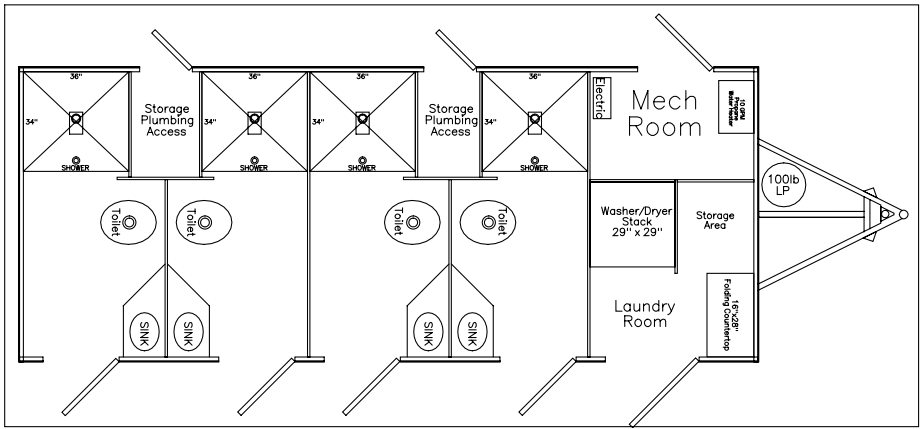
Showers, restrooms and washer dryer sets in one chassis, built for remote crews of roughly twenty to forty. It's the closest thing we deploy to a complete camp in a single tow. The shower side runs private stalls with hot water. The restroom side runs flush fixtures. And the laundry end keeps the crew in clean gear without anyone driving to town. Pipeline programs, wildfire support and agriculture operations book this unit for entire seasons. One utility plan covers all three functions, which cuts the site electrician's work to a single afternoon. And when the crew size grows past forty, the combo simply becomes the satellite unit while dedicated shower and laundry trailers take over the main load. Nothing gets returned early. The fleet just grows around it.
| Stations | 4 private bathrooms (toilet + sink + shower each) + 1 washer/dryer stack |
| Capacity | Up to 200 guests |
| Box Size | 26' 6" |
| Length w/ Tongue | 26' 4" |
| Width w/ Stairs | 12' 4" |
| Height w/ AC | 11' 4" |
| Fresh Water | 105 gal |
| Waste Tank | 750 gal |
| Power | One dedicated 220V-50 amp circuit |
| AC Units | 1 |
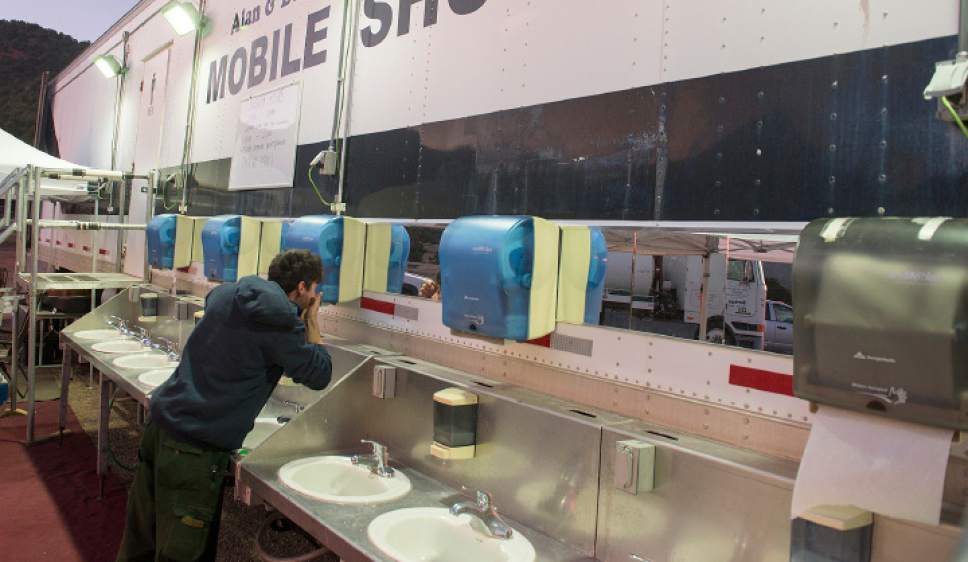
Shower capacity fails at the peak, not the average. A 240 person camp doesn't need 240 showers spread evenly across a day. It needs most of them inside a three hour window after shift. So we plan against the surge: one stall per eleven occupants as the floor, more when everyone knocks off at once.
Water heating is the second failure point. A storage tank system dies twenty showers in (ask anyone who's rented the wrong unit), which is why our high occupancy trailers heat continuously instead. And greywater is the third: capture fills faster than people expect, so pump out frequency gets planned from your head count, not guessed. "Plan the water before the trailers" applies double when the water is hot.
Bring us the head count and the shift pattern, plus anything odd about the ground (slope, soft soil, a gate with three inches of clearance to spare, we've seen it all). We'll bring back a unit count, a heating spec and a service cadence that holds through week six. "Sell the second week, not the first," is how our dispatch lead frames shower planning, because week one always works. It's day 11, when the novelty is gone and the crew is tired, that separates a planned bathing program from a rented box. We plan for day 11.

Every shower camp faces the same bottleneck, and it arrives on schedule: end of shift, everyone wants hot water at once. The camps that handle it treat showers like any other production line. Posted stall etiquette keeps individual showers near seven minutes without anyone having to play hall monitor, because peer pressure inside a queue is the most reliable enforcement mechanism ever deployed on a jobsite. Camps that skip the sign learn this in reverse. Staggered shift releases (even 14 minutes of offset) cut the peak queue roughly in half. And putting the towel exchange directly beside the trailer instead of across camp removes the round trip that quietly doubles everyone's absence from dinner. Small geometry, real minutes. A camp gives away hundreds of them a night without noticing where they went.
Our part of the equation is engineering the peak instead of the average. Water heating recovers between users fast enough that stall number eight at minute 39 runs exactly as hot as stall one did at minute one. That single spec separates working camps from mutinous ones, and it can't be checked from a brochure. It has to be engineered in, then proven at shift change. Camp bosses who've run both kinds talk about it the way chefs talk about knives. "The line moves when the water never flinches," one wildfire camp manager told us, and his camp of 340 odd personnel processed evening showers in under two hours nightly, all season, without a single cold water complaint reaching the morning briefing. That's the whole game, played correctly.
We've supported Cal Fire strike teams and federal wildland incidents where shower lines ran eighteen hours a day. Units stage in convoys, hot water is running while the rest of camp is still arriving, and servicing happens between shifts (usually before anyone's awake to notice).
Pipeline, energy and heavy construction crews live on site for months. Private stalls with real hot water keep skilled labor from quitting over living conditions. And our maintenance program keeps month six feeling like day one, which is when most rental fleets start falling apart.
Displaced families need dignity, not just capacity. Small difference on paper. Enormous difference in person. Private locking stalls, ADA roll in suites and daily cleaning make a temporary shelter feel managed instead of endured. Compliance documentation comes standard for agency files.
Camping festivals and endurance events book luxury shower trailers for competitors and VIP camping. Overnight servicing between event days keeps Saturday morning civilized, even after eight thousand people did their worst on Friday. Race directors add rinse stations at the finish line, and multi day obstacle events have run our stalls through an eighteen hour service day without a failure.
High occupancy units heat on demand instead of storing a single tank. So shower number forty runs as hot as shower number one, even at full line pace. Propane or generator fired. We size the plant to your surge window, not the average.
Site spigot, onboard tanks or scheduled water delivery all work. Figure thirty gallons or so per shower. Our quote includes the full supply math (source, tank sizing, refill cadence) so the line never runs dry mid shift.
Every drop goes to sealed onboard tanks. Our crews pump them on schedule and dispose at licensed facilities, with documentation for environmental files on regulated jobs like abatement or remediation work.
Ventilation, lighting and controls run off standard dedicated circuits, nothing exotic. No hookups on site? Generator packages cover the whole unit. Fuel service comes included where the mission needs it, which on remote fire support usually means our truck tops the generator on the same visit that pumps the greywater.
Heated lines and enclosed tank bays keep showers alive through hard freezes. We've run bathing operations through mountain winters where everything else on site froze solid, including the coffee.
Cleaning, restock, pump out, systems check. All of it scheduled around your shifts, and high use sites see our trucks daily (our trucks tend to beat the crew's alarm clocks).
Follow one day's water and the logistics stop being abstract. Fresh supply arrives by potable connection or a scheduled morning tanker, sized off yesterday's actual meter reading rather than anyone's guess. The gauge doesn't negotiate and neither do we. Through the day the trailer holds it, heats it on demand and meters it out through low flow heads that stretch every gallon without anyone noticing the difference at skin level. A crew of 61 runs through a surprisingly predictable volume, and by week two our dispatcher forecasts a camp's draw within 3 or 4 percent off nothing but the shift roster.
The outbound half is where operations get graded. Every gallon that goes down a drain lands in onboard greywater tanks, gauges visible, capacity planned with margin for the heavy nights. Our pump truck draws them down on a cadence matched to the observed fill rate, hauls the load to permitted disposal and logs the volumes in both directions, every visit, initialed. On one long fire assignment the water ledger became the camp's favorite piece of trivia. Fourteen weeks, roughly a quarter million gallons through the stalls, and the ins matched the outs to the end. Nothing touches soil, ever, which matters double on the environmentally sensitive sites where shower camps tend to happen: watersheds, US Forest Service burn areas and working agricultural land. The water ledger balances every single day, in writing. Auditors like that sentence. So do the landowners who host the camps.
One 2 station shower restroom combo carries the whole site. Add the single station ADA combo when accessibility is required and you're at two placements, total, with the entire hygiene question answered.
One 8 station shower trailer plus a laundry unit, with the 4 station combo as overflow or supervisor quarters. It's the configuration our dispatch board fills with most. Pipeline spreads, mid size emergency responses and remote construction programs all land here.
Banks of 8 station showers at one stall per eleven occupants, staged near the sleeping rows but away from generator noise. A 280 person fire camp typically runs three shower trailers, two laundry units and daily service. Bigger than that? We've built bigger.
Shower access sells as a paid ticket upgrade at camping festivals. Producers meter entry by wristband, we service overnight, and the Sunday morning line stays shorter than the coffee line. One unit per fifteen hundred campers is the working floor we plan from (heavier if camping runs three nights instead of two, lighter if hotels split the crowd).

The usual workaround is gym day passes or letting the crew drive to town. But run the numbers on a forty person crew driving twenty five minutes each way, every evening, on the clock or on their own dime. It's hundreds of lost hours a month and a morale bill on top. A shower trailer at camp deletes the commute entirely.
There's a retention angle too, and it's not small. Trade publications have written about hygiene driving camp retention for years, and our repeat clients confirm it every season. Skilled trades talk, and camps with real hygiene keep crews through the whole season. One superintendent told us the shower trailer was "the cheapest raise I ever gave." We put that on the quote sheet now.
And for public operations, shelters especially, on site bathing carries weight beyond convenience: dignity for residents, health policy compliance and OSHA aligned sanitation in a single placement.

Six hundred plus personnel at peak. The shower line never once became the bottleneck, which anyone who's run a fire camp knows is half the battle. Their crew serviced at 4 a.m. so day shift walked into clean stalls, and we never had to ask for that timing. It just happened.

We run their 8 station shower trailers at two of our man camps now. Hot water? Never once run out on a shift change, and when a door latch broke they swapped the part the next morning. Zero drama in fourteen months.

Mobilized with us three days after the storm hit. Shower trailers plus laundry meant our linemen stayed in the field instead of driving an hour back to civilization. Worth it to keep crews rested.

The ADA shower unit made our temporary shelter actually work for every resident, not just most of them. Ramp came installed, paperwork came with it, and their dispatcher checked in weekly without being asked.
"Every buyer asks a different first question," our operations lead likes to say, "and you can tell the whole contract from it." He's right, so here's the honest version of what each type of client cares about and how the fleet answers it.
Their first question is always hours, not features. The answer: the emergency line picks up 24/7, mobilization can start the same day, and during fire season equipment stages regionally so a Cal Fire support request isn't waiting on a cross country tow. First stalls run while the camp is still being built around them.
SAM.gov registration, insurance certificates before mobilization, W-9s on request and invoicing that survives an audit. We've cleared federal, state, county and district procurement enough times that the folder is pre built. Send the vehicle list requirement and it comes back the same day.
A construction program measures everything in schedule risk. So the answers they want: winterized units, weekly systems checks, same visit repairs from truck stock and a swap policy that replaces any stall we can't fix within a day. In fourteen months on one site, one client counted zero down mornings.
Event buyers want to know what a VIP camper sees at 7 a.m. on day three. The answer is a clean, private, hot shower with pressure, because overnight servicing reset every stall while the campground slept. Ticket upgrade revenue tends to settle that conversation quickly.
Private locking stalls, a genuine roll in ADA suite, daily cleaning and staff who treat residents like people. Documentation supports the agency file, but the thing directors remember is that residents stopped asking when the "real" showers were coming. These are the real showers.
Workforce housing runs showers next to laundry, restrooms, kitchens and bunkhouses, so the smartest question is whether one vendor can carry the whole block on one service schedule. That bundle is exactly what Mavirus Group was built to deliver, and it's why the twelve fleet catalog exists.
Shower trailers live or die on upkeep, so we put the standard in writing. Every service visit on a Mavirus Group bathing deployment covers the same checklist, and the completed logs belong to you.
Stalls scrubbed and disinfected, drains cleared, benches wiped, mirrors polished and floors mopped dry. Soap and towel stock refilled. Greywater pumped when tanks pass the planned threshold, never after. A tech runs the water heater through a full cycle and signs the log before leaving the site.
Pressure and temperature checks at every stall, door hardware and lock inspection, ventilation filter check and an exterior wash when conditions allow. Small failures get fixed on the spot from truck stock. Anything bigger triggers a unit swap so your crew never loses a stall for more than a day.
Service timestamps, disposal manifests, water sourcing records and repair notes, formatted for agency files. School districts want one format, FEMA supported operations want another, and environmental consultants want a third. We've produced all three enough times that it's routine now. On one 2024 deployment the auditor's only comment on our bathing logs was a single word: complete. We keep that email.
Cold climate deployments get heat trace on the lines, enclosed and heated tank bays, and a freeze response plan in the contract. When a cold snap beat the forecast at a mountain site last winter, the swap unit was rolling before the first complaint call landed. That's the standard: the client heard about the problem and the solution in the same phone call. Weather gets a vote on every deployment. It doesn't get the last word.
One more thing worth saying plainly. We own the fleet, employ the service crews and answer the emergency line ourselves. There's no rental broker in the middle of a Mavirus Group deployment, and no finger pointing when something needs fixing at midnight. That structure, more than any spec sheet, is why the shower line stays open.
Long deployments expose equipment the way long marriages expose character. By month three, a shower trailer has cycled thousands of individual uses, and the difference between genuinely maintained and merely rented shows in every hinge, every valve and every drain the building owns. Our preventive calendar front runs the wear: shower valves rebuilt on operating hours rather than on failure, drain lines jetted before they ever slow, water heaters descaled on a strict schedule anywhere the water runs hard, exhaust fan bearings checked on rotation, because a squealing fan at 5 a.m. becomes the camp's unofficial alarm clock within a week and the camp's official grievance within two. We've read that grievance. Once was enough, and the checklist grew a line.
There's also a quieter month three phenomenon that nobody warns camp managers about: standards drift. It never announces itself. It accumulates, one small tolerated flaw at a time, until the camp's definition of clean has moved without a single decision being made. A camp that tolerated a dim bulb in week one starts treating it as policy by week ten unless somebody resets the baseline, so our techs work from the same 31 point checklist on visit 40 as they did on visit one, photographing conditions rather than trusting anyone's memory of them. "It still feels new," is how clients usually name the effect, without knowing they're describing a maintenance calendar. The trailer that still smells like a clean hotel bathroom in month four is always the one whose maintenance program never once negotiated with itself. There is no third explanation, and we've looked. Pipeline camps in the Permian and the upper Midwest have kept ours for 14 straight months on exactly that discipline, and renewed without a walkthrough.
Here's the real sequence, because "we deliver shower trailers" hides all the parts that matter. This is the version our dispatchers actually run, whether the order came from a county emergency manager at 2 a.m. or a project office six weeks ahead of mobilization.
Fifteen minutes on a normal week. We ask for head count, shift pattern, site conditions and the water and power picture. If it's a declared emergency, this call happens while the trucks are already being loaded. We've taken scoping calls from FEMA supported staging areas where the answer to every site question was "unknown," and that's fine. The fleet plans around unknowns.
Before anything rolls, you get a unit list and a plan for water in, heat, greywater out and power. On grid sites it's a page. Off grid it covers tank sizing, delivery cadence and generator loads. And it's honest: if your spigot can't feed three shower trailers at shift change, we say so now instead of discovering it live.
Drivers arrive with the site plan, walk the approach, then set, level and connect each unit. Every stall gets a hot water test before sign off. On convoy mobilizations the first trailer is operational while the last is still on the highway.
Pumping, cleaning, restock and a heater check on a cadence set by your occupancy. Daily on fire camps and shelters. We schedule around your shifts so nobody meets a service truck at the stall door, and the logs are yours whenever an auditor asks.
Camps grow. Crews double. Cold snaps arrive early. Because the fleet is ours end to end, adding a second shower trailer or swapping in a winterized unit is a dispatch note, not a renegotiation. You call one number and the site adjusts.
When the mission winds down we pull units on your timeline, close out the utilities and leave clean ground. Final service records and disposal documentation follow for the project file. Then the trailers head back for a full recondition (deep clean, systems test, hardware pass) and get staged for whatever the next call turns out to be.
We'll come back with the unit mix, the heating spec and a mobilization date. Emergency requests jump the line, every time.