Home / Services / Laundry Trailer Rentals
Laundry Trailer Rentals

Laundry Trailer Rentals That Keep Disaster Crews, Basecamps and Long Term Sites in Clean Gear

We put commercial washers and dryers on your site, keep them stocked and keep them running. Because a crew in clean gear works better, stays longer and stops burning Sundays at a laundromat forty minutes away.

The Overlooked Trailer

Clean gear is a supply line, and most camps forget to build it.

Everyone plans restrooms. Most plan showers. Then week two arrives and 90 people are wearing the same three shirts in rotation, morale sags, and somebody starts driving loads to a laundromat an hour away on the company clock. We rent out mobile laundry trailer rentals so that day never comes. Commercial washers and dryers, on your site, serviced by our crews and stocked without anyone asking.

And it's not just comfort. Hotshot crews need fire gear cleaned to function. Medical and shelter operations have hygiene standards with teeth. And on regulated sites, "we couldn't wash anything" reads as a finding in somebody's audit report, with follow up questions attached.

Freshly washed and folded crew clothing stacked in bright colors
The Machines

Two on site laundry trailer rentals, sized for camps and crews.

The Laundry Fleet 2 units

One dedicated laundry trailer and one combo that folds washing into a full hygiene unit. Expand either for photos, the floor plan and the spec table.

8 Station Laundry TrailerLength 26' 4"
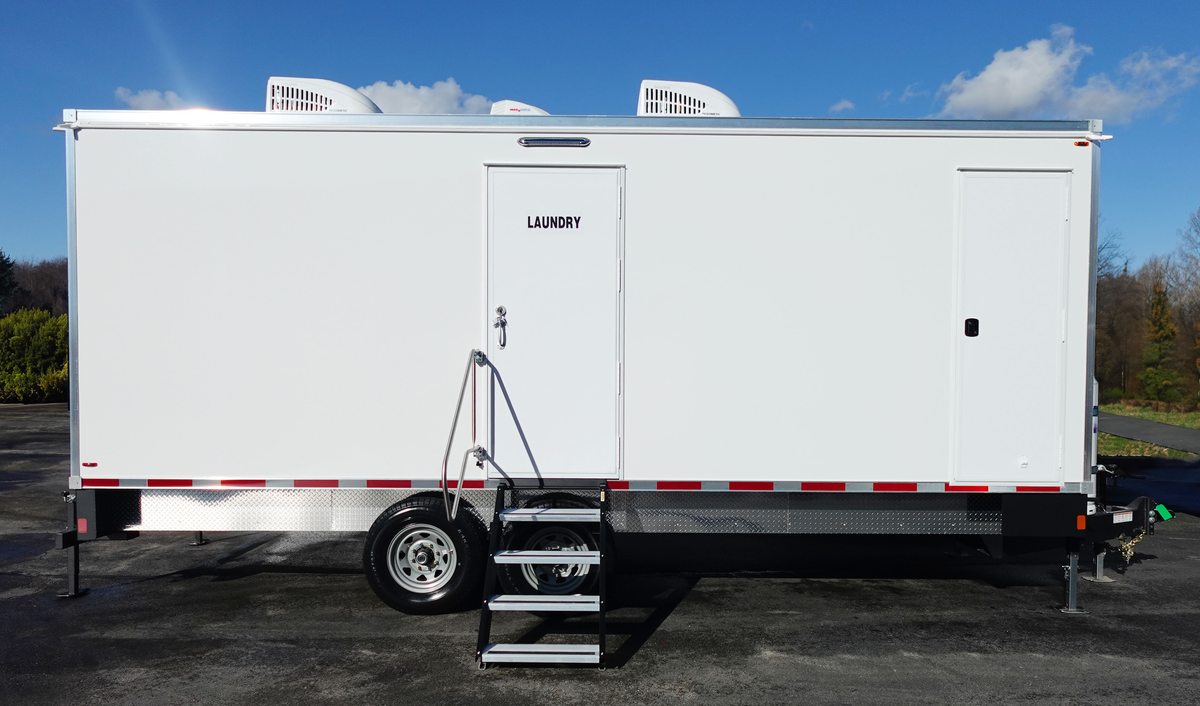
White laundry trailer rental with utility door open and fold down entry steps deployed
Exterior
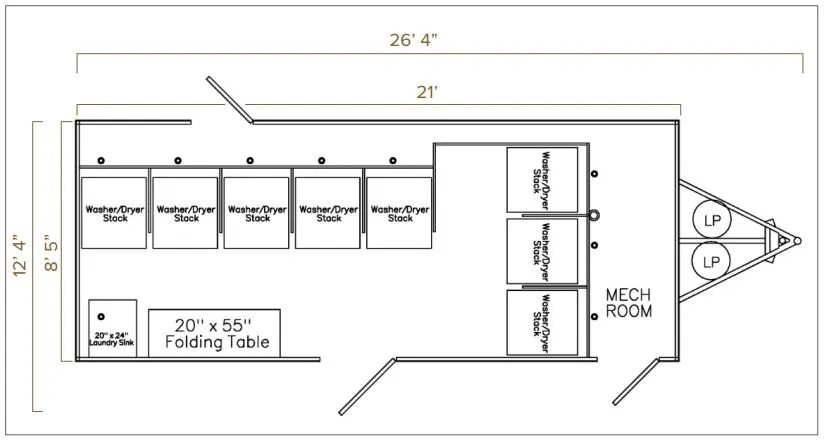
Machine layout drawing for the 8 washer dryer trailer with folding counter along one wall
Floor plan

Eight commercial washer and dryer sets in a climate controlled trailer, plus folding counters and detergent storage. That's the whole idea, and it's enough to change a deployment. One of these units cycles hundreds of loads a week, which keeps a crew of 130 or so in clean gear indefinitely. We stock detergent on the same service visit that checks the machines, and a tech (not a phone tree) handles any unit that acts up. Fire camps run it next to the shower line. Man camps run it around the clock with a sign up sheet. And school districts have used it during dorm renovations, because 300 students generate laundry whether the building works or not.

Stations8 industrial Whirlpool washer + dryer stacks
AdditionalBasin sink + folding table
Box Size8' 5" x 21'
Length w/ Tongue26' 4"
Width w/ Stairs12' 4"
Waste Tank750 gal
PowerTwo dedicated 50-amp 240V circuits
AC Units2
4 Station Shower & Restroom Combo + LaundryShower + restroom + laundry
Multi door combo unit that adds washers and dryers to showers and restroom stations
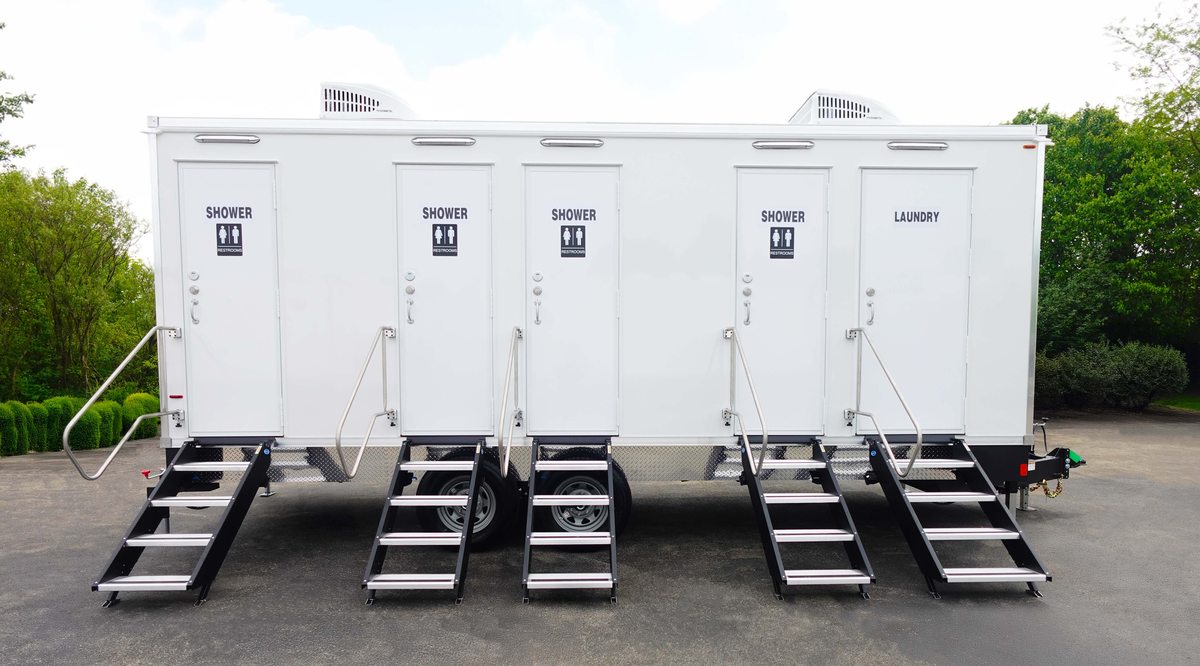
Exterior
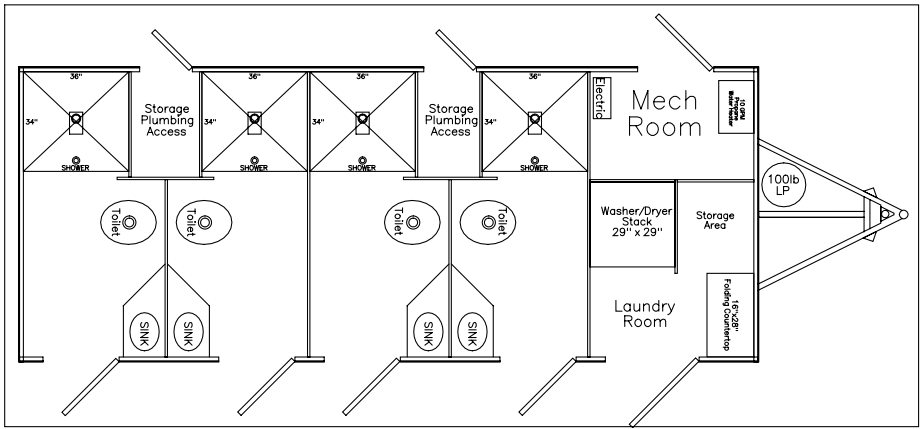
Chassis plan placing the laundry bay beside shower stalls and the restroom end
Floor plan

Washers and dryers riding in the same chassis as private showers and restroom stations. For remote crews of twenty to forty, this one tow covers the entire hygiene question (bathing, restrooms and clean clothes) behind a single water connection and one power plan. The laundry end holds commercial machines sized for work clothes, not apartment duvets, and our crews restock supplies on the standard service cadence. Pipeline spreads and wildfire support teams book it for whole seasons at a time. But it's just as at home behind a rural hospital renovation or a county fairground project where three separate trailers would crowd the site.

Stations4 private bathrooms (toilet + sink + shower each) + 1 washer/dryer stack
CapacityUp to 200 guests
Box Size26' 6"
Length w/ Tongue26' 4"
Width w/ Stairs12' 4"
Height w/ AC11' 4"
Fresh Water105 gal
Waste Tank750 gal
PowerOne dedicated 220V-50 amp circuit
AC Units1
Laundry Math

Loads per week, not machines per brochure.

"Count the loads, then count the machines," our operations lead says, and the order matters. Here's the arithmetic we run before quoting any laundry trailer rental, so the machine count matches the mission instead of the sales pitch.

The per person baseline

A working adult on a physical job generates two or three loads a week, and nobody has ever accused a fire camp of being below average. Mud season pushes it higher. Wildfire assignments run heavier still. So a 130 person camp lands near 340 loads weekly, and one 8 machine trailer handles that across a 16 hour operating day with margin left over.

Cycle time drives everything

A wash runs 35 minutes flat on the normal cycle. A commercial dry runs closer to 45 minutes. Each washer dryer pair therefore turns 14 loads in a full day, and eight pairs put you past a hundred daily loads. The math that looked tight on paper breathes easily once the machines are actually spinning.

When to add the second unit

Past 150 people, or when the schedule compresses washing into two frantic evenings (shift camps do this constantly), a second trailer beats a waiting list. But we'll tell you honestly when one is enough. Overselling machines makes the invoice look bad in month three, and we intend to be there in month three.

Gear versus clothes

Turnout gear, coveralls and heavy canvas eat capacity fast, so gear heavy crews get counted differently. Tell us what your people wear and we'll adjust the plan. It's a two minute conversation that saves a season of bottlenecks.

Included

What rides along with every mobile laundry rental.

Delivery and commissioning

Set, level, connect, then a full test cycle on every machine before the driver leaves the site (yes, all eight). A washer that ships with a rattle never reaches your crew.

Supplies on schedule

Detergent, dryer sheets and cleaning stock arrive with the service visit, and special detergent policies get honored on request. Fragrance free, sensitive skin, whatever the safety officer signed.

Machine maintenance

Our techs check machines, clear lint systems and fix small faults straight from truck stock. Bigger problem? The machine gets swapped, because throughput is what you rented.

Greywater handling

Wash water goes to sealed capture, pumped by our crews and disposed at licensed facilities. Documentation follows for regulated jobs.

Climate control

HVAC keeps the folding area humane in July and the water lines alive in January. Winterization is a checkbox on the quote, not an upsell surprise.

One point of contact

The same dispatcher who runs your restrooms and showers runs your laundry. One call adjusts the whole hygiene block at once.

Where It Deploys

Temporary use laundry trailers, from fire lines to campuses.

Disaster response and shelters

After Hurricane Helene response work in 2024, we watched laundry access change the mood of an entire operation. Displaced families washing their own clothes recover a piece of normal life, and responder crews stay field ready week after week. FEMA supported sites get full documentation alongside the machines.

Fire camps

state fire agencies and the US Forest Service supported camps run laundry beside the shower line, often overnight. Gear dries by morning, and nomex that gets washed lasts longer than nomex that doesn't. The service truck handles supplies before day shift wakes.

Workforce housing and man camps

Energy, pipeline and heavy construction camps treat the laundry trailer as permanent infrastructure. So do we: maintenance programs, machine rotations and quarterly condition reviews keep month nine running like week one.

Institutions in transition

Dorm renovations, athletic programs, correctional and hospital projects. When a building's laundry room goes offline, the trailer takes the load, baskets and all, until the contractor hands the keys back.

Field Notes

What a working laundry deployment actually looks like.

Skip the brochure version. Here's how a mobile laundry rental runs on a real site, starting at the first conversation and ending the day the trailer rolls home, based on the deployments our dispatch board carries every season.

1

Scoping

Head count, gear type and schedule. That's the whole first call. A hotshot crew washing nomex nightly is a different plan than a shelter washing family loads through the afternoon, and the machine math shifts with it. Ten minutes here saves a season of waiting lists.

2

Utilities on paper first

Water feed, drain or capture, power by machine count. On grid it's simple. Off grid we bring tanks, schedule potable delivery and size a generator (the same plan our shower trailers run, so combined hygiene blocks share infrastructure). You see the whole layout before anything ships.

3

Commissioning day

The driver sets and levels the trailer, connects everything, then runs a test load in every single machine. Not a spot check. Every machine. A washer that ships with a wobble gets swapped at the yard, never discovered by your crew at 9 p.m.

4

The running rhythm

Supplies, lint systems, machine checks and greywater pump outs ride one service schedule. High volume camps see us daily. And because the same dispatcher runs your restrooms and showers, one call re-times the whole block when your shift pattern changes.

5

When something breaks

Small faults get fixed from truck stock during the visit. Anything bigger triggers a machine or unit swap inside a day, because throughput is the contract, not the excuse. One client counted a single breakdown in ten months. It was fixed the same week.

6

Wind down

We pull on your timeline, close out utilities, and hand over service logs and disposal manifests for the project file. Long term clients keep the same unit season over season, which is its own kind of endorsement.

Buyers

Five kinds of clients, five different first questions.

"You can tell the contract from the first question," our operations lead says, and laundry proves him right weekly. Here's who books these trailers and what each one wants settled up front.

Camp managers ask about throughput

Loads per day, machines per person, hours of operation. We answer with arithmetic, not adjectives: 14 loads per pair per day, eight pairs per trailer, second unit past 150 occupants. Then we put it in the contract.

Emergency coordinators ask about timing

The line answers 24/7 and laundry typically rolls in the second wave behind restrooms and showers. On FEMA supported recovery work, family laundry access has been one of the most requested services on site, and we plan capacity for it from the start.

Fire support contractors ask about gear

Turnout gear and nomex wash different from t-shirts. We count gear heavy crews at a heavier load factor, stock the detergent the safety officer approves, and schedule cycles overnight so equipment dries before day shift.

Facilities directors ask about disruption

A dorm or hospital laundry room going offline can't take the building's schedule with it. Placement happens around loading docks and quiet hours, service runs before the day starts, and the trailer leaves the week the renovated room reopens.

Procurement asks about the paper

SAM.gov registration, insurance certificates before delivery, disposal documentation during, and invoices that reconcile without a phone call. The folder is pre built because these questions arrive weekly.

Why It Pays

The laundromat run is the most expensive free option on your site.

Do the drive math once and the trailer sells itself. A forty person camp sending people to town twice a week burns hundreds of crew hours a month on driving, waiting and folding at a strip mall. Some operations assign a runner instead, which converts a skilled worker into a part time courier. Either way you're paying wages for machine time you don't control.

An on site laundry trailer deletes the commute, runs on your schedule and keeps people inside the fence (site security teams appreciate that part more than anyone). And there's the retention angle again: camps that handle the small quality of life problems keep crews through the season. Clean clothes are a small problem exactly once.

For shelters the value isn't measured in hours at all. After a flood or fire, washing your own family's clothes is one of the first pieces of ordinary life that comes back. We've watched it happen. It matters more than the machine count.

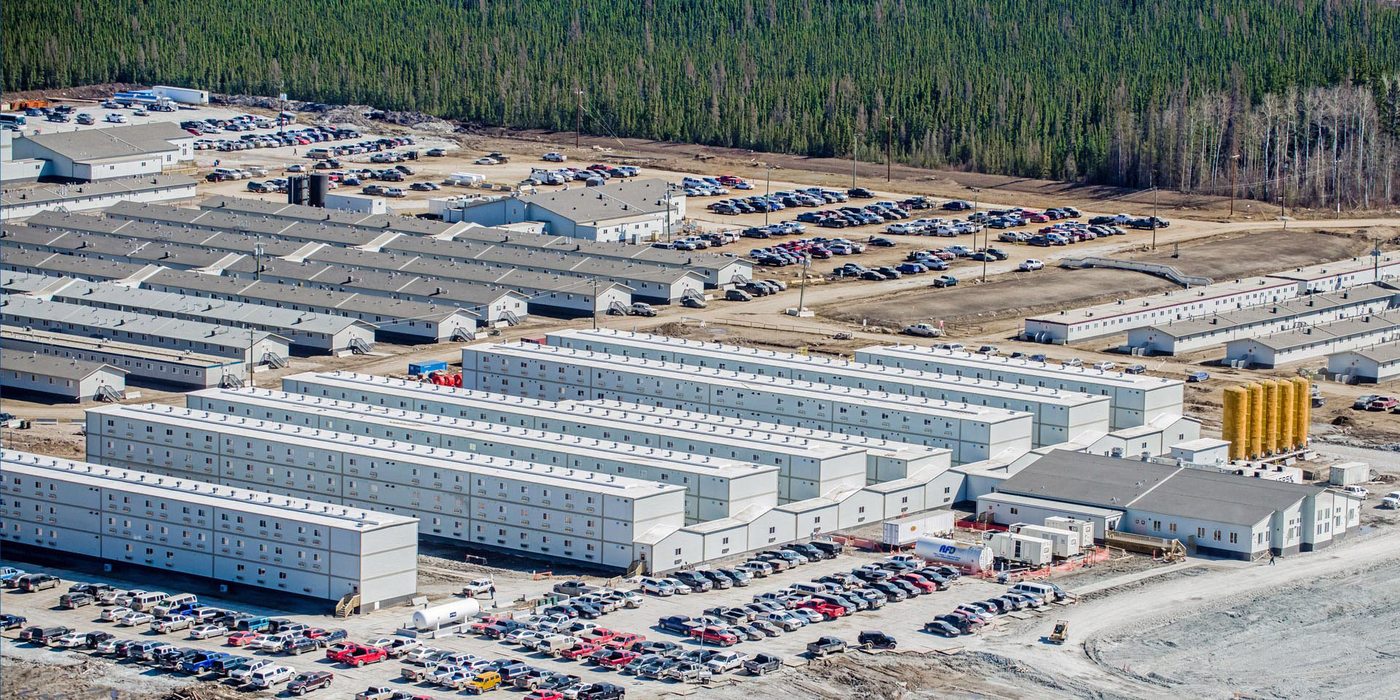
Aerial rows of a large workforce camp where on site laundry keeps crews out of town
The Utility Bill Question

What eight commercial washers actually draw, answered before you ask.

Facilities managers from school districts to USACE support contractors always circle back to the same worry: is this trailer going to flatten my site's water and power budget? Short answer, no, and here's the longer one. The machines are commercial high efficiency units, so water per load runs well below what a home washer burns, and the trailer's total draw stays inside what a modest generator or a standard service panel handles without drama. On tank supplied sites, our refill schedule is built off your actual load counts (the techs read the meters at every visit), so the water plan tightens itself as the deployment settles into a rhythm. By week three, the refill truck arrives within an hour of when the tanks actually want it.

And the comparison that matters is trailer versus the laundromat run, the thing crews actually do without one: a van, a driver, four lost hours per trip and a stack of receipts from a business 40 odd minutes away that closes at 9. One pipeline client added up 27 days of those trips and stopped mid spreadsheet. The trailer's utility line was a rounding error next to the windshield time it deleted, and his crews got their evenings back in the same transaction. That's the bill worth auditing, and it's the one nobody had been tracking because it never arrived as an invoice. Windshield hours never do. They just quietly eat the week.

The Service Standard

Machines are easy. Keeping them spinning for nine months is the job.

Any yard can drop a laundry trailer. The contract we actually sell is uptime, and uptime comes from a maintenance discipline most rental outfits skip. Here's what that discipline looks like written down, because it belongs in writing.

Every service visit

Lint systems cleared (the number one fire and throughput risk on any laundry operation), machine cycles spot tested, leveling checked, supplies restocked and greywater pumped before the tanks argue about it. The tech signs a log, and the log is yours. On a Cal Fire supported camp last season, that visit happened at 5 a.m. daily and the day shift never saw a truck.

Weekly on long placements

Hose and valve inspection, dryer vent flow measurement, door seal check and a full cycle timed against spec. Drift gets caught while it's still boring. And twice a year on multi season contracts, the whole unit rotates out for a shop recondition while a fresh trailer takes its place, so the machines your crew touches never age past their service curve.

The swap promise

A machine we can't fix on site within a day gets replaced, and a trailer with a chassis or systems problem gets swapped whole. We'd rather move steel than argue about a warranty clause. That's the line our repeat clients quote back at us, and we're happy to keep earning it.

Documentation without asking

Service timestamps, water sourcing, disposal manifests and repair notes, formatted for the file your auditor expects. FEMA supported operations, school districts and environmental consultants each want it differently. We've built all three folders enough times that your version already exists as a template.

Sector Notes

Laundry looks different in every sector. The trailer doesn't care.

Same machines, wildly different missions. A few notes from the sectors that book mobile laundry most, because the details below are the ones that decide whether your deployment feels effortless or improvised.

Emergency management

County OES teams and FEMA supported operations fold laundry into shelter planning right after showers. The detail that matters: family loads run bigger and slower than crew loads, so shelter machine math uses a different factor than camp math. We plan for washing machines full of children's clothes, because that's what a shelter actually washes. And the emotional weight of that service is real. Coordinators tell us the laundry line is where residents start talking about what comes next. One Red Cross adjacent shelter manager put it to our dispatcher this way: "Showers made people feel clean. Laundry made them feel like themselves." We think about that one a lot when we're sizing shelter contracts, and it's why family machine capacity gets planned generously even when the head count math says it could squeak by smaller.

Wildfire and forestry

Nomex has washing requirements, ash is corrosive and the operational tempo leaves one overnight window for everything. US Forest Service supported camps run our machines on that window nightly. The detail that matters: gear drying capacity, not wash capacity, is the real constraint, so we spec dryer throughput first on fire contracts. Crews staging out of a US Forest Service supported camp near the Sierra front learned this with us two seasons ago: wash capacity was never the choke point, drying eighty sets of gear before the 0500 briefing was. Extra dryers solved it in a week, and that config is now the default on every fire board quote.

Energy and pipeline

Man camps of eighty to two hundred, months at a time, mud in every season. The detail that matters here is longevity: machine rotations, quarterly condition reviews and a service tech who knows the site by name. One pipeline client has renewed the same laundry setup across three spreads and calls it "the only trailer nobody complains about." We'll take that.

Institutions and campuses

Dorm renovations, hospital projects, athletic programs and correctional facilities all rent laundry capacity during building transitions. The detail that matters: placement and scheduling around a population that never leaves. Service before first bell, machines quiet by lights out, and background checked crews with badges where the site requires them (districts always do). Athletic departments deserve their own mention: a football program's laundry volume rivals a small fire camp's, arrives all at once after practice, and smells like it. We plan those machines the way we plan gear loads, with capacity to burn.

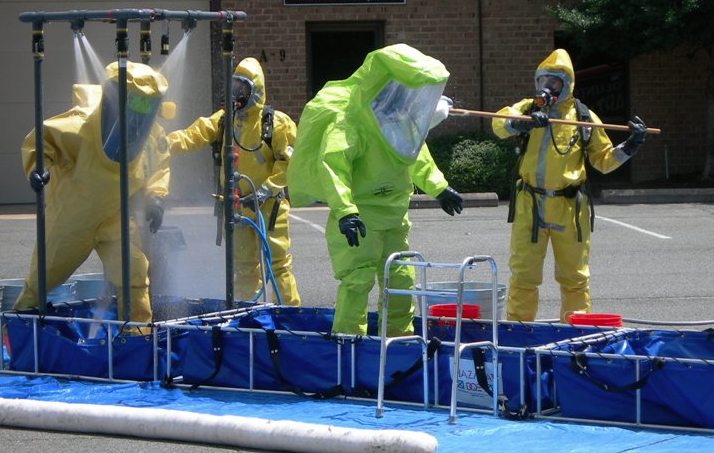
Response personnel processing contaminated gear, the kind of load camp laundry has to handle safely
Gear Care

Work gear has washing rules. We actually follow them.

Nomex and flame resistant clothing lose protection when they're washed wrong, and NFPA guidance on turnout gear care exists for a reason. So fire contracts get machines assigned to gear only, temperatures set to the manufacturer's card, and no fabric softener within a hundred feet (it degrades FR treatment, which surprises people every season).

Industrial sites bring their own rules. Hi vis vests wash separate from grease heavy coveralls. Ash loads off wildfire assignments get pre rinse cycles because ash is mildly corrosive to drum seals. And on abatement or remediation projects, contaminated clothing doesn't enter the general machines at all: it routes to the decon program instead, which is a different trailer and a different page on this site.

None of this is complicated. But it's the kind of detail that separates a laundry program from eight machines in a box, and it's why safety officers sign off on our setups quickly. Bring us your gear list and any care requirements from the manufacturer. We'll fold them into the operating plan (pun fully intended) before the first load runs.

Before You Book

Seven questions our dispatchers will ask you anyway.

"The best scoping call is the one where the client already knows these answers," says the dispatcher who runs our laundry board. So here's the cheat sheet. Come to the call with even half of these settled and your quote lands the same afternoon.

1. How many people, and what do they wear?

Head count sets the baseline, but the wardrobe sets the multiplier. Office clothes wash light. Coveralls, turnout gear and anything worn in mud wash heavy, sometimes double. A ninety person crew in heavy gear needs the machine count of a 140 person crew in polos.

2. When can washing actually happen?

Around the clock camps spread the load beautifully. Single shift operations compress everything into evenings, and compressed schedules are where waiting lists are born. Tell us the real rhythm and we'll size for the crunch hours, not the daydream version.

3. What utilities exist on the ground?

A spigot and drainage make life easy. Nothing at all makes life normal (for us anyway), because tanks, potable delivery and generator power are standard kit. What hurts is finding out mid deployment, so we walk utilities on the first call.

4. Is there a compliance file to feed?

School districts want background checked crews. Environmental consultants want disposal manifests. FEMA supported operations want everything twice. None of it slows us down, but knowing early means the paperwork arrives with the trailer instead of after it.

5. Where does the trailer physically sit?

Near the bunkhouse beats near the gate, every time. Laundry gets used when it's a short walk in work boots after a twelve hour day. We'll mark a spot on your site plan that people will actually use, with truck access for service kept clear.

6. How long is the mission, honestly?

Three week responses and three season programs get different maintenance plans and different unit assignments. Underestimating the duration is common (most deployments run longer than the first estimate) and it's fine. Contracts extend with a phone call, not a renegotiation.

7. Who's our one contact on your side?

The sites that run smoothest give us a single name, and we give them ours. One camp boss plus one dispatcher has solved every laundry problem we've ever had, including the ones at 11 p.m. involving a raccoon. Long story. Ask the dispatcher. The short version: the machines survived and the camp boss still has the photo. Point being, one name on each side turns a weird surprise into a fifteen minute fix instead of a three vendor conference call. We've tested this more times than we planned to. The single contact rule has never lost.

Program Feedback

Reports from the wash line.

Gordon M., Pipeline camp manager
Gordon M.Pipeline camp manager
★★★★★

Before the laundry trailer, my guys burned every Sunday driving to a laundromat forty minutes out. Now it's a twenty step walk from the bunkhouse. Machines have run ten months straight and the one breakdown got fixed the same week, no chasing anyone.

Maricela C., Emergency shelter coordinator
Maricela C.Emergency shelter coordinator
★★★★★

Clean clothes did more for shelter morale than almost anything else we provided. Families could wash everything they owned, which after a flood is exactly what they needed. The trailer showed up stocked and stayed stocked.

Josh C., Wildfire support contractor
Josh C.Wildfire support contractor
★★★★★

We paired their laundry unit with two shower trailers on a six week fire assignment. Crews rotated through at night, gear was dry by morning, and their service guy kept the lint and detergent situation handled without a single reminder from us.

Good Questions

Laundry trailer rentals, asked and answered.

How does laundry pair with showers and bunkhouses?
Extremely well, and that's the point. A hygiene block (showers, restrooms, laundry) beside the sleeping rows means a crew member can shower, wash gear and be in a bunk inside an hour. One contract and one service schedule covers the whole block.
Do you service laundry trailers during the rental?
Yes. Machine checks, lint management, restocking and greywater pump outs happen on a cadence set by usage. High volume camps see our trucks daily. And a machine we can't fix on site gets swapped, not apologized for.
Can a laundry trailer run in freezing weather?
Yes. Winterization keeps water lines, drains and machines working through hard freezes. We've kept camp laundry alive through mountain winters, which the crews appreciated more than they said out loud.
How fast can a laundry unit arrive for an emergency?
Same story as the rest of the fleet: the emergency line answers 24/7 and mobilization can start the day you call. On declared disasters, laundry usually rolls in the second wave, right behind restrooms and showers.
Who rents laundry trailers most?
Fire camps, pipeline and energy crews, disaster shelters, remote construction programs and long term workforce housing. Anywhere the drive to a laundromat costs more than the machine time, the trailer pays for itself in the first month. Film productions on remote locations and county fair boards have joined that list lately, for exactly the same arithmetic. A location manager in the Sierra foothills put it best on a wrap call with our dispatcher: the laundry trailer cost less than the vans.
Do you rent laundry trailers to film productions and events?
Yes, and it's a growing slice of the board. Location shoots run wardrobe departments that wash daily, and multi week festivals with staff camping treat a laundry unit as staff retention (crew who can wash clothes stay cheerful past day ten). Same trailers, same service cadence, different call sheet.
What happens to the trailer between rentals?
Full shop recondition. Machines get serviced against hour counts, drums and seals inspected, interiors deep cleaned and every unit runs a complete test day before it's staged for the next contract. "Nobody inherits the last camp's problems" is the shop rule, and the shop enforces it better than we could from a desk.
Is there a minimum rental period?
We support everything short of a single afternoon. Weekend events rarely need laundry, so most contracts run weeks to years. Long placements include maintenance programs and machine rotations to keep throughput at spec.
What crew size does one laundry trailer cover?
One 8 machine unit supports 130 people, more or less, on a normal weekly rotation. Push past that and wash cycles start stacking, so bigger camps take a second unit or pair the trailer with the combo. Give us the head count and we'll set the machine count honestly. If one trailer covers it, that's the quote you get. Overselling machines is a thirty day win and a nine month embarrassment, and we plan on the nine month timeline.
Are these household machines or commercial ones?
Commercial, and it matters. Work gear is heavy, filthy and constant, and residential machines quit inside a month of camp duty. Ours are built for the cycle volume a deployment actually produces, and our techs maintain them on schedule. The difference shows up around week five, when the borrowed apartment units start dying and ours are just getting warmed up.
Who supplies detergent and supplies?
We do. Detergent, dryer sheets and cleaning supplies ride on the service schedule, so the trailer never runs bare. If your crew prefers a specific detergent (some sites have skin sensitivity policies), tell us and we'll stock it.
What does a laundry trailer need from the site?
Water, drainage or greywater capture, and power appropriate to the machine count. No hookups? We run onboard tanks and generator packages the same way we do for shower trailers. The utility plan comes with the quote, not after it. And if your site already runs our shower or restroom trailers, the laundry unit ties into the same water, power and service plan without a second mobilization.
Can the machines run all night?
They can, and at man camps the overnight hours carry a third of the weekly volume. Interior lighting, climate control and ventilation are built for continuous use. Some operators run a sign up sheet. Others just let the night shift own the quiet hours.

One last point, because procurement teams ask: laundry is the smallest trailer category we run and it gets the same infrastructure as the biggest. Same dispatchers, same 24/7 line, same SAM.gov registration and insurance stack, same service trucks that already visit your restrooms and showers. A camp is a system (sleep, wash, eat, work), and we'd rather run the whole system than hand you the missing piece and wish you luck. That's the difference between renting machines and hiring an operator, and it's the reason the laundry trailer almost never comes back alone on the second contract. We've watched it happen 31 times now by our own count. A county rents laundry for one flood response, then the next contract adds showers. A contractor rents the combo for one spread, then the next bid lists our whole hygiene block by name. We track those sequences in our own CRM because they tell us the service worked. And when OSHA, a district risk manager or a FEMA reviewer walks one of our laundry setups, we want the same result every time: a shrug, a signature and no notes. So far, so good.

Next Step

Hand us the crew count and the rotation schedule. We'll count the loads.

A laundry plan takes one call. Emergency requests move immediately, and the machines arrive tested, stocked and ready to run.

Request Services Call (855) 687-1887