When the job puts something on your crew that can't ride home, the wash out line is the control that matters. Staged entries, hot showers, captured wastewater and a log your project file will be glad to own.
Every contaminated worksite has an invisible boundary, and the day's success is measured by what crosses it. Asbestos fibers and lead dust have no business in a crew truck. Mold spores, fire residue and industrial chemistry have no business in a laundry room or anyone's home. The boundary is the job. Our decontamination trailer rentals hold that boundary. Staged entries and hot showers that run all shift. Separated clean and dirty sides, plus wastewater that gets captured instead of shrugged at. The crews process through and the contamination stays behind. And the wash out line becomes the most defensible page in your compliance file.
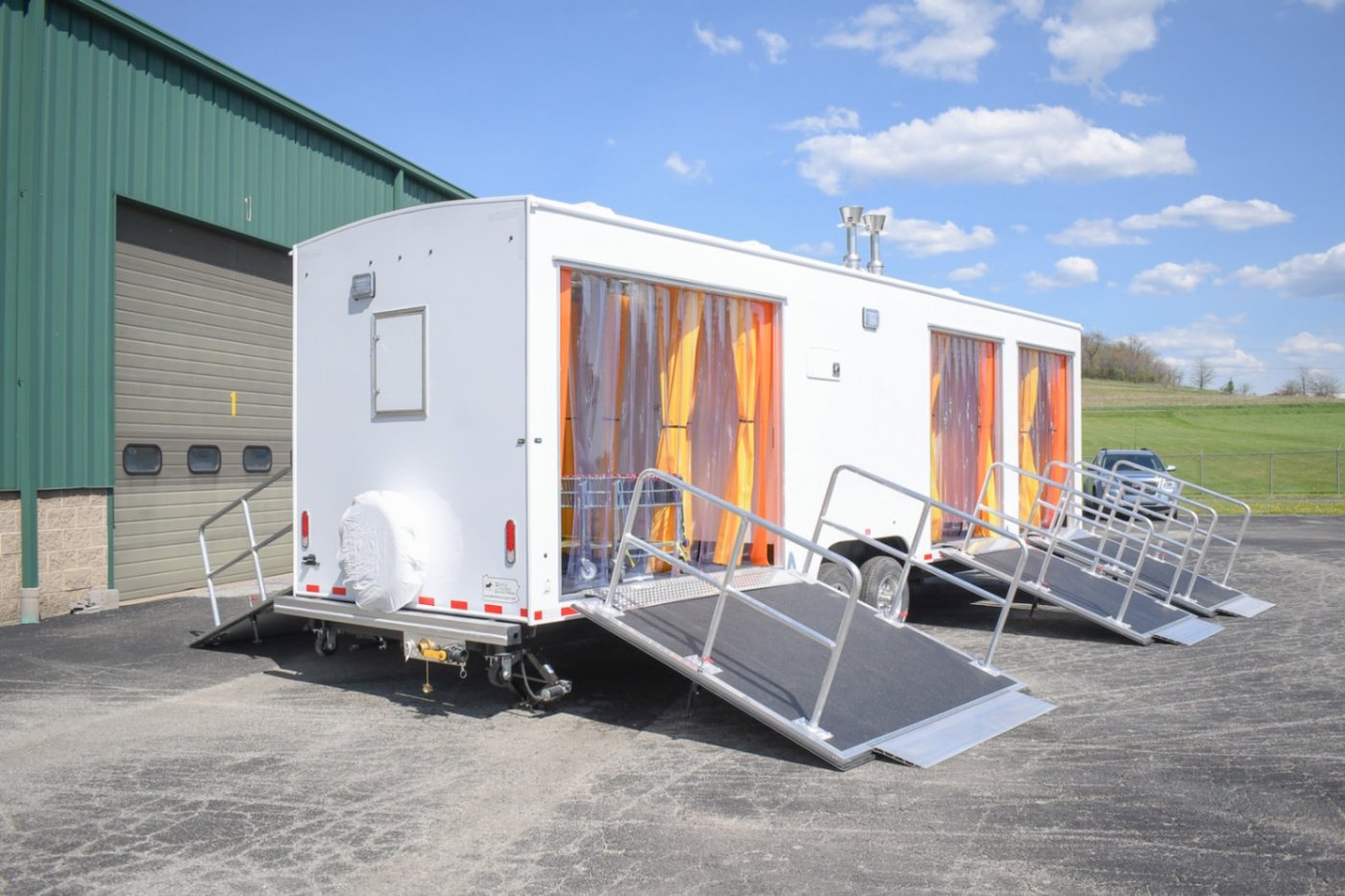
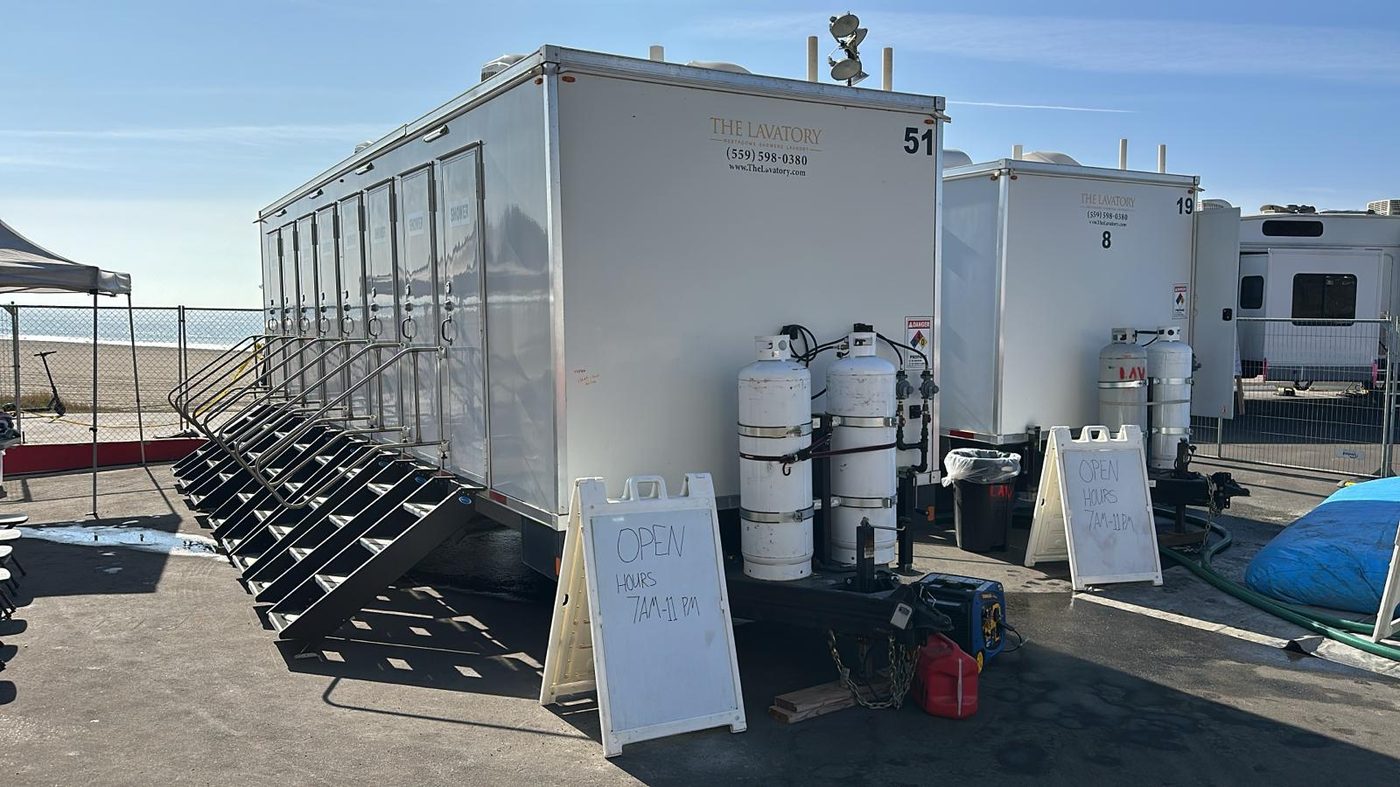
The layout is the product. Crews enter on the dirty side, where contaminated gear comes off and stays put until it leaves in a labeled bag. Curtained stages move them through the wash line, where private showers with genuinely hot water handle the part that can't be rushed. They exit the clean side dressed in what the dirty side never touched, carrying nothing that crossed the line. Ramped entry keeps the sequence accessible and lighting keeps it usable on night shifts. The flow only runs one direction. That's the entire theory of decontamination, expressed in floor plan.
Underneath, the plumbing does the quiet half of the job. Every gallon that touches a worker drains to onboard containment rather than the ground, because on an abatement or hazmat site the rinse water is part of the waste stream. Tanks get pumped on schedule by our crews. Disposal follows the path your permits name, and the paperwork follows the water everywhere it goes.
"A decon line works when nobody can take a shortcut through it," an abatement superintendent told us years ago, and we've specced the fleet to his sentence ever since. The trailer removes the shortcut. The shortcut is the risk.

Asbestos work is the marathon runner of the three: long projects, strict sequencing and crews who treat the line as liturgy because their licenses depend on it. "The fiber doesn't care what the day felt like," an abatement trainer likes to remind his classes, and the discipline has to hold absolute even when nothing looks dirty at all. Asbestos crews use the most hot water per worker of any trade we serve (about a third more than the fire crews, by our meter readings), and the good foremen consider that a feature worth paying for. Nobody rushes a shower that stands between amosite fibers and their truck keys, and OSHA's Class I rules agree with the instinct.
Lead is the chemistry problem of the three. The dust runs heavier, it clings to skin oils and the wash out matters most for what tries to leave under fingernails and in hair, which is why lead crews run the longest scrub protocols of any trade we serve and why wipe sampling shows up throughout their compliance files. Bridge painting outfits in particular treat the shower stage like a second job site, and their blood lead monitoring results are the reason why. Mold is the sprinter of the group: shorter jobs, faster crew turnover, and a spore load that dies with ordinary soap yet somehow triggers more client anxiety than either regulated metal manages to. Mold remediation firms working under IICRC protocols rent for the optics as much as the biology, and we mean that observation as a compliment. A hospital administrator watching a proper wash line operate stops asking whether the remediation is being taken seriously. The line answers the question before anyone asks it out loud.
We place decon units with the same care the containment itself gets, because geometry does half the enforcement. The placement rules our drivers carry:
The contaminated side entry points at the exclusion zone exit, close enough that nobody walks contaminated gear across open site to reach it. Every yard of dirty travel is a yard of potential spread, so we measure in steps rather than parking convenience. Eleven steps between containment flap and dirty door makes a good line. Fifty steps makes a finding waiting for its inspector.
The exit side opens toward break areas, vehicles and everything the job is protecting. Once the geometry is set, the site's traffic sorts itself within a shift or two. Supervisors spend less breath policing the boundary because the trailer polices it structurally, all day, without a break or a bad mood.
Water feed, power connections and service access all route to the clean side, so our techs and your utilities never cross the dirty path. The pump truck's approach gets planned at delivery, not discovered mid project with a containment in the way.
Abatement crews stage bagged suits, respirators and tools on the dirty side, and that footprint needs planning. We walk the layout with your competent person before the containment goes up, and the ten minute conversation prevents the classic week one shuffle. Bring the site drawing to that walk. Our driver brings the tape measure, plus 14 years of firm opinions about turning radii.
The handoff between a built containment and a mobile wash line is the detail that separates practiced abatement contractors from improvisers. The trailer's dirty side entry wants to sit close enough to the containment exit that a suited worker travels only steps in the open, but far enough that the tow vehicle and service truck never disturb the enclosure or its negative air machines. We stage that geometry in the delivery plan, down to which way the entry door swings relative to the flap, because a door that opens against the traffic flow adds a clumsy pirouette to every single exit, in a suit, for the whole project.
On multi containment jobs the choreography compounds. A hospital abatement might run 3 enclosures across two floors feeding a single wash line, so the route from each exit gets walked, marked and agreed before work starts, with the building's infection control committee signing the routing map, on paper, before day one. Our part is placing the trailer where the routes converge without crossing clean corridors, and our techs service it through an approach that never touches the marked paths. We've been told the whole ritual reads as fussy, right up until the first audit, at which point it reads as the reason the audit went well. Precision at the wall is cheap. Rework behind a failed containment is not, and everyone in this trade knows which invoice they'd rather explain.
We timed a full abatement crew through one of our units during a school summer project, with the foreman's blessing and a stopwatch. Minute one: entry on the dirty side, where suits get bagged and respirators get wiped and racked in their labeled slots. Minutes two and three: staging through the curtained transition, with gloves coming off last, always last. Minutes four through nine: the shower, unhurried, because hot water was designed into the schedule rather than hoped for. Minutes ten and eleven: dressed in street clothes on the clean side and out the far door toward dinner. So an 8 person crew cleared the line in 38 minutes flat at shift end, with no queue drama and nobody skipping a stage.
But the number that stuck with us wasn't the eleven. It was zero: the count of workers who touched anything on the clean side while still carrying anything from the dirty side. "Your trailer's floor plan does my job for me at quitting time," the foreman said, and that sentence goes a long way toward explaining why abatement companies rent the same unit job after job. The layout enforces what a policy can only politely request. We just keep the water hot, the tanks empty and the sequence identical every single shift.

Abatement and hazmat work lives downstream of regulators, and sometimes of litigation. OSHA's HAZWOPER and substance specific standards, EPA project requirements and state agency oversight all eventually converge on one question: show us how decontamination was managed. Our answer ships with the trailer. Service visits logged, water temperatures recorded, tank volumes pumped and disposal handoffs documented, every entry dated and initialed.
Contractors tell us the binder earns its keep at closeout, when the project file gets assembled and the decon chapter is already written. "The only subcontractor paperwork I never have to chase," is how one environmental firm's compliance officer described our log, and we've quoted her internally ever since. Dispatch has it printed above a desk.
And years later, when a records request or an insurance question surfaces, the same binder answers it. Contamination work has a long memory, sometimes a 30 year one. The paperwork should be built to match it, page for page.
Every regulated site manages two escape routes. The air side belongs to negative air machines, HEPA filtration and the containment envelope, all owned by your abatement plan and monitored by your air sampling. The water side belongs to the wash line, and it's the exit inspectors trace with the most interest because water goes somewhere the moment anyone stops watching it. Our trailer's answer is total custody. Shower water, boot wash runoff and handwash drainage all land in the same sealed onboard tanks, gauged and pumped by our crews, with the disposal path documented load by load.
The two systems also have to cooperate at the boundary, which is a detail that trips up first time site plans. The trailer's dirty side entry sits inside the workflow but outside the negative pressure envelope, so opening its door never disturbs the containment's airflow (an abatement supervisor's nightmare, and a fixable one at the drawing stage). We flag the interaction during placement planning and adjust the geometry before it costs anyone a pressure reading. Sites that manage both exits with this kind of intent close out clean, and the closeout package shows a water ledger and an air log that agree with each other. Two exits, both guarded, nothing leaves but the crew, showered and documented. That's the whole doctrine in one sentence, and it fits on a whiteboard where we've seen more than one safety officer write it.
We're equipment people, not your compliance counsel, and your competent person owns the plan. But we've supported enough regulated projects to sketch the map the trailer lives on, and new project managers tell us this five minute version saves them an afternoon of reading:
OSHA's hazardous waste and emergency response standard requires decontamination procedures before anyone leaves a contaminated zone. It's the backbone rule for spill response and cleanup sites, and it's the reason trained hazmat teams stage decon before anyone makes entry rather than after the first exit surprises everybody.
Asbestos (1926.1101), lead (1926.62) and silica each carry their own decontamination and hygiene facility language, with asbestos the most explicit about shower requirements on Class I work. Abatement contractors live inside these paragraphs daily, and our trailers were specced by reading them line by line with a highlighter.
AHERA governs school asbestos projects, RRP covers renovation lead work and state environmental agencies layer their own permit conditions on remediation and disposal, wash water included. The paperwork side of our service exists in large part because these programs audit, and audit thoroughly, and audit on their own schedule.
Not a regulation yet so much as a movement. Firefighter cancer research has pushed agencies toward aggressive post incident decon over the past decade, and NFPA guidance now treats contamination control as core practice rather than an afterthought. Support contractors rent our units to give that doctrine somewhere physical to happen, one shower at a time.
NIOSH has studied take home exposure for decades, and the findings read the same across substances: lead on a worker's boots ends up in a toddler's blood test, asbestos on a jacket ends up in a spouse's medical history 34 years later. The research named it para occupational exposure. Families named it something angrier, and the court dockets running since 1994 show exactly how those stories end for employers who treated wash out as optional.
So we talk about the decon trailer as family equipment, because functionally it is. The shower that runs hot at 6 p.m. is the control standing between the containment and somebody's kitchen table. "I tell my guys the last ten minutes of the shift are for their kids," one abatement owner told us, and his crews process through the line every night with a discipline no fine schedule ever produced in anyone. Our part is humbler. We keep the water hot and the sequence enforceable, and the log stays current down to the visit. But we've never once considered it just a trailer, and the contractors who rent it a second time never describe it that way either.
The classic user. AHERA school projects, commercial strip outs and industrial pipe work all require decontamination facilities as a matter of regulation, and the trailer gives traveling crews the same line at every site instead of a new improvisation per job. One of our abatement clients has moved the same unit through 19 buildings across four school districts, and their crews can run its sequence half asleep. That familiarity is a compliance feature in itself.
Bridge painters, demolition crews and renovation contractors working under the lead and silica rules use the wash out to keep take home exposure at zero, measured in wipe samples rather than wishful thinking. The families of those crews are the actual clients here, and we take that framing seriously.
Hospitals, school districts and housing authorities want remediation crews cycling through a controlled line, especially in occupied buildings where infection control committees hold veto power. The trailer parks discreetly at a service entrance. Nobody it protects ever notices it working, which is the point.
Spill response teams and industrial emergency crews stage decon as the response stands up, not after. Our emergency dispatch treats these calls the way fire calls get treated. The unit arrives ready to run its first line within the hour of placement, water hot and tanks empty. Hazmat doesn't wait. Neither do we.
Structure fire residue rides home on gear and skin unless a wash out intercepts it, and fire service research keeps sharpening that concern. Support contractors stage our units at basecamps and training burns so shower out becomes part of demobilization rather than a suggestion on a whiteboard. We've watched the culture shift on this over the past several seasons, and we're glad to be equipment for it.
Refinery turnarounds and plant maintenance windows put 800 odd contractors into process units on brutally compressed schedules. The math is relentless. A decon trailer at the exit holds the plant's boundary. Weeks of around the clock shift changes roll through it without the line ever going cold.
A growing share of our decon calendar is rehearsal. Fire academies running live burn evolutions rent wash out capability so recruits learn gross decon as habit rather than theory (a 2 hour evolution teaches what 20 slides never will). Hazmat teams drill their entry and decon sequence against a real trailer because taping off an imaginary corridor in a parking lot teaches imaginary lessons, and the teams know it. Realism is the entire budget justification, and the training officers write it exactly that way. And county emergency exercises across the map increasingly include a functioning decon corridor, staffed, timed and graded, because the after action reports kept flagging the same gap: everyone knew decon mattered and nobody had ever actually run one.
Training rentals get the same unit the real responses get, deliberately. Muscle memory built on the real door spacing and the real shower controls transfers directly to the incident that eventually comes. So does the one way flow, drilled until it stops requiring thought. We watched one regional hazmat team drill quarterly with our trailer for two years, 8 exercises in all. Then they worked a genuine chemical release and processed 14 entries through decon without a single procedural correction from the safety officer. Their captain emailed our dispatcher the after action excerpt with one line highlighted in yellow. It said the decon corridor performed as trained. As trained is the whole product, and we're pleased every time a client proves it.
Plenty of regulated work happens after dark on purpose. Occupied schools get their abatement at night, refineries run turnaround crews around the clock and hazmat incidents pick their own hours with total disregard for anyone's sleep. So the units carry lighting inside and out, and the wash line at 2 a.m. runs exactly like the wash line at 2 p.m. The night foreman gets the same hot water and the same log entry format, and the after hours dispatch line means a 3 a.m. problem talks to a person rather than a recording.
Winter asks a different question and gets the same answer. Heated interiors, protected plumbing and cold weather packages keep the line functional through hard freezes, because a frozen decon trailer on a lead abatement job doesn't pause the exposure. It just pauses the control. We've kept lines hot through mountain Januaries and prairie wind chills that made the drive out the hardest part of the service visit. The crews still washed out warm. That's the entire job description, and the weather isn't listed as an exception anywhere in it.
Districts cram AHERA asbestos work into the twelve weeks students are gone, and every abatement contractor in America knows it. Units for June projects book in March and April. Call in May and we'll still solve it, but the placement choices narrow with every warm week.
A portion of the decon fleet holds ready through the western fire months, because contractors supporting wildland fire incidents call with hours of notice, not weeks. Those units don't take long bookings on purpose. Readiness is the product they're assigned to.
Refineries and plants schedule outages in the mild months, and the decon bookings arrive with the crane bookings, quarters ahead. Planners who've run one outage with a proper wash line write it into the next one's scope without being asked.
Mold, lead and industrial cleaning work doesn't keep a season. This is the fleet's baseline load, and it's why a unit is usually positioned within reach when your emergency turns out to be today. The boring contracts subsidize the fast response. We tell clients that plainly.
Every year a wave of contractors lands their first regulated job (a renovation that turned up asbestos behind a 1974 wall, a water damage contract that grew mold, a first SAM.gov abatement bid) and calls us slightly overwhelmed. The onboarding is gentler than the regulations read. You tell us the substance and the crew size. We spec the unit, walk your competent person through placement on a site drawing in ordinary language, and our driver covers the one way flow rule at delivery until it's boring. "Boring is when it's learned," he likes to say, and he's right. Your crew learns the sequence in a single shift end, because the physical version is far simpler than the regulatory prose ever suggested. Steps beat paragraphs.
We hand every first timer two pieces of advice, both earned. First, budget the wash line into the original bid instead of discovering it during change order season, because the decon line is small against the contract and enormous against a stop work order. Estimators who've eaten one of those stoppages never make the omission twice. Second, lean on the log harder than feels natural. Your first compliance file is the one that teaches your company the habit, and our documentation carries most of that weight for you: service visits, water temps, tank pulls and disposal receipts, accumulating in order while you concentrate on the actual work. First timers become second timers with us at a rate that tells the whole story about whether the system works. The trade calls us a rental company. On the first regulated job, clients tend to describe it as training wheels with a water heater, and we take the description happily.
Hazmat responses and fire camps rarely order a single trailer, and our fleet lets one dispatcher assemble the entire support block. The pairings we deploy alongside decon units most:
Regulated wash out at the exclusion zone, ordinary end of day hygiene at camp. Our shower trailer rentals carry the comfort load so the decon line stays a control point instead of becoming the camp bathroom, and crews sort themselves within a day.
Fire camps and long remediation programs add an 8 station laundry trailer so washable gear gets cleaned on site instead of riding home. Contamination control and morale turn out to be the same purchase here.
A staffed decon operation is still a workforce with ordinary needs. Portable restroom trailers and chilled water stations round out the block, delivered in the same convoy and serviced in the same visit.
Multi week responses in remote counties add sleeper bunkhouse trailers so the crew that washes out clean sleeps 200 feet away instead of 90 minutes down the highway. The whole camp arrives on one contract with one point of contact.
"Order the decon first and the rest of the camp around it," a veteran incident logistics chief advised us once, and we pass the advice along verbatim. The wash line's placement is the least movable piece, so it anchors the map. Everything else parks where the boundary says it can.
A decon trailer works only as well as its consumables, so ours ship stocked and stay stocked. Soap and shampoo wait at every shower head, with wash brushes racked on the dirty side. Towel service runs where the contract includes it, and disposal bags stay staged at the entry so nothing improvises. Water heating capacity gets matched to your crew count during the quote (a 6 person mold crew and a 23 person turnaround gang need very different plants, so we ask the crew question before anything ships). Lighting covers the night shifts. Heating covers January in the mountains. The generator package covers sites where the nearest outlet died with the building.
And the restock rides our service schedule, not your supply run. Techs count consumables at every visit and leave the line ready for the next shift, which sounds trivial until the Friday a crew finds the soap dispensers empty at 5 p.m. That Friday doesn't happen on our contracts. It's a small promise. We keep it every week without exception, because the whole category of small promises is what separates a decon program from a trailer parked near one.
The question comes up weekly, and our answer starts with the job's exposure profile. If the crew is dirty in the ordinary sense (sweat, mud, a long shift), a shower trailer rental serves them better and costs the project less. If the crew is contaminated in the regulatory sense (a substance with a standard, a containment, an exposure record), only the decon unit's one way layout and captured wastewater will satisfy the plan you filed. The middle cases get a phone conversation, and we've steered plenty of callers to the cheaper trailer when the job allowed it.
The two also work as a pair on large responses. Decon at the exclusion zone handles the regulated wash out, while a shower trailer at camp handles ordinary end of day hygiene, and crews learn quickly which door belongs to which part of their shift. Wildfire basecamps have run exactly this split for whole seasons, with both trailers on one Mavirus contract and one service truck covering the pair. It's cleaner in every sense of the word, and the cost difference between the two units means nobody's paying decon rates for a comfort shower.
The first call covers three things: the substance, the crew count and the shift pattern. From those we spec the unit, the water plan and the pump cadence, and we'll ask for your site drawing if a containment already exists on paper. Delivery happens ahead of your containment build (a day early is our preference, and we'll push for it politely but persistently), so the wash line is tested and hot before the first suit gets taped shut.
Through the project our techs service on a rhythm your foreman helps set. Tanks pump before they matter and water heat gets verified under real load, not a quick faucet touch. Every visit lands in the log with initials attached to it. When phases move, the trailer moves on a service day so the line never goes dark mid shift. And when the job closes, the final pump, the disposal handoff and the completed log arrive as one package for the project file. We've run this shape for single week hazmat responses and for abatement programs that crossed 13 months. The shape doesn't change. Only the number of pages in the binder does.

We run asbestos jobs across three states and the decon trailer just travels with the crew now, same as the negative air machines. Ramps, curtained stages and hot water that has never once quit on us mid shift. Our compliance officer stopped losing sleep over the wash out documentation because their log does the remembering for all of us.

Mold remediation in an occupied hospital wing meant our decon line had to be flawless and completely quiet about being there at all. The trailer parked at the service entrance and the crew cycled through between zones without a hitch. The infection control team signed off after one walkthrough, which in seventeen years of this work has never happened to me. Ever.

After a structure fire assignment the crews come back carrying residue nobody should ever take home to their families, and for years everybody did anyway. The decon unit gave us a proper wash out point at staging. Guys shower out, gear bags stay outside the clean side and the ride home stopped being part of the exposure. My wife noticed before I said a word about it.
Decon is a niche, and niches run on reputation. Of the abatement companies that have rented our units on two jobs, all but a handful book a third, and the multi year relationships now outnumber the one offs on our contract list by a comfortable margin. The reasons they cite are unglamorous: the water was hot in week nine and the pump truck came when the log said it would. The binder survived an audit. A foreman's phone call got answered at 9:40 p.m. on a Sunday. No single line item wins the category. The accumulation does.
So if your next project involves a substance with a standard attached, call Mavirus before the containment drawings finish. We'll spec the line, walk the geometry and put the wash out where the plan needs it. And if the job turns out to need a plain shower trailer instead, we'll say so and quote you the cheaper unit, because the client who trusts the recommendation this year is the client who calls first next year. That arithmetic has built this company one held boundary at a time, and we intend to keep building it exactly that way.
We'll spec the unit, walk the placement with your competent person and keep the wash out line hot, pumped and documented for as long as the job runs.