Home / Services / Office Trailer Rentals
Office Trailer Rentals

Put a Locking Door on Your Jobsite: Office Trailer Rentals for Construction, Security and Emergency Management

Projects run on decisions and decisions need a room. We deliver the room: workstations, climate control, a locking door and a floor plan matched to whether you're running a build, an incident or a gate.

The Site Needs A Room

Every operation eventually needs four walls, a lock and a working thermostat.

Projects run on decisions, and decisions need somewhere to happen. Not a truck cab with a laptop balanced on the console, and not a folding table under a pop up canopy that surrenders to the first real gust of an afternoon. Our mobile office trailer rentals put an actual room on your site: workstations, climate control, lighting that flatters a drawing set and a door that locks behind the last person out. Construction superintendents run entire projects from them. Emergency managers have run 73 day activations from them. Security details run quiet months of gate operations from them without a hiccup worth reporting. The common thread is simple, and it's about the oldest one in working life: people think better indoors, with the weather on the other side of a wall.

Step Inside

A working interior, not a shell with a rental sticker.

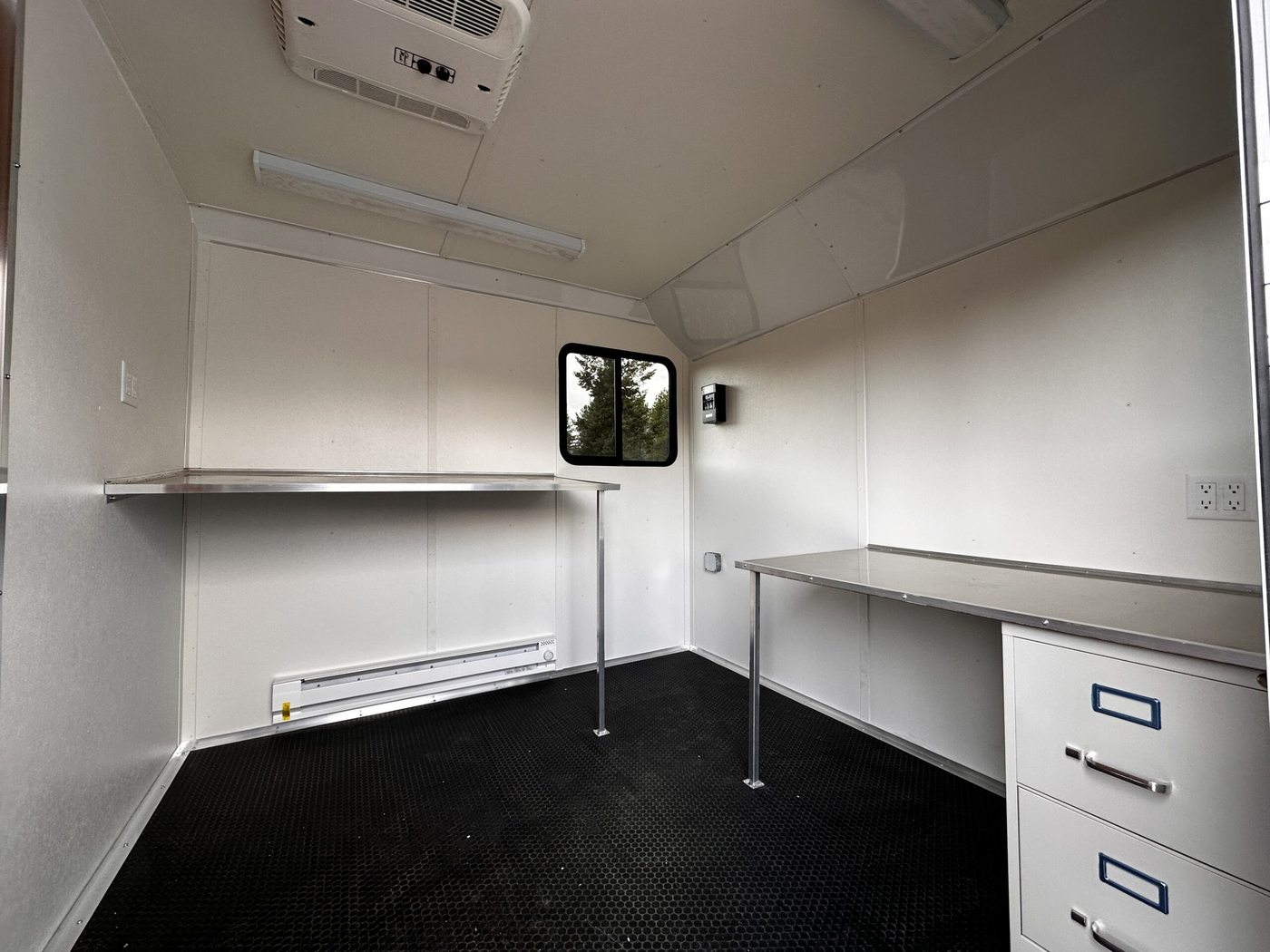
Walk in and it reads as an office. Desks and work surfaces hold spread out drawing sets, task lighting sits over each station, outlets live where the laptops do and the HVAC holds a meeting temperature through July or January without commentary. Flooring takes muddy boots without flinching. Walls take pinned drawings, inspection cards and status boards. The layout keeps a walking lane clear even with five people working, because a room you have to shuffle through sideways stops getting used within a week.

Configurations scale with the mission, and the mission gets asked about before anything ships. A single superintendent's office needs a desk, a plan table and somewhere for the coffee logistics to happen. A project running weekly OAC meetings needs conference seating for eleven. An incident command post needs briefing space, radio charging shelves and wall area best measured in square feet of taped up county maps. We ask what the room has to do before we send it, and the floor plan follows the answer rather than whatever happened to be parked closest.

"The trailer's ready before the coffee maker is," a superintendent told our driver on a delivery last spring, and that's the standard: working room within the hour, everything after that is your operation's business.

Office trailer interior with workstations set up and ready for the project team
The First Morning

What delivery day looks like when a room arrives at 7 a.m.

Our driver walks the pad first, checks level and clearance, then backs the unit in and sets it on its blocks. Steps and landing go on next. Power connects, then the HVAC gets run through both of its modes and every outlet gets tested with the meter our drivers carry (a habit that started after one bad breaker cost a client's Monday, seven years ago, and never happened again). Keys go to your named contact along with the two minute tour: thermostat here, panel there, service number taped inside the door where the weather can't get at it.

By 8:15 the superintendent's plans are spread on the table and the first phone call of the project is happening indoors, seated. "I moved in before my coffee went cold," one project manager reported, and that's roughly our target metric. The room should be the easiest thing that happens to your project all month, possibly all year, and our drivers treat that sentence as a delivery standard rather than a slogan. Everything we do at delivery aims at that one sentence, and the drivers grade themselves against it.

Three Missions, One Trailer

How the office fleet actually gets used, told by deployment type.

The construction site office

The backbone booking. Plans, permits, payroll paperwork and the superintendent's sanity all need a dry home for the duration of the build, and the trailer follows the contractor across projects for years at a stretch. Our longest running office relationship is on its 7th consecutive jobsite, and the superintendent refers to the trailer by a first name we won't print.

The incident command post

When an emergency operations center needs to exist somewhere it didn't yesterday, the trailer becomes one. ICS section staff get desks, radios get charging shelves, maps get wall space and the hard conversations get a door that closes. County OES offices and utility storm organizations book these on standby agreements ahead of every season.

The security + operations post

Gate operations, event command posts, remote monitoring assignments and long term guard details all need staffed shelter that reads professional to every member of the public who approaches it. A trailer with lights on reads as authority to every driver who slows at the gate. A pickup truck with a clipboard doesn't, and never has, anywhere. Security firms can quote you the difference in their renewal rates, and several of ours have.

The overflow workspace

Hospital campuses mid renovation, schools during construction, plants during shutdowns: anywhere the permanent building ran out of desks. The trailer absorbs the displaced team until the walls come back, desks and all. More than one has stayed a full year past the original plan without a single complaint filed, and one hospital's facilities office grew oddly fond of theirs, or so their emails suggested at pickup.

The check in + processing point

Disaster assistance intake, workforce onboarding and vendor credentialing at big events all fit here. A counter. A queue outside, a working room behind it. The trailer turns an administrative scramble into a line that actually moves, and disaster assistance programs have processed applicants out of our units through more than one recovery.

The basecamp headquarters

Every camp we build (housing, feeding, hygiene) needs a brain. The office trailer anchors the operation: schedules on the wall, radios on charge and the camp boss reachable at one known address all day. It's the first unit lit each morning and the very last one to go dark at night.

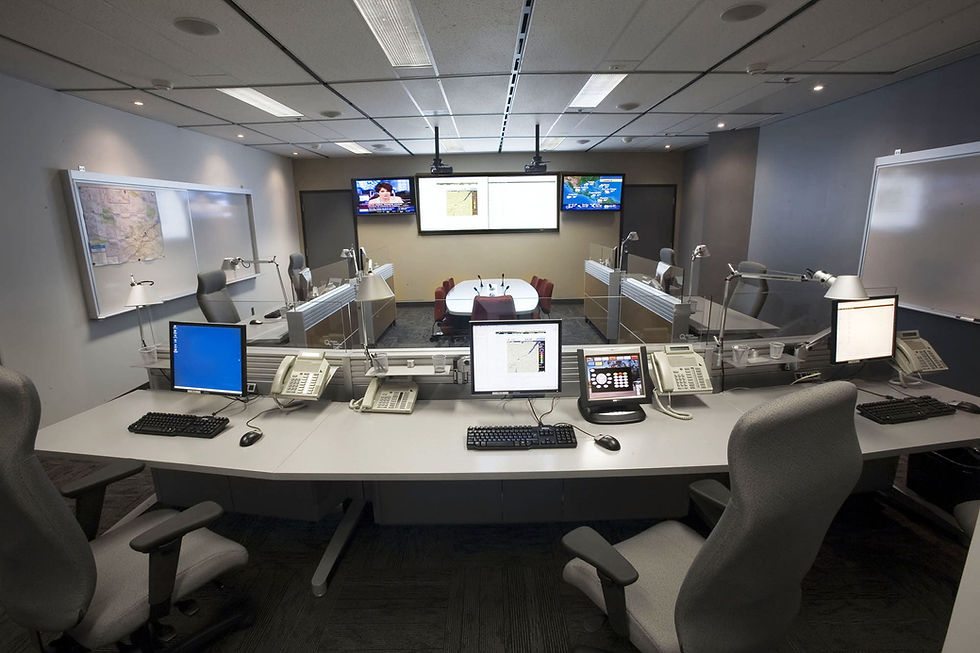
Incident command room in operation with monitors and status displays being worked
The Command Post Standard

Emergency management asks more of a room. We spec for the asking.

An incident command post is an office with the volume turned up: more people per square foot, more electronics per circuit and zero tolerance for a dead thermostat during a 16 hour operational period. "If the room fails, the response wobbles," a section chief once put it to us, and we spec like she's watching. Our command configurations plan for that load. Power gets budgeted for the radio bank and the monitor wall rather than just the laptops, with headroom left for whatever the third operational period plugs in. Lighting supports around the clock staffing without the fluorescent hum that makes hour 14 feel like hour 40. And the layout leaves a briefing wall clear, because every ICS operation lives and dies by what's taped to it at 0600.

The other half of the standard is speed. Declared incidents get same day placement whenever the road miles permit, and our drivers treat a command post delivery like the emergency it's supporting. One county stood up its interim EOC in our unit while the primary building was still being pumped out, and the response never dropped a beat between the two addresses. Their after action review gave the address transition its own approving paragraph. We framed that paragraph, naturally, and it hangs by the dispatch desk.

"Give me a room and a generator and I can manage anything," an emergency manager told us once. We've been delivering that sentence ever since, usually within hours of the phone call.

The Meeting Machine

A project with a real meeting room runs differently. Measurably.

Ask any construction executive where schedule slippage hides and the honest ones mention meetings that didn't happen: the OAC that got postponed because there was nowhere dry to hold it, the subcontractor coordination that happened over tailgates in scattered fragments, and the punch walk that never got its sit down afterward because the rain had opinions. A site office with conference seating converts those ghosts back into calendar entries. Owners show up more often when there's a chair and hot coffee waiting for them. Architects stay longer at the table, and longer at the table tends to mean fewer RFIs the following week. Decisions get made on Tuesday instead of drifting toward next Tuesday, and drift remains the most expensive material on any jobsite, priced by the calendar.

One of our GC clients started tracking it, in his own rough way: RFIs turned around faster once weekly coordination moved indoors, and his phrase for the trailer was "the schedule's cheapest insurance." We won't pretend to audit his numbers. But we've heard versions of the same observation from enough superintendents across enough projects that we stopped treating it as flattery and started treating it as the product description. The room isn't overhead at all. The room is throughput wearing a modest disguise and a rental sticker.

Power, Climate + The Practical Stack

The unglamorous engineering that keeps the room working in week 40.

Power that plans ahead

Standard units run on ordinary 120V service, and the generator package covers raw sites with fuel service on our schedule. Command configurations get a load plan during the quote, because discovering a circuit limit during a storm response is the wrong week for surprises.

Climate that holds meetings

HVAC sized for full occupancy in real weather. A conference of nine bodies generates its own heat load (about the same as a space heater running in the room), and the system carries it without the 2 p.m. stuffiness that ends meetings early.

Data ready pathways

Surge protected power, cable routes and placement guidance for antennas and routers. Your connection rides your carrier of choice. Our job is making sure the environment never fights your IT, and week one setup usually finishes in an afternoon.

Serviced like it matters

Climate checks, door hardware, lighting and interior condition on a maintenance cadence. An office that degrades gets abandoned for the truck cab again, so ours don't degrade. The 14 month rentals look like the 14 day ones inside.

1 hrPlacement to working room
120VOrdinary power, generator ready
3 yrLongest current office program
24/7Emergency command dispatch
Placement Notes From The Field

Where the office sits on site shapes how the site behaves around it.

Fourteen years of deliveries produce opinions, and our drivers hold them firmly. The office placement rules they push for (politely, mostly) on every site walk:

At the gate, facing traffic

The office should see arrivals before arrivals see the site. Deliveries check in properly. Visitors get intercepted before they wander, and the superintendent watches the site's whole circulatory system through one window while returning calls. An office buried behind the laydown yard supervises nothing but its own parking spot, and it gets skipped by everyone who should've stopped in.

Out of the crane's shadow

Nobody thinks about swing radius until the day the load path crosses the roof where the payroll paperwork lives. We ask the lift plan question at every delivery on vertical projects, and we've relocated exactly 3 units in 14 years because somebody skipped the question.

Power before preference

The scenic corner of the site loses to the corner near the temporary power drop, every single time, unless the generator package changes the math. A 90 foot cord run is a reasonable extension of the office. A 400 foot one is a maintenance program with tripping hazards, and we've talked more than one client down from it.

Room for the second trailer

Projects grow, always. The office that leaves pad space beside it for the future restroom trailer (or the owner's rep's own office, a plot twist we've watched arrive many times) saves an entire mid project shuffle. We stage the pad layout for the site you'll have in month six rather than the one you have at delivery, and month six always thanks us.

The Long Program Math

Rent against the project, not the calendar, and the numbers behave.

Construction offices live on project timelines, and project timelines lie. A 14 month build becomes 19 without anyone quite agreeing when. A phased campus job planned for two years finds itself a third phase and a funding extension. Our term structure absorbs that reality: rates step down with commitment, extensions cost a phone call and the trailer never becomes a hostage negotiation at month 13. One commercial GC has run our offices across three consecutive projects (an elementary school, then a distribution center, most recently a municipal annex) without the unit ever returning to our yard between them. The delivery truck just drove it 40 odd miles across town to the next address, badge stickers and all.

Compare that against buying a used office trailer: capital out the door, maintenance on your facilities list, a roof and an HVAC unit aging on your balance sheet, then a resale chore when the market's soft. Renting turns all of that into one predictable line per month with our name signed to the maintenance risk. Estimators who've priced both models for a multi year program keep landing on the rental. And the ones who own aging units? They call us when the AC dies in year six. We're gracious about it. Their next program rents, every time so far.

The Standby Model

How agencies guarantee themselves a command post before the season starts.

Emergency management runs on a rude little paradox: the week you need a command post is exactly the week everyone else in the region needs one too. Standby agreements resolve it. An agency or utility signs before the season starts (rates set, configuration specced, after hours contacts named on both sides), and when the activation call finally comes, dispatch skips the paperwork entirely and goes straight to logistics. The units move in hours precisely because all the thinking happened back in April, over coffee, with nobody's county underwater yet.

Hurricane exposure

Coastal counties and utility storm organizations sign ahead of June 1 and then think about us exactly never until landfall week arrives. That's the entire product: a room they don't have to remember exists, delivered the day the forecast cone stops being theoretical and starts having their county in it.

Fire season readiness

Western agencies and support contractors stage command capable units through the burn months. Some years the phone never rings for a given unit at all. But the years it rings, it rings at 6 a.m. with a column of smoke somewhere behind the caller's voice, and the trailer rolls before lunch is a thought.

Utility mutual assistance

Storm restoration brings hundreds of out of area crews who all need coordination. The office trailer becomes the staging yard's brain, tracking crews and assignments through every operational period. Cost recovery teams appreciate that our invoices survive regulatory review without edits, a sentence we worked years to earn.

Exercise season

Agencies also book units for drills and full scale exercises, because practicing in the actual room beats practicing in a conference hall. More than one exercise client has activated the same configuration for a real event within the year, and the muscle memory showed in how fast the room went operational the second time.

The Quiet Posts

Not every office runs a project. Some just hold a corner of the world steady.

A share of our office fleet lives quieter assignments: the guard post at a substation that got interesting once, the weigh station office at a gravel pit, the seasonal check in trailer at a county fairground that works 27 days a year and rests the other 338. These rentals rarely call us at all. The trailer sits and does its one job. It gets serviced on schedule and renews by a one line email. We've had units hold the same address for six plus years, outlasting the personnel who signed the original contract, then their replacements, then one full corporate rebrand.

We mention the quiet posts because they answer a question callers sometimes ask sideways: is a trailer office a real office, or a stopgap? The substation post answers real. So does the fairground, and so does the construction office currently working its 7th consecutive project without a week off. Temporary describes the foundation under the room, never the seriousness of what happens inside it. And when the assignment finally does end, the room leaves on a truck within the week, which is the one graceful move a poured foundation never learned to make.

One Convoy, Whole Site

The office rarely travels alone, and the paperwork loves that.

A new jobsite standing up needs the office, the restroom trailers, the drinking water station and sometimes the whole camp: showers, sleeper bunkhouses and a mobile kitchen for the crews who'll live there. Ordering it all through one dispatcher collapses a week of vendor calls into a single conversation, and the convoy arrives sequenced so the site builds itself in the right order. Office first, almost always. Somebody has to sign for everything else that follows it through the gate.

Project managers who've run it both ways don't go back to the multi vendor version. One contract, one service schedule and one phone number that a human actually answers. And when the project finally ends, one pickup order clears the whole street of equipment in a single afternoon, leaving nothing behind but the compacted gravel pad and a forwarding address for the last invoice.

Four Seasons, One Thermostat

The room has to work in the weather the work happens in.

Construction doesn't pause for climate and neither do incidents, so the office fleet is built for the full calendar. Summer means HVAC that holds a meeting through a 104 degree afternoon while the door opens 63 times a day (every opening is a thermal event, and the system is sized like we counted them, because one bored week years ago, we actually did). Winter means insulation and heat that keep drawings flat and coffee warm, with fingers functional through mountain Januaries and the kind of prairie wind that edits attitudes. Between those extremes sit the mud seasons, when the steps, landings and walk paths our driver set at delivery quietly decide how much of the site ends up tracked across the office floor by Friday.

Our maintenance calendar follows the weather too. Pre summer visits check refrigerant and airflow before the first heat wave lands, and fall visits verify the heaters weeks before anyone needs them at a dark 6 a.m. It's the same preventive logic our refrigeration fleet runs, applied to people instead of produce. "You service the office like it's a machine," a client observed once. It is a machine. It's the machine the rest of the project gets managed from, and treating it casually shows up later, in ways nobody ever bills honestly or traces back to the room where the decisions quietly slowed down. We trace it. That's the maintenance calendar's whole reason for existing.

Tenant Reports

Rooms that ran projects, incidents and long quiet posts.

Katherine H., County emergency management director
Katherine H.County emergency management director
★★★★★

Our EOC annex flooded in the exact storm we were busy managing, which is the kind of joke this job tells. The office trailer became our incident command post by that evening, with our radios and laptops running inside two hours of placement. We kept it 73 straight days and the after action report called it the best single equipment decision of the whole response.

Edgar A., General contractor, commercial builds
Edgar A.General contractor, commercial builds
★★★★★

Every project needs a door that locks and a table where the drawings stay dry. The site office handled both, plus the superintendent finally had somewhere to hold OAC meetings that wasn't the hood of a pickup in the rain. We've moved the same exact unit through three consecutive projects now, and my PM would riot if it changed.

Jackie Z., Security services regional manager
Jackie Z.Security services regional manager
★★★★★

We staff remote gate operations in places where the nearest permanent building sits a county away. The office trailer gives our officers proper shelter, working monitors and a place to process credentials that looks fully professional to every visitor who pulls up to the gate. Clients notice the difference immediately, and it wins us contract renewals year after year.

What We Hear At Pickup

The end of a rental is our best product research, so we listen hard.

Pickup day conversations follow patterns, and we mine them. The most common comment is a version of surprise at how central the trailer became. "The whole job ran through that room" is nearly a stock phrase at this point, delivered with a head shake and a handshake. The second most common is the request to hold the same unit for the next project, which is exactly how every one of our multi project relationships got started. And the third is the confession: teams that budgeted the office as a line item afterthought and would now rank it above the pickup trucks in any honest triage of what the operation needed. We hear that one from emergency managers especially, usually delivered while their staff carries out 73 days' worth of taped up maps and coffee rings.

The criticisms teach us more, and we've made real changes off them. Step rails got noticeably beefier after one winter's worth of feedback from gloved hands. The service number moved inside the door frame because outside, the weather sanded it blank in a season. A conference layout got reworked after three separate clients bumped the exact same corner in the exact same spot. Small stuff, adjusted continuously, which is the only way rental equipment actually improves. Nobody redesigns a trailer in a boardroom. You redesign it one pickup day comment at a time, and we've been collecting those comments across enough years to fill a binder of our own.

Practical Questions

Office trailer rental questions.

Where can the trailer be placed?
Any reasonably level spot with tow access works: gravel pads, parking lots, fairground infields and staging yards have all hosted units this year. Our driver levels, blocks and stabilizes the unit on arrival, then verifies the door swing and step placement along the walk path. Ten extra minutes at delivery saves a month of small annoyances, so we spend them every time.
Do you rent offices with the rest of a site package?
Constantly, and it's the efficient way to buy. The office lands in the same convoy as the restrooms, the water station and whatever else the site needs that week, all riding one contract with one service schedule behind it. Project managers tell us the single invoice is worth almost as much as the trailer itself. Accounts payable departments have written us unprompted thank you notes, which remains one of the stranger compliments this company collects.
What does servicing look like for office units?
Lighter than our plumbed fleet, but real: climate systems get checked under load, doors and windows get serviced before they stick and interiors stay maintained on a schedule matched to your actual occupancy. Long programs get preventive attention so the AC never quits during an August OAC meeting with the owner in the room. If something acts up anyway, dispatch moves a tech the same day.
What comes inside a mobile office trailer?
The essentials: workstations, lighting, real climate control and the door that locks. Basic, until you've run a project without them. Configurations range up to conference layouts and command post setups with room for radios, monitors and a briefing wall. Tell dispatch how many people need to sit down at once and we'll match the floor plan to the head count. Nine person conference room or a lean two desk superintendent setup, just tell dispatch which one your week looks like. The wrong floor plan annoys everyone for months (quietly, daily, at elbow level), and the right one costs exactly the same phone call, made a little earlier.
What power does an office trailer need?
Standard 120V circuits cover the typical unit. A generator package carries sites that don't have power yet, which on day one describes most construction sites by definition. Heavier configurations with dense electronics get a power plan drawn during the quote so nothing browns out mid meeting.
Can it work as an incident command post?
That's one of our steadiest deployments. Emergency managers run ICS operations out of our units: briefing space, radio charging, status boards and a quiet room where section chiefs can hear themselves think. County OES offices and utility storm rooms have both kept units on standby agreements for exactly this purpose, and activation calls have gone placement to operational inside 6 hours.
How fast can an office trailer arrive?
Same day in emergencies, and disaster support calls jump the queue the way they do across our whole fleet, with no questions asked and no premium invented to punish the urgency. Emergencies get our best logistics, not our opportunism. Planned projects book one to three weeks out for choice of configuration. Either way the unit arrives ready to occupy: power connected, climate already running, door keys handed to your named contact along with the two minute orientation. Working room, working day.
What about internet and phones?
We keep the data story simple: the trailer provides the environment (power, surge protection, cable pathways) and your IT or a cellular router provides the connection. Most clients run a hotspot or a bonded LTE unit and are working within the hour of delivery. Emergency operations bring their own comms packages as a rule, and the trailer's whole job there is giving all of that equipment clean, surge protected power and a dry desk to live on. For long programs, carriers will happily install fixed service straight to the trailer's address, and we've watched fiber get pulled to a gravel pad more than once. The world has changed. The trailer kept up.
Is the unit secure enough for documents and equipment?
Locking doors, solid construction and window coverings come standard on every unit, and plenty of clients store plan sets, laptops and charged radios inside overnight for months without an incident to report. Higher requirements get a specific conversation on the call, and we'll say plainly what the unit can and can't guarantee. Security contractors rank among our steadiest office clients. That says plenty about the baseline.
How long can I keep an office trailer?
A weekend event or a three year program, whichever your work demands, and the rate improves visibly with term. Construction offices typically ride the whole project and then follow the contractor straight to the next one, sometimes without a day in between. We move the unit, the crew keeps their familiar room and the new site starts with muscle memory already installed. Extensions take a phone call. Nobody renegotiates anything, and the unit simply stays put doing its job.
Claim The Room

Tell us what the room needs to do and how many people it holds.

We'll match the configuration, plan the power and put a locking door on your operation, this week if the schedule demands it.

Request Services Call (855) 687-1887