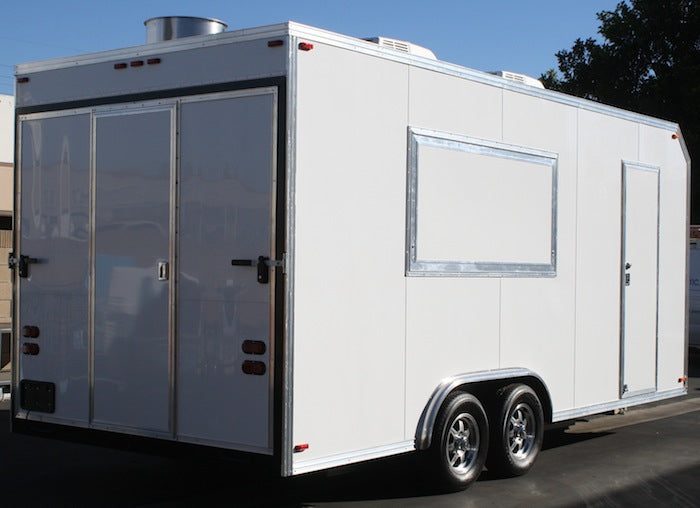
When an operation has mouths to feed and no kitchen in reach, we deliver the kitchen: commercial cook line, real ventilation, cold chain alongside and the utilities running before your chef ties an apron.
Fire camps and hurricane recoveries share one non negotiable line item with university renovations, workforce basecamps and location shoots: hot food, on time, at volume, prepared somewhere an inspector would happily sign off on. Our mobile kitchen trailer rentals deliver that somewhere. A commercial cook line under real ventilation. Prep and warewashing stations, hot holding that actually holds, plus the utility systems to run it all in a parking lot or a mountain staging area. Your cooks bring the menu and the talent. We bring the kitchen, keep it fueled and watered on a schedule your staff never has to think about, and haul away everything a working kitchen produces besides the meals themselves.
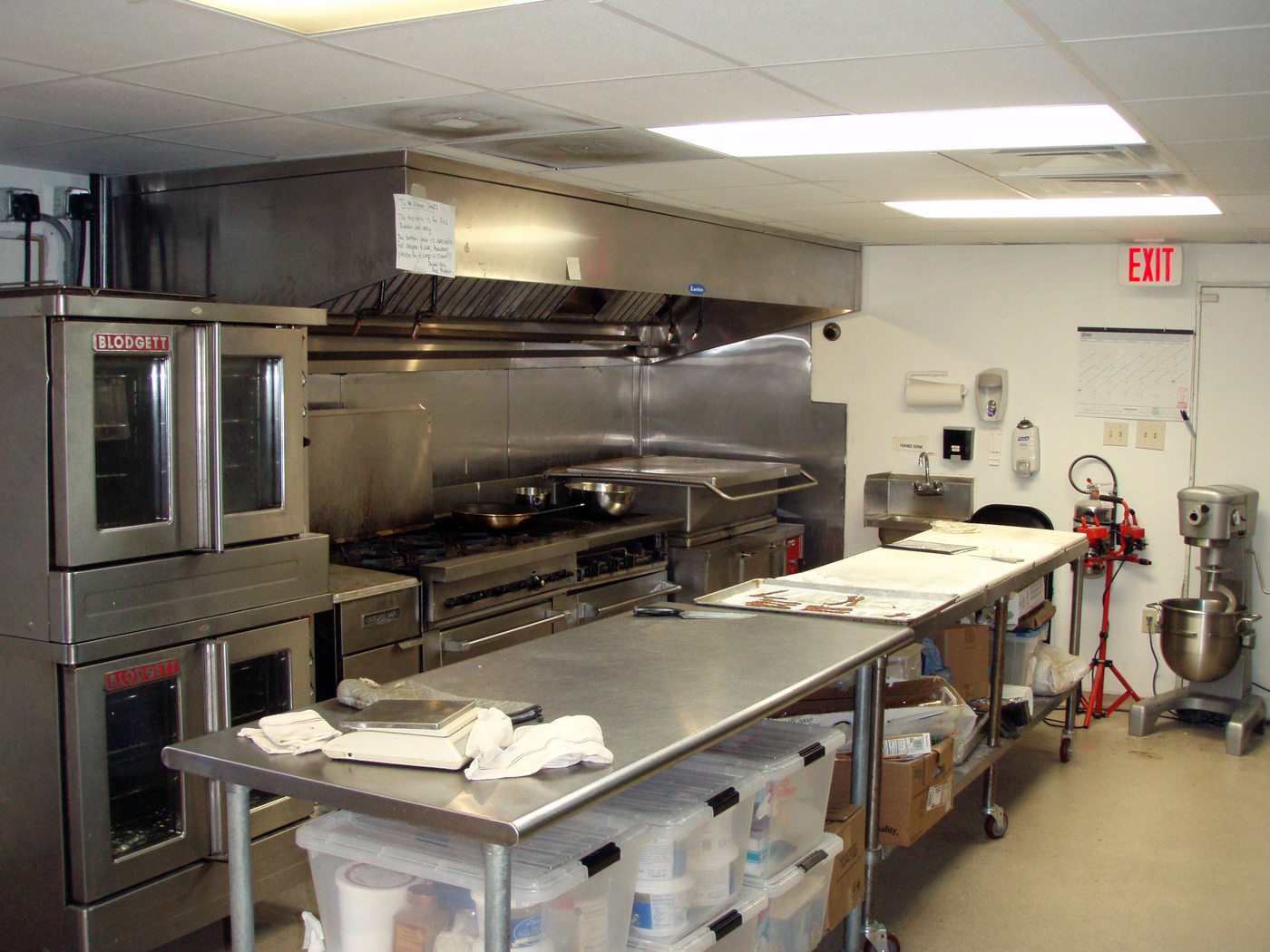
The interior reads as a commercial kitchen because it is one. Griddle, range and oven capacity work under real ventilation. Stainless prep surfaces sit at proper working heights, hot and cold holding flank the line, and a warewashing station keeps pace with whatever service throws behind it. Handwash stations sit exactly where health code wants them. Lighting supports knife work at 4:30 a.m., which is when serious feeding operations genuinely start their day, whatever the brochure hours claim.
The layout earns its keep at volume. A line built for flow lets four cooks produce without collisions, and the door placement separates the delivery path (raw product in one way, finished plates out the other) so service runs continuously straight through a resupply. These sound like small choices. At meal 1,708 of a long day, they're the difference between a kitchen and a fight.
"Give me this trailer and six good cooks and I'll feed a battalion," a disaster feeding chef told us during a recovery deployment. She then did exactly that, for 23 straight days, and her program has booked the same unit twice since.

Disaster feeding has a staffing truth nobody designs for: the crew changes constantly. A culinary trained lead might open the operation, hand it to a rotation of volunteers by week two and welcome a second organization's team by week four. So the kitchen has to be legible to strangers. Equipment sits where commercial convention says it should sit. Controls read plainly without a manual, and our delivery orientation covers the trailer's few quirks in twenty minutes flat. A volunteer who's cooked in any church hall or restaurant kitchen walks in and immediately knows where things live, which is the entire design brief.
We also leave the wipe clean cheat sheet behind (yes, a habit no client has ever asked us to drop) covering startup, shutdown and the after hours dispatch number. It gets consulted most during crew handoffs, which is exactly the moment feeding operations historically wobble. One relief kitchen changed volunteer crews 9 separate times across a six week deployment and never once missed a scheduled meal service, and their program director credited the boring stuff for it: consistent equipment, clear labeling everywhere and a service company that answered the phone on the second ring, every time. Boring stuff is our love language, and we say that with zero irony. The meals were apparently excellent too.
A professional brigade runs our kitchens one way: stations claimed by rank, prep lists on clipboards, service like a metronome. They need equipment that keeps up and nothing else. Volunteer crews run them another way entirely, with enthusiasm outpacing knife skills and a rotating roster that resets every few days. They need the layout to do the organizing for them, which is why clear station signage and simple traffic flow matter more in relief work than any single piece of cooking equipment. Both crews produce excellent food in the same trailer. They just get there differently.
The third configuration is the hybrid, and it's become the most common on long deployments: one or two paid culinary leads directing a volunteer rotation. The lead owns the menu and the food safety log. The batch schedule stays on the lead's clipboard too. Volunteers own the prep mountain and the serving line. It works beautifully when the kitchen supports clean delegation, so we walk the lead through the trailer with exactly that lens at delivery: here's what only you should touch, here's what anyone can run, here's the laminated station guide for whoever shows up Thursday. A Salvation Army feeding captain called the setup volunteer proof, then apologized to his volunteers, who agreed with him anyway.
Hot meals are morale and nutrition at once after a disaster (public order too, quietly), and feeding programs need production capacity the exact same week the local restaurants lost their own. Red Cross partners, county OES feeding task forces and church relief networks have all cooked from our lines. Our kitchens have cooked straight through hurricane recoveries and fire seasons, parked beside our own cold storage boxes for the duration of each one.
A camp that sleeps 124 has to feed 124 twice a day at minimum, and usually finds a third meal hiding in the night shift. The kitchen anchors the whole camp's daily rhythm, and pairing it with our bunkhouse and hygiene fleet turns a bare gravel lot into a functioning small town with a dinner bell and opinions about dessert.
Dining hall renovations don't excuse anyone hungry. Campus food service runs full menus from our trailers for semesters at a stretch, keeping board plans and allergy protocols intact (USDA meal program requirements included) while the permanent kitchen gets rebuilt around the corner.
Location catering for a 128 person crew is restaurant volume with no restaurant in sight. Caterers run our kitchens just behind the set, and producers learn quickly that crew meals shape crew mood, which in turn shapes the entire day's footage. The kitchen line item defends itself.
Hospitals, correctional facilities and care operations can't pause food service for a renovation or an equipment failure. Not for a day. Not for a meal. The trailer becomes the interim kitchen with compliance paperwork matched to the setting's own standards, delivered and inspected before the service gap ever opens.
Harvest crews and seasonal workforces eat like the work demands. Growers pair the kitchen with our housing and hygiene units for the full season, and the cook they hire becomes the most popular person within 43 miles.

After the hurricane we scaled up to 2,300 hot meals a day inside a week, starting at nothing. The kitchen trailer ran two full shifts, passed the county's emergency inspection on day one, and their service crew kept the propane and water flowing so my volunteers could focus on just cooking. I've written this company into our official response plan by name, with the phone number.

Our main dining hall renovation ran 11 months, which is 11 months of students who still eat three times a day. The mobile kitchen carried the full board plan menu from a parking lot for two entire semesters. Health inspections came quarterly and passed quarterly, all four of them. Honestly, some students preferred the trailer era.

Location work means cooking real food in places with no kitchen, for a crew of 92 or a crew of 141, twice a day. The trailer gives my chefs an actual line: hot holding, cold prep, ventilation that works. My clients noticed the food got measurably better when the kitchen stopped being tents and folding tables in a field.
The old assumption ran simple: temporary kitchen means temporary standards, and everyone politely eats the gray chicken without comment. But feeding expectations have climbed everywhere the trailer goes. Fire camps follow the interagency feeding standards (the same framework Cal Fire, US Forest Service and CalOES incidents contract against) with daily calorie targets a sports nutritionist would nod at approvingly. Universities carry their allergy protocols, halal and kosher accommodations and full vegan lines straight onto the temporary menu, because a board plan makes promises that don't pause for construction. And film crews? Film crews review the catering in the call sheet group chat by 12:40 p.m. sharp, in detail, with adjectives that would make a food critic blush.
So the equipment has to support ambition, and ours does. Scratch cooking with real sauces has run on these lines, alongside proteins with actual sear marks and more than one ambitious bakery program that started as a dare. One university chef staged a full holiday dinner for 784 out of our trailer during renovation year, carving stations included, mostly to prove a point to his own staff. The point held, and the photos circulated through his department for a year. When clients ask whether the menu has to shrink for the trailer, we tell them what that chef told us afterward: the kitchen was never the limit. The kitchen's just the tool that shows up honest.

The line lights at 3:40 a.m., before the camp generator's hum has any competition. Griddles come to temperature while the first cook pulls the day's protein from the refrigeration trailer parked a few steps off the back door. By 4:15 the full crew of five is on station, and the hot holding cabinets start banking eggs and potatoes in hotel pans. Service opens at 5:30 in the dark, because crews bus to the line at 6:00 sharp, and a fire camp breakfast has to survive the math of 400 some hungry people through a serving window in about 77 minutes, give or take a slow tray.
It does, morning after identical morning, because the equipment holds temperature and the layout holds flow even when the crew is running on four hours of sleep. Warewashing runs continuously behind service, unglamorous and undefeated. Our tech visits during the mid morning lull: propane topped, water tanks filled, greywater pumped, a ten minute equipment walk. By the time lunch prep starts at 10:20, the kitchen's logistics are already tomorrow proof, and nobody on the cook line ever had to think about any of it.
"The camp judges everything by breakfast," an incident caterer told us once. No pressure at all. We just make sure the kitchen never hands the camp a reason to grade harshly, and the renewal rate across fire seasons says the system works as designed.
Meals per day is really three smaller numbers multiplied: line output per hour, service window length and shift count. A practiced crew pushes hundreds of plates an hour through a well laid line, so an 82 minute breakfast window covers an entire camp before the buses load at the gate. Run two shifts back to back and the arithmetic climbs fast, which is exactly how our disaster clients hit their 2,300 a day figures without anyone on the line ever sprinting. The trailer's job in that equation is refusing to become the bottleneck: burners that recover fast, holding that holds and a warewashing loop that never backs up the line.
The honest limit is usually cold storage turnover rather than cooking power, which is why we push the cold chain conversation on every volume quote. A kitchen without enough refrigerated runway either shops daily (expensive, fragile, weather dependent) or quietly trims the menu (sad, and entirely avoidable). Pair the boxes correctly at the start of the contract and neither compromise ever happens. "Size the cooler to the menu, then size the kitchen to the crowd," is dispatch's stock phrasing, and it's ordered that way on purpose. The sequence matters more than callers expect.
Volume feeding rewrites culinary priorities in an honest and slightly brutal way. Dishes that hold win. Dishes that die under a heat lamp lose, regardless of how they taste at minute one. If you've catered even one 380 seat banquet, you've already learned this the expensive way. The programs that thrive in our trailers learn to build menus around braises, roasted proteins, sturdy starches and sauces that improve with an hour in hot holding, then spend their finesse on the one component per meal that gets finished to order. Crews eat better under that philosophy than under any ambitious menu that collapses at plate 300.
Batch cycling is the other discipline. Instead of cooking a meal, the line cooks a rolling sequence: a fresh batch finishing every 22 or 23 minutes through the service window, so your last diner eats food the same age as your first diner's. The trailer's layout supports the rhythm with oven capacity staged beside holding, and the cold boxes parked outside hold tomorrow's prep in delivery order. One Red Cross partnered feeding chef walked us down her menu board during a deployment visit. "My board reads like a train schedule, and I mean that as a brag," she said. Trains run on time in her kitchen. So does dinner in her operation, 1,900 plus plates at a stretch, week after week.
Cooking fuel runs out at the worst possible hour unless somebody owns the schedule, so our service owns it. Tanks get exchanged or topped against your actual burn rate (tracked visit by visit in the same log as everything else), and no chef of ours has ever plated a cold breakfast because the fuel math failed.
Fresh water arrives through a certified connection or scheduled tanker fills, with the same source documentation our drinking water program keeps on every unit (fill ticket, source, time, initials). Nothing about the water path gets improvised, ever, on any deployment. Warewashing and handwash stations drink a surprising share of it, and the refill plan accounts for every sink from day one.
Refrigeration, ventilation, lighting and small equipment all pull power, and the generator package carries the whole load where the grid doesn't reach. Fuel service rides our schedule. Your cooks flip switches and everything simply answers, which is the entire point of hiring the backbone out.
Greywater pumps on cadence, grease gets managed to code and the paperwork trails every gallon. Feeding operations under FEMA reimbursement or USDA program review get files built for the audit, and everyone else just gets the quiet comfort of never thinking about it.
A trailer kitchen eats like the operation it feeds, and keeping it supplied is its own trade skill. Broadline distributors (Sysco, US Foods, the regional houses) deliver to a trailer's address exactly the way they deliver to a restaurant's, usually within a day or two of the account paperwork clearing, and their sales reps in Denver, Baton Rouge and everywhere between have long since stopped blinking at parking lot delivery instructions. Disaster deployments layer in the commodity flows: USDA product, donated pallets and whatever Feeding America's regional warehouse routes over that week. Good programs run both streams at once and let the menu flex around what arrives.
The trailer's job in all this is receiving discipline. Deliveries land through the dedicated raw side door and get checked against the invoice on a table that exists for exactly that purpose. Product moves straight into the cold boxes parked alongside, with temperatures logged on arrival the way a ServSafe manager would insist. Nothing sits in the sun learning bad habits. We watched one university program clock their receiving routine at 11 minutes per delivery by the third week, down from 40 odd chaotic ones in week one, and their food cost variance tightened right in step with it. "Know what came in the door and the rest of the numbers behave," their dining director told us at that same visit, quoting the oldest rule in the trade. Wheels under the kitchen change nothing about it.
Chefs audit a strange kitchen the way pilots audit a strange plane, fast and in a fixed order. First the hood: is the ventilation actually pulling, or just humming? (Ours pulls, and they can feel it standing at the line.) Second, recovery: does the griddle come back to temperature after a full load of pancakes hits it, or does breakfast slow itself to the equipment's lazy pace? Third, the sanitation triangle of handwash, warewash and surfaces. Fourth, cold holding within reach of the line, because a cook who walks 62 feet for mise en place walks a marathon by Friday. Fifth, workspace: can two working cooks pass behind the line without choreographing a dance?
We know the checklist because we've watched hundreds of chefs run it over the years, and the fleet is specced to pass every station of it without commentary. The best compliment in this category is a shrug and a nod, followed by knife work. One caterer's chef finished her walkthrough, looked at our driver and said only: "Fine. Where's my produce?" He points to that morning as a career highlight, and we've quoted her at three equipment meetings since. Fine is the goal. Fine means the kitchen disappeared into the work, which is the entire job of good equipment anywhere.
Feeding at volume is really an inventory problem wearing an apron, so the kitchen rarely deploys alone. Here are the standard combinations, every one of them riding a single contract:
A refrigeration trailer rental beside the cook line holds the week's produce, dairy and staged prep at working temperature. Chefs shop their own cooler instead of managing daily vendor deliveries, and the food cost math improves in the first invoice cycle.
Deep frozen reserve in a freezer trailer rental means the program survives a supply hiccup without a menu crisis. Disaster feeding operations treat this pairing as functionally mandatory, and their after action reports keep saying so in language procurement officers underline.
A drinking water station serves the same crowd the kitchen feeds, and we coordinate the potable supply so the cook line and the fill rail never compete. Summer feeding programs run this pair as one unit of thought, ordered together and serviced together.
Kitchen, cold storage, restrooms, showers, laundry and sleeper housing, sequenced into a working camp by one dispatcher. We've stood these up in under 48 hours for operations that needed dinner served on night one. Dinner was served on night one, hot, and the camp slept fed.
Kitchen deliveries carry more setup than the rest of our fleet, so the day runs to a checklist our drivers know cold. The pad gets walked and leveled first, carefully (cook lines and their fryers care about level more than any other equipment we own, and fryers hold grudges). Utilities connect in strict sequence: water first, then power, then propane, with each one verified under an actual load rather than assumed from a gauge. Ventilation gets run at full draw. Refrigeration gets a temperature check against the reference thermometer, and every single burner meets a flame test before anyone signs anything. The whole sequence takes a few careful hours, and your kitchen lead walks every station of it with our driver before the handoff finishes.
Then comes the part we can't do for you but love watching: the crew moves in. Knives come out of their rolls first. The walk to the cold box gets rehearsed twice, and somebody claims the good corner of the prep table by ancient kitchen law that predates us all. Most operations serve their first meal within 24 hours of placement day. Emergency feedings have done it in under 11 hours flat, with the county inspector nodding along during the setup itself. And from that first plate forward, our half of the job goes intentionally quiet: fuel, water, waste and maintenance on schedule while your cooks do all the visible work. That division of labor has fed an enormous number of people over the years. It scales beautifully, and neither side ever wants the other's job.
Ask any chef what actually limits a kitchen's output and the honest ones point past the burners to the dish pit. Hotel pans cycle through a volume kitchen like ammunition, and if the wash loop can't keep pace, the cook line starves for equipment at exactly the wrong hour. The trailer's warewashing station is positioned and plumbed as a production asset: sized against the cook line's realistic pan velocity, supplied with hot water that doesn't compete with the cooking side and drained into the same managed greywater system as everything else.
The three compartment discipline (wash, rinse, sanitize, in that order, forever) is the part every health inspector checks and every rushed volunteer is tempted to shortcut, so the setup makes the right way the easy way: compartments labeled, sanitizer test strips mounted at eye level, air drying racks within arm's reach. Sixty seconds of orientation covers it. On a 1,900 cover day, the pit turns the same pans nine or eleven times over, and the cooks never once wait on steel. That invisible loop is a fair share of what clients are actually renting, whether or not it ever comes up on the phone. It comes up in month two, as a compliment, phrased as silence. If your kitchen has ever waited on pans, you already know exactly what that silence is worth.
Every jurisdiction inspects food service, emergency or not, and the inspection always walks the same familiar route: handwash access first, then hot holding temperatures, cold holding temperatures, ventilation draw, the warewashing loop and finally the surfaces everything happens on. Our kitchens answer each stop on that route the way good commercial kitchens do, because that's what they are: commercial kitchens that happen to have axles underneath. University food safety officers, county environmental health reviewers and emergency inspection teams have all walked our lines. The notes come back boring, and boring is the entire ambition.
Your program's own paperwork gets support too. Temperature logs and service records accumulate alongside propane and water delivery tickets and the waste disposal documentation, all in the one file our techs maintain visit by visit, and programs answering to USDA meal requirements or FEMA reimbursement reviews lean on that file hard when closeout season arrives with its questions. "You're the only vendor whose paperwork arrived before I asked," a school nutrition director told us at the end of a renovation year. That sentence became the internal standard the day she said it. We hold ourselves to it on every contract now, cooking or otherwise, and the file proves it.
Campus dining renovations are our longest and most choreographed kitchen deployments, so here's the anatomy of one. Placement happens in early August, deliberately close enough to the old dining hall that the student traffic pattern barely has to shift at all. Utilities connect over two unhurried days. The county health department walks the line before a single meal serves, and the dining team spends a full practice week learning the new geography with no students watching. Then classes start. The board plan runs like it always ran. Nobody posts about it, which the dining director counts as total victory. "Invisible is the goal," she told our tech at the fall service visit, and the whole program agreed.
Through the year, our techs service around the academic calendar (never during the lunch rush, always during the 2:30 lull between waves), and the quarterly inspections come and go without a paragraph of drama. The trailer handles finals week volume without blinking, plus a February norovirus scare that turned out to be nothing and one visiting parents weekend that pushed covers 31 percent past forecast without a single hiccup at the line. When the renovated hall finally opens on its third promised date, the trailer leaves quietly during spring break. Most students never learn that the kitchen they ate from all year had wheels underneath it, and honestly, that's about the highest compliment this entire category of equipment can earn.
The planned call sounds like a facilities director in February: dining hall renovation starts in June, 1,860 students on board plans, need a bridge kitchen for two semesters. Those bookings get the full planning treatment (a site walk, utility design, health department pre coordination and a delivery week chosen rather than accepted), and the resulting programs run so smoothly the trailer becomes campus furniture by October. School districts, hospitals and universities live in this lane year after year, and their procurement teams appreciate that we speak fluent RFP without an interpreter.
The burning call sounds altogether different. Maybe a feeding program director, maybe a county emergency office, sometimes calling at 11 p.m., always with a specific number of hungry mouths attached to the request. Those calls skip every queue this company has. The nearest ready kitchen gets a driver immediately. The cold chain gets sequenced behind it, and the first hot meal target gets set on the call itself rather than promised vaguely. We've hit next evening meal service more than once from a standing start. But the callers who signed standby agreements before their season began hit that target fastest of all, and every one of them would be the first to tell you to copy their homework.
We'll spec the line, plan the utilities and cold chain, and have your cooks producing real meals within a day of placement.