Home / Services / Combo Trailer Rentals
Combo Trailer Rentals

One Trailer, Three Jobs: Combo Trailer Rentals with Restrooms, Showers and Laundry for Remote Crews

We build complete hygiene points out of single trailers: restrooms, showers and laundry sharing one chassis, one water line and one service visit. Small crews get big site infrastructure without the utility project.

The One Hookup Argument

Every extra trailer is another hose, another breaker, another service stop.

Small sites don't fail on capacity. They fail on complexity: three trailers, three water lines, three power drops and three vendors who each think the schedule is a suggestion. Our combo trailer rentals collapse that stack. Restrooms, showers and laundry ride one chassis, drink from one connection and get serviced in one visit by one crew. So a site with fifteen people gets infrastructure that behaves like one appliance instead of a utility project.

3Combo formats in fleet
1Hookup, placement + service stop
8 to 40Crew sizes covered
ADAFully accessible option
Pick Your Coverage

Three combos, from one accessible suite to a rolling micro camp.

The Combo Fleet 3 units

Three combination trailers, three levels of coverage. Every one puts multiple hygiene functions behind a single water connection and one power drop.

Single Station ADA Shower & Restroom ComboADA all in one
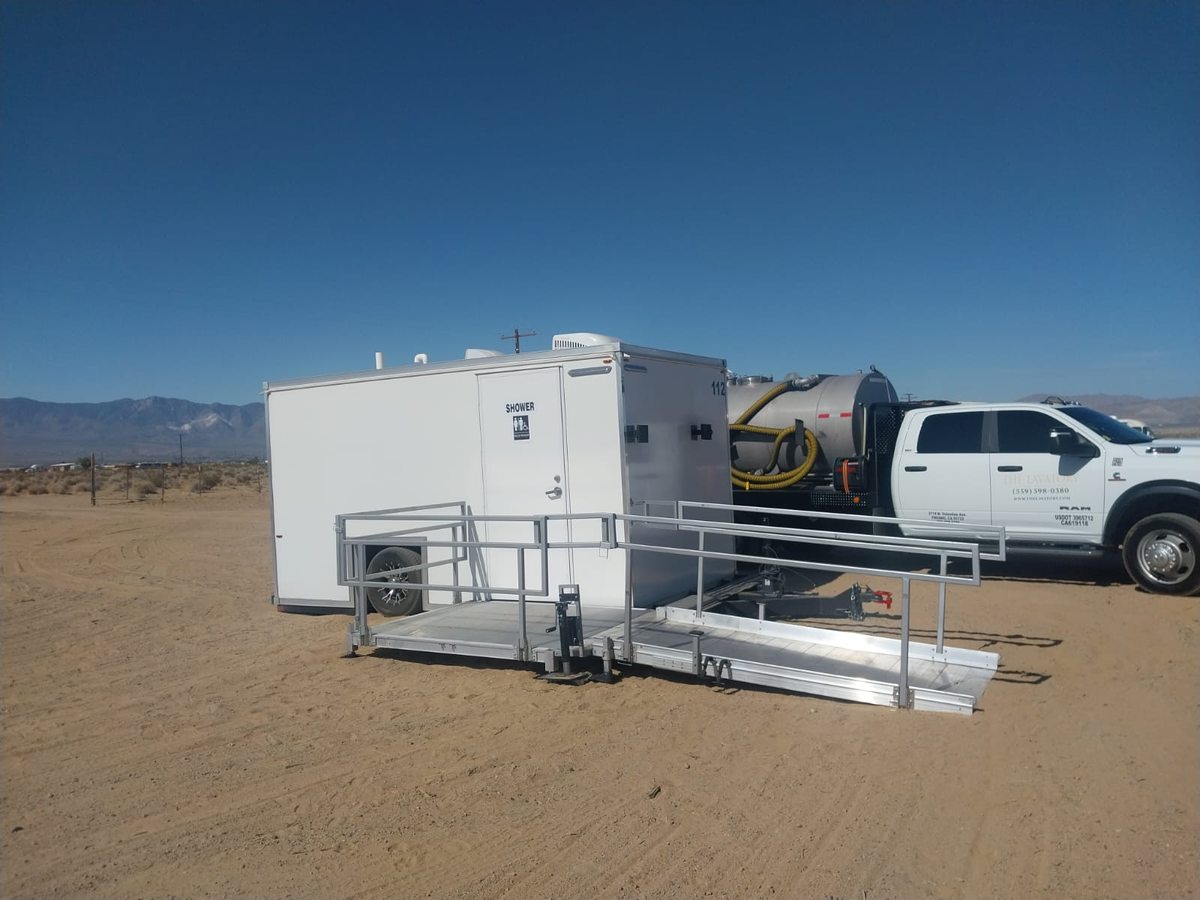
All in one accessible combo trailer with ramp leading to the single suite entrance
Exterior
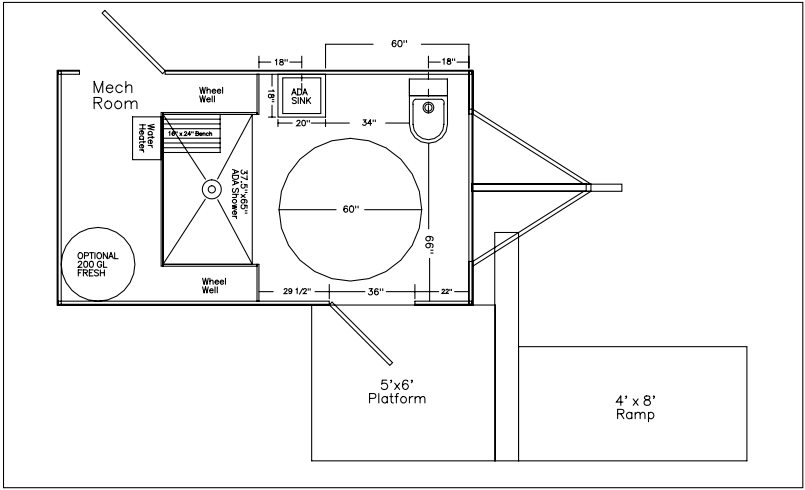
Suite drawing showing roll in shower, toilet and sink arranged around the turning circle
Floor plan

The smallest complete hygiene point we build, and the only one that's fully wheelchair accessible end to end. Behind one ramped entrance: a roll in shower, a toilet and a sink, all in a single climate controlled suite. It draws like a small restroom trailer, which means it slots into a site plan (or an existing camp) without touching the utility budget. Who books it? Shelters serving residents with mobility needs. Camps that just hired someone the standard trailers can't serve. Long term projects where the ADA requirement and the space constraint arrived in the same memo. One placement answers both, and our drivers install the ramp before they leave. Inside, the suite is a real room: turning circle to code, fold down shower seat, grab bars through the wet zone and a sink with knee clearance. Compliance documentation rides along for the permit file. Utility draw stays modest (a single circuit and a standard water connection), which is why this unit gets added to existing sites more than any other in the combo fleet. It arrives, it plugs in, and the accessibility line item goes quiet.

Stations1 combined shower + toilet ADA room
Box Size8' 5" x 14.5'
Length w/ Ramp25'
Width w/ Ramp13' 6"
Fresh Water105 gal
Waste Tank300 gal
PowerTwo dedicated 120V-20 amp circuits
AC Units1
2 Station Shower & Restroom ComboLength 17'
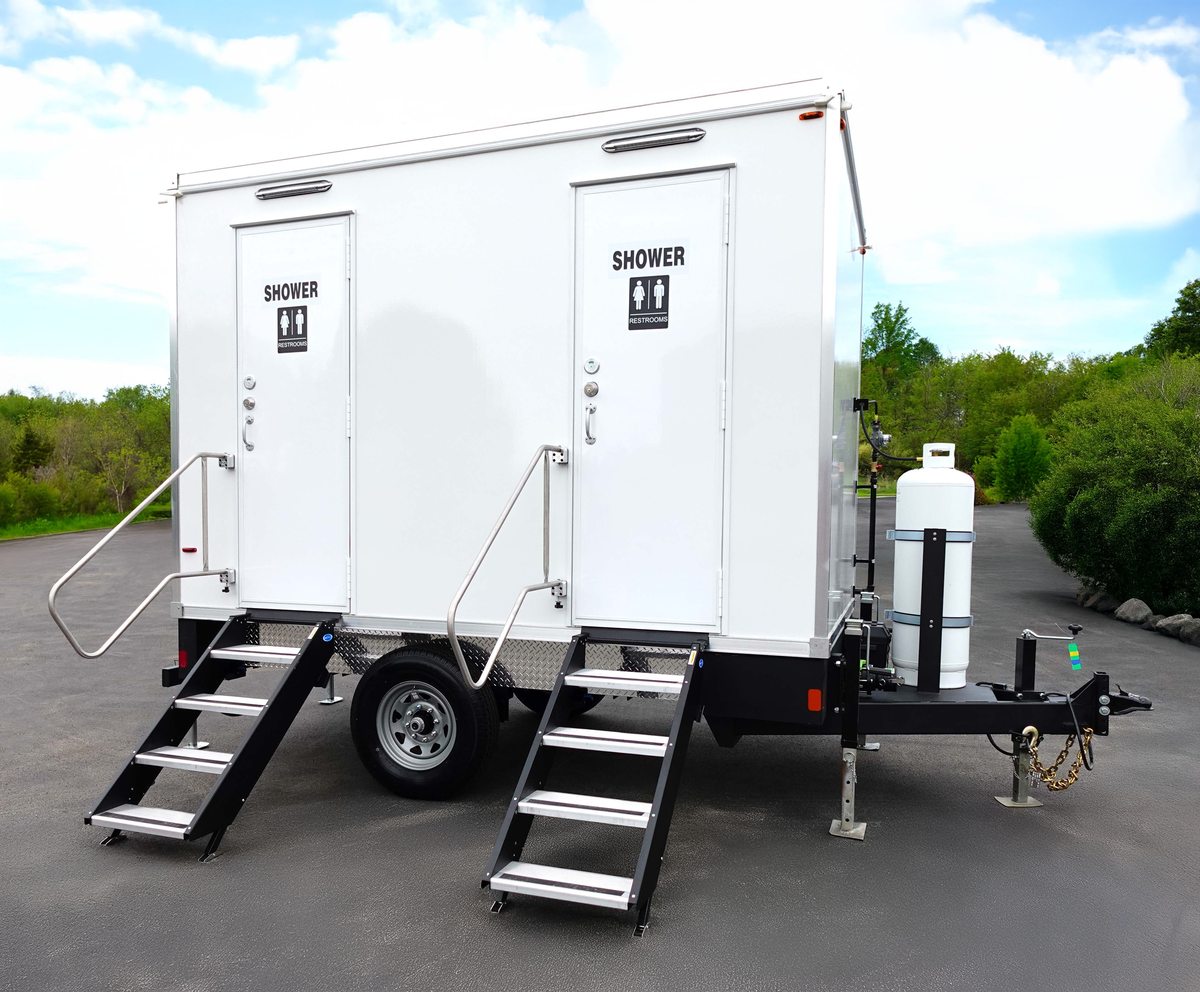
Twin suite combo rental where each locking door opens to a shower, toilet and sink
Exterior
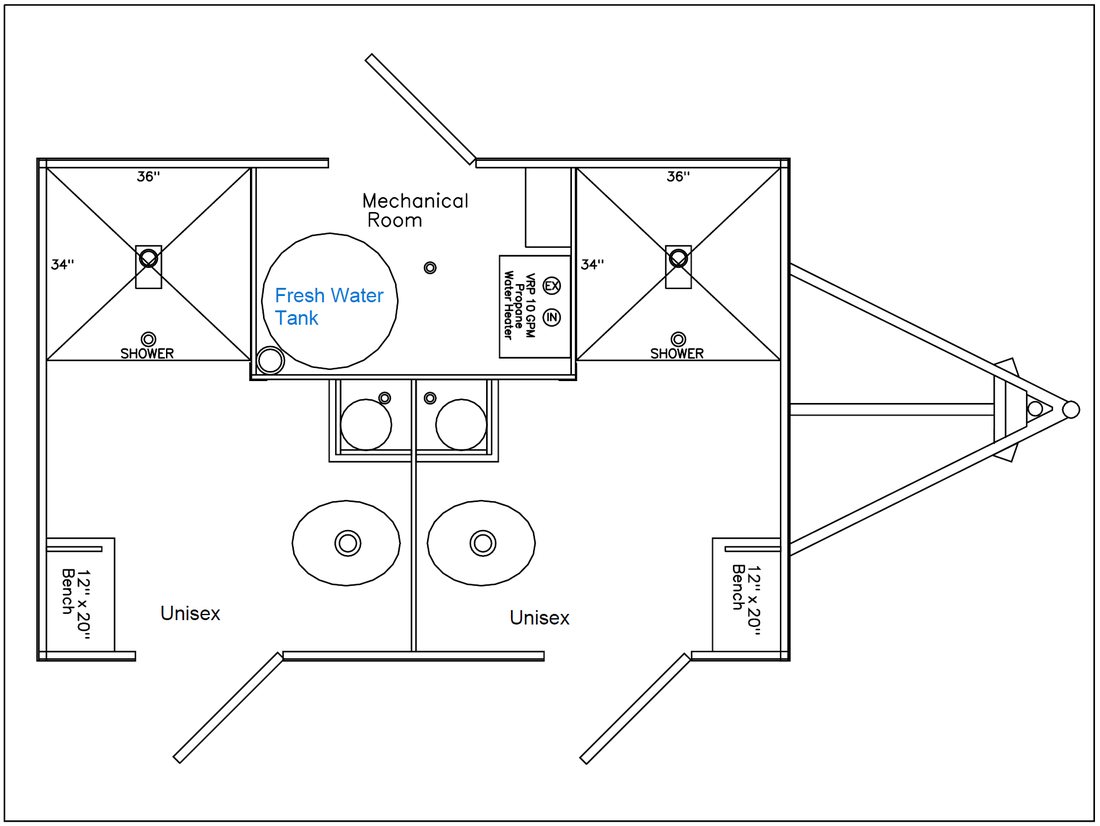
Two suite layout with mirrored fixtures and the shared water heating bay between them
Floor plan

Two private suites, each holding its own shower, toilet and sink behind a locking door. This is the crew camp classic: eight to fifteen people, no facilities on site, one trailer solves the whole question. The hot water plant is built to keep pouring through the whole end of shift rush (we learned that spec the hard way years ago, on someone else's undersized unit). Advance teams use it as a self contained hygiene point ahead of the main camp build. Gate crews and security details run it standalone for months. And because both suites lock independently, day shift and night shift can each claim one without a scheduling debate. The interiors carry the same finish standard as our big trailers: porcelain fixtures, running water, climate control that actually keeps up, lighting that doesn't flicker. Crews notice within a day. Superintendents notice at renewal time. And when the assignment moves, the whole hygiene setup moves in one tow behind one truck, which has saved more than one relocation weekend.

Stations2 private bathrooms, each with 1 toilet, 1 sink, 1 shower
Box Size7' 7" x 11'
Length w/ Tongue17'
Width w/ Stairs11' 7"
Fresh Water105 gal
Waste Tank300 gal
PowerTwo dedicated 120V-20 amp circuits
AC Units1
4 Station Shower & Restroom Combo + LaundryShower + restroom + laundry
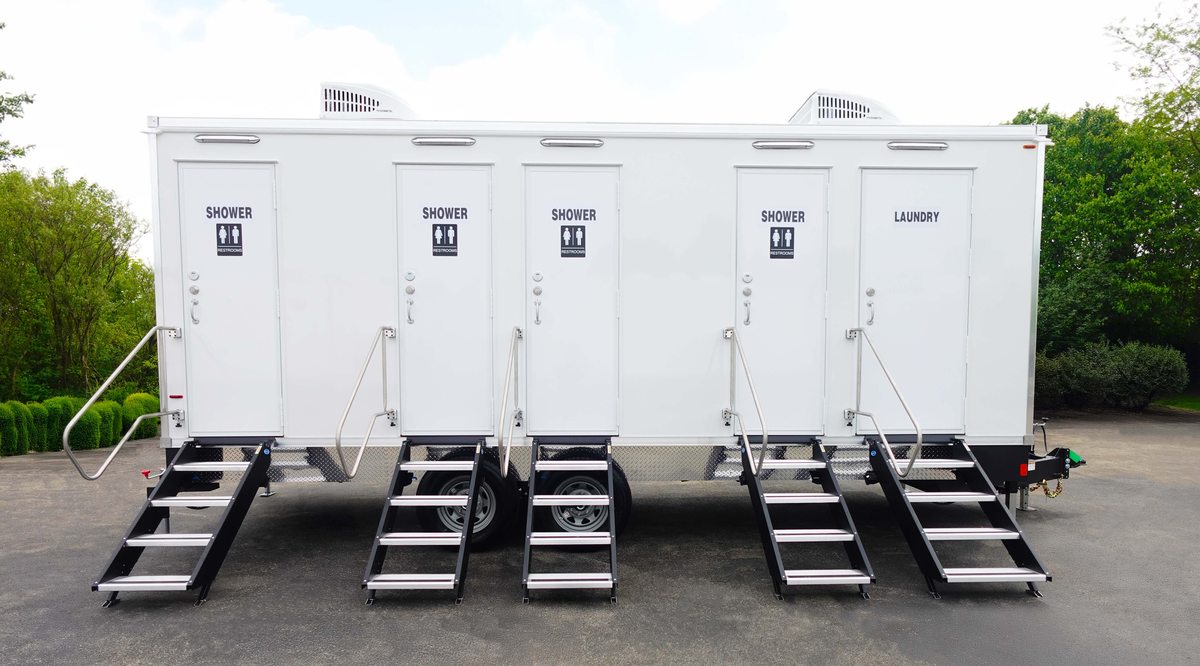
Full length combo trailer carrying showers, restrooms and a laundry bay in one chassis
Exterior
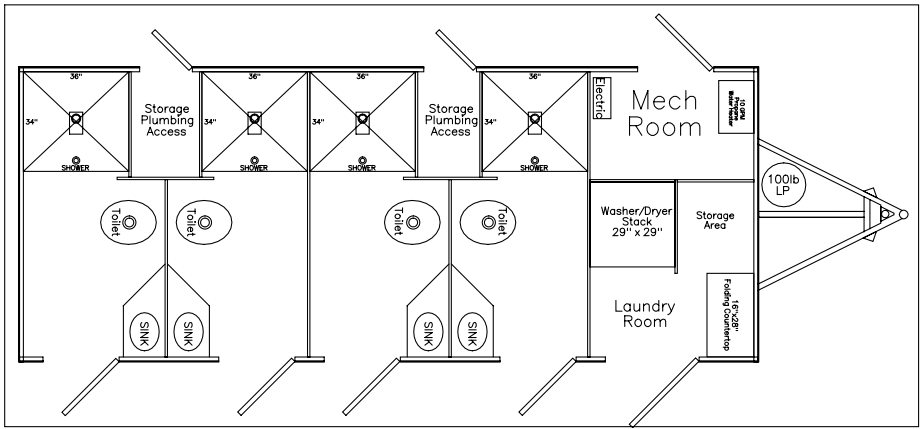
Chassis plan mapping washers and dryers at the tongue end through showers to the restroom stations
Floor plan

The flagship combo: showers, restroom stations and commercial washer dryer sets sharing one chassis. For remote crews of twenty to forty, it replaces three separate trailers, three utility hookups and three service visits with one of each. The laundry bay runs machines built for work gear. The showers run hot through shift change. The restroom side keeps OSHA conversations short. Pipeline spreads, wildfire support operations and agriculture programs book this unit for entire seasons, and it pairs with a bunkhouse trailer to make a complete micro camp in two tows. When clients outgrow it, it stays on as the satellite unit while dedicated trailers take the main load. It never goes home early. A note on the laundry end, because it surprises people: the machines are commercial grade, sized for work clothes and run through the same maintenance program as our dedicated laundry trailers. Detergent and supplies restock on the service visit. And the greywater from all three functions rides one tank system with one pump out, which is the kind of small engineering decision that makes month four feel exactly like week one.

Stations4 private bathrooms (toilet + sink + shower each) + 1 washer/dryer stack
CapacityUp to 200 guests
Box Size26' 6"
Length w/ Tongue26' 4"
Width w/ Stairs12' 4"
Height w/ AC11' 4"
Fresh Water105 gal
Waste Tank750 gal
PowerOne dedicated 220V-50 amp circuit
AC Units1
The Decision

Combo or dedicated units? Here's how we actually call it.

"Count heads, then count hookups," our dispatch lead says when new clients ask, and that's genuinely the whole framework. The longer version, with the numbers we use:

Under 15 people: combo, no debate

A 2 station shower restroom combo covers a small crew completely, and anything more is paying to service capacity nobody uses. Add the ADA combo if accessibility is required and the site is done in two placements.

15 to 40: the 4 station sweet spot

This is where the laundry combo earns its reputation. Full hygiene (washing included) from one tow, one utility plan and one service visit. Most of our seasonal contracts in this range renew without editing a single line item.

40 to 60: judgment territory

Shift patterns decide it. A staggered schedule can stretch a combo beautifully. A single shift that ends at 5 p.m. sharp will form a line by 5:20, and lines are our failure condition. We ask about the schedule before we quote, every time. One energy client in this exact band ran a 52 person site on the 4 station for a full year by splitting shift end times just forty minutes apart. Their safety officer called it "the cheapest scheduling decision we ever made," and our dispatcher quotes him at least once a month.

Past 60: dedicated units, combo as satellite

Dedicated shower, restroom and laundry trailers take the main load, and the combo moves to the far corner of the site or the supervisor row. Its second life is often longer than its first. The contract just grows, and nothing bounces back to the yard.

The Advance Team Playbook

Why the first trailer into any major response is so often a combo.

Advance teams live a strange professional life. They arrive at a bare site days ahead of everyone else, with no infrastructure, a short equipment list and a deadline that assumes the camp will somehow exist by the time the main body rolls through the gate. For that assignment, the combo is close to purpose built. One tow delivers toilets, showers and (on the 4 station) a working laundry bay. One generator wakes the whole thing up. One person can run it between their other eleven jobs. The advance team gets functioning facilities on night one, and the camp that follows grows around a hygiene point that was already working, tested and hot before the first tent stake went into the ground. Two people have stood up that arrangement in under three hours. We've watched them do it with the truck still warm.

The playbook we've watched the good teams run goes like this. The combo lands at the future camp's center of gravity rather than its convenient edge, because everything else on a growing site will orbit whatever exists first. Camps are gravitational that way. Water and power connections get staged with expansion in mind, so the dedicated trailers arriving later plug into a plan instead of a puzzle. The good advance leads even chalk out where the future shower trailer will sit, days before anyone has ordered one. That chalk line has predicted our own delivery map more than once, down to the yard. And the advance lead keeps our dispatcher's direct line, because the moment the incident grows, the next equipment call is a two minute conversation between people who already know the site. "Anchor the camp on the combo and build outward," is how one FEMA seasoned advance lead described the pattern to us, and teams that work it credit the approach with shaving a full day off standing up a functioning base. A day matters enormously in that world. Sometimes a day is the entire assignment, and the combo keeps handing it back.

Utility Math

One connection, fully accounted for.

A combo's utility story fits on an index card, and we like it that way. Water arrives through one line (or one onboard tank plan). Power lands on one circuit, two for the laundry model. Greywater and waste ride sealed tanks our techs empty on a fixed cadence, with permitted disposal and paperwork when the job requires it.

Compare that against three separate trailers: three water runs to trench or hose, three circuits your electrician has to find, three tank schedules to coordinate. On a tight site the difference is a full day of setup labor. And on an off grid site it's the difference between one generator and a small power plant.

Our quote spells out the whole card: source, draw, tank sizes and pump cadence. If your spigot or your generator can't carry it, you'll know before delivery morning, not after. And when your site already runs other Mavirus Group units, the combo joins the existing utility plan and service route automatically. One more trailer on the manifest, zero new complexity on your side. That's the shape every addition takes here, whether it's the second unit or the twentieth.

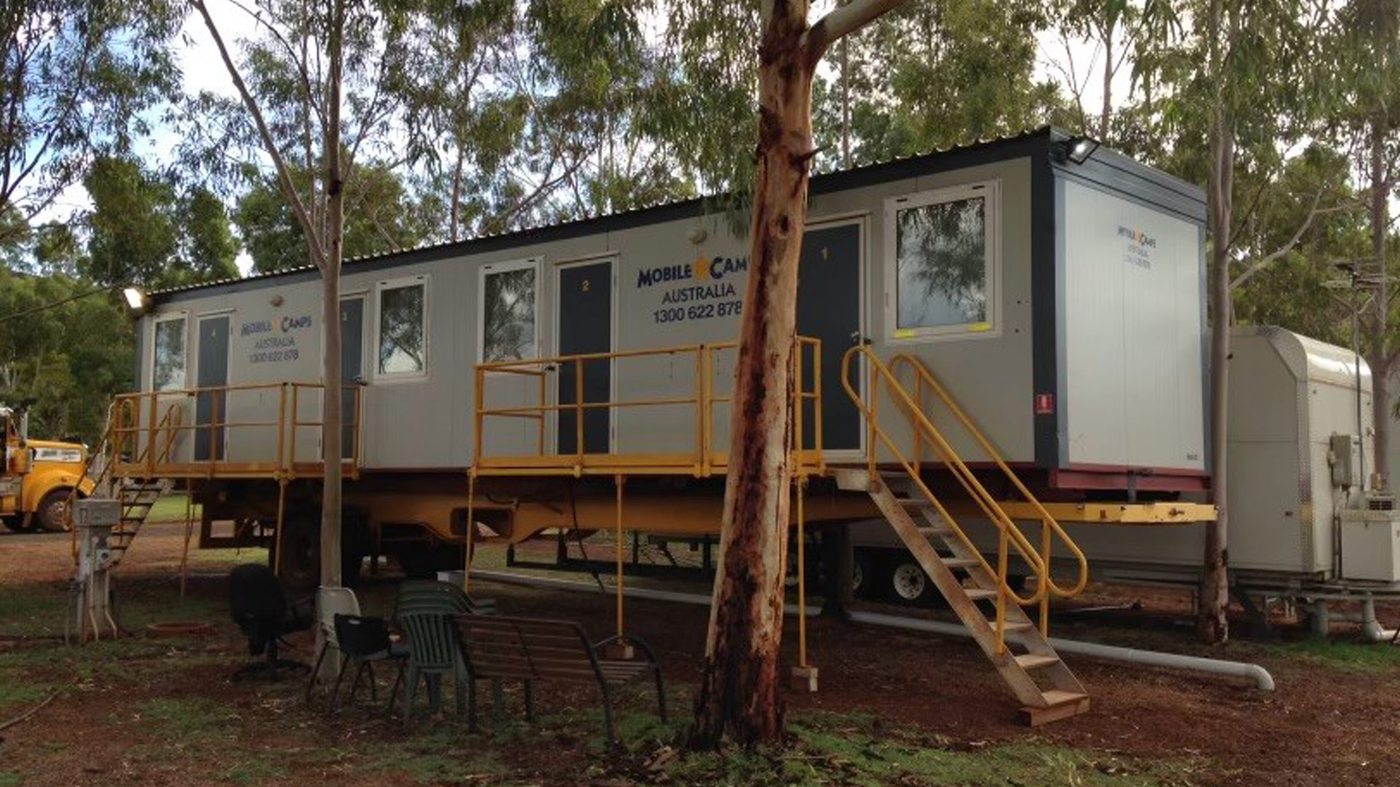
Combination trailer positioned at a remote work site with utility access staged
A Week One Diary

What the first seven days of a combo rental look like.

We asked our dispatch team to reconstruct a typical first week from the service logs of a real 4 station deployment (a utility crew, twenty six people, no hookups). Names removed, rhythm intact. This is the texture of the thing you're actually renting.

Day one: arrival and first showers

Trailer lands at 10 a.m., set and level by 11, generator online and water tank connected by noon. Our driver runs test cycles on every function (both showers, all fixtures, washer and dryer) before signing out. First crew showers happen that evening (the generator had been running exactly six hours by then). The foreman's log entry, which the client later shared with us, read two words: "about time."

Days two and three: the rhythm forms

Crew figures out its own shower order without being told, the way crews do. Laundry starts as a trickle. Then somebody washes a full week of gear at once and the machines run four hours straight. Water consumption settles at a number our dispatcher tracks against the tank plan. It held, with margin to spare, and that margin became the buffer that carried the crew through a surprise weekend shift without an extra delivery.

Day four: first service visit

Pump out, fresh water top off, restock, lint clear, heater check. Forty minutes, one truck, done before the crew returned from the work face. Compare that against coordinating three vendors for the same afternoon and you understand why site contacts describe combo service as the easiest line on their weekly checklist. The service log becomes the baseline cadence for the rest of the contract, adjusted to the actual usage instead of the estimate. Estimates start conversations. Logs run contracts.

Day seven: the review nobody schedules

Our dispatcher calls the site contact (we do this on every new combo placement, no exceptions) and asks exactly one question: what's annoying? The answer that week was "nothing yet, but the soap runs out fast." Double soap joined the restock list the same afternoon. Small fix, thirty second conversation. That's the entire point of the call, and it's why week two problems on our combos are nearly extinct.

Multiply that week by a season and you have the whole product: infrastructure that fades into the background of the job. And when the crew doubled for a rush phase in month three, a second combo arrived within the week on the same contract. No renegotiation, no new vendor, no drama worth remembering.

Field Reviews

Combo deployments, reviewed by the people who ran them.

Manuel J., Pipeline spread superintendent
Manuel J.Pipeline spread superintendent
★★★★★

One combo unit replaced the three trailers we ran the previous season, and my utility bill and my headache count both dropped. Same service truck handles everything in one stop. Should have switched years earlier.

Zeke F., Security operations manager
Zeke F.Security operations manager
★★★★★

Our gate detail lives at a remote checkpoint for weeks at a stretch. The 2 station combo gave the team showers and restrooms with one generator and one water tank. Simple to run, and their crew keeps it stocked without being chased.

Jadan R., Emergency advance team lead
Jadan R.Emergency advance team lead
★★★★★

We stage ahead of the main response, which means no infrastructure, ever. The combo trailer is our standard first drop now. It was running within an hour of arrival and covered the whole team until the full camp caught up.

Industry Angles

Where combos earn their keep, industry by industry.

Emergency advance teams

The first vehicles into a disaster zone can't wait for a camp build. One combo tow establishes showers and restrooms in an hour, and FEMA supported advance work has made this our most repeated emergency pattern.

Pipeline and energy

Spreads move. The combo moves with them, and one hookup means relocation day costs hours instead of days of re trenching utilities. Seasonal contracts in this sector renew at the highest rate anywhere in our book.

Security and checkpoints

Small details posted for long stretches need dignity without footprint. A 2 station combo plus a generator is a complete post, and it fits where a trailer convoy never could. Checkpoint details, remote gate assignments and monitoring posts have kept these units for a year at a stretch, with service visits timed to shift rotations so the post never stands unmanned.

Agriculture

Harvest crews swell and shrink by the week. Combos flex with the roster, and the laundry bay keeps field gear wearable through the dusty months. OSHA field sanitation expectations get met without a second thought, and the crews who came for the toilets stay loyal over the showers. Growers tell us retention through harvest improved the season the combo arrived, which is a sentence worth more than any spec we could print.

Film and events

Location shoots and back of house compounds want maximum function in minimum footprint, usually behind a fence nobody can see over. The combo disappears into the operation, which is exactly the compliment it's built for. Producers on multi week shoots also like that wrap day takes one tow instead of an afternoon of vendor coordination, because wrap days have enough moving parts already.

Municipal projects

Park rehabs and utility work in neighborhoods need clean, contained, quiet infrastructure that residents won't photograph for the city council meeting. Combos keep the site tidy and the meeting short. City project managers have told us the single trailer footprint made their community notice letters easier to write, which is the most municipal compliment we've ever received.

Multi year construction program site of the kind that keeps a combo on contract season after season
Built To Grow

Start with one tow. Scale to a town.

The quiet advantage of starting with a combo is that it never boxes you in. Every unit in our twelve fleet catalog runs on one contract structure, with the dispatcher and service trucks you already know. So the site that starts with one combo can add a bunkhouse next month, then dedicated showers, then whatever the peak demands. Growth is a phone call each time.

We've watched a two person advance placement become a 280 person camp across a single fire season, and the paperwork stayed one contract the entire time. The site contact never changed. The dispatcher never changed. Only the manifest grew, week by week, as the operation demanded, with every addition arriving on the service rhythm the site already knew. "Same number, bigger site" is how the client described it, and honestly we'd struggle to write a better tagline for the whole company.

So don't overthink the first order. Get the combo that fits this month's head count, and let the contract breathe as the mission does. If you're truly torn between two sizes, take the smaller one. Upgrades take a phone call here, and paying to service empty suites helps nobody's budget.

Under The Hood

The engineering choices that make a combo feel bigger than it is.

Cramming three functions into one chassis is easy to do badly, and the rental market proves it weekly. Here's what separates a combo that works for a season, and it comes down to four decisions made long before delivery day.

Independent water circuits

Showers, sinks and toilets each draw through their own path, so a running shower never starves a flush. The heating plant serves the shower line exclusively. Cheap combos share everything and prove it at 6 a.m. Our units were specced by people who've stood in that 6 a.m. line, and it shows.

One tank system, sized honestly

Greywater and waste consolidate into a tank plan built for the unit's real daily output, with capacity margins our dispatchers track from actual service data. When OSHA sanitation counts or environmental disposal records matter, the paperwork exists because the plumbing was designed to produce it.

Serviceability first

Every pump, heater and machine sits where a tech can reach it without emptying the trailer. Sounds obvious. It isn't standard. Our average combo service visit runs under 45 minutes for all three functions, and that number is the direct result of maintenance access being a design requirement instead of an afterthought.

Finish that survives crews

Porcelain, stainless and commercial hardware everywhere hands touch. The interiors take a season of work boots and come back for reconditioning instead of retirement. FEMA supported deployments and Cal Fire adjacent camps have run these units hard enough to test that claim thoroughly. The claim held.

None of this shows up in a listing photo, which is exactly why we write it down. Ask any vendor how their combo handles simultaneous shower and laundry load at shift change. If the answer takes longer than a sentence, you've learned something useful about the unit.

Who Calls, And Why

The five phone calls that end in a combo quote.

"Every combo starts as a different problem," our dispatch lead likes to say, and after enough seasons we can usually name the problem from the first sentence of the call. Here are the five we hear most, and what we send back.

"We've got fifteen people and a bare field."

The classic. A utility crew, a drilling pad, a survey team, somewhere with no water, no power and a schedule that started yesterday. We send the 2 station combo with a generator package and a tank plan, and the field stops being bare by Thursday. This call is a third of the combo board in any given month.

"The county says we need ADA and we have room for one trailer."

Public projects and small venues hit this wall constantly. The single station ADA combo answers it in one placement, with the ramp installed by our drivers and the measurement documentation their reviewer wants attached to the confirmation email. We've turned this call around inside a week more times than we've had to apologize for, which is to say always."

"Our crew doubled and the porta units aren't cutting it."

Growth call. A project that started polite got real, and the workforce needs actual showers and actual laundry before morale files a grievance. The 4 station combo replaces the row of plastic boxes with something crews describe as civilization. We hear the word "finally" a lot on the follow up call. Superintendents hear something better: quieter safety meetings and fewer early departures on Fridays.

"We're first in after the storm."

Advance teams, damage assessors, utility restoration leads. They need hygiene infrastructure that arrives with them, not behind them, and a combo tow is the fastest complete answer we or anyone else can stage. During season we position these units regionally so the drive is short when the call is urgent. Hurricane windows on the Gulf and Atlantic, fire season across the West: the staging map moves with the calendar, and the combos move with the map.

"We just need it to not be a project."

Our favorite call, honestly. A facilities manager or event producer with nine bigger fires wants hygiene handled in one line item they never think about again. One combo, one contract, one service cadence and a dispatcher who calls them before they'd ever need to call us. That's the entire pitch, delivered as a product.

If your situation rhymes with any of these, the quote conversation takes about fifteen minutes. And if it doesn't rhyme with any of them, honestly, we want the call even more. The weird ones are how the fleet got this good. A checkpoint on an island. A combo craned onto a rooftop staging area. A three month placement that moved eleven times. Each one taught the dispatch board something, and the next client inherits all of it free of charge.

Site Prep

Getting ready for a combo, in one short list.

Combos were designed to demand almost nothing from the site, and the prep list proves it. Here's everything we'll ask about, and what happens when the answer is "we don't have that."

Ground and access

A reasonably level pad and a clear tow path. The 2 station tows behind a heavy pickup, and even the 4 station needs less approach room than people expect. Our drivers walk tight approaches before committing, and they've threaded gates that made the site super nervous. Photos available on request, along with the super's reaction.

Water, or not

A standard spigot within a hundred feet is ideal. Missing it costs nothing but planning: onboard fresh tanks plus scheduled potable delivery keep every function running, and our dispatcher sets the refill cadence against actual consumption from week one's numbers.

Power, or not

One dedicated circuit runs the smaller combos, and the laundry model takes a second for the machines. Off grid, a right sized generator package covers everything, with fuel service folded into the visit schedule so nobody's hauling cans on a Sunday.

The one thing we insist on

A single site contact with a phone that answers. That's it, that's the list. Every smooth deployment in our logs has one name on each side, and every messy one we've inherited from another vendor had five. Pick your one person and we'll introduce them to ours on delivery day. They'll trade cell numbers, walk the placement together and agree on where the service truck parks. Nine deployments out of ten, that handshake is the last coordination the contract ever needs, and the tenth is why both numbers exist.

Before You Sign

Combo trailer rental questions.

Who services a combo, and how often?
Our crews, on one visit that covers every function: pumping, fresh water, restocking, machine checks on the laundry end and a systems pass on the heaters. Cadence follows occupancy, weekly for a quiet site, daily for a full camp. One trailer, one stop, one log entry.
Can I get an accessible combo?
Yes, the single station ADA combo is exactly that: a wheel in shower, commode and sink behind one ramped door, with the ramp installed by our drivers and compliance documentation included. It's the fastest way to add complete ADA hygiene coverage to any site. District placements get badged crews and bell schedule servicing on top, and public agencies get the placement photo record our drivers shoot at install. The accessible route review comes free with the quote, because a compliant suite at the end of a gravel path helps nobody.
Do combos work in winter?
They do. Winter packages heat the water lines, tank bays and the laundry plumbing on the 4 station, so every function keeps working through hard freezes. Mountain camps have run our combos through full winters without a frozen morning. The winter package is quoted as one line, installed at the yard before delivery, and tested against the climate window you give us. Cold weather is a spec, not a surprise, and we treat the forecast as part of the site plan.
What's the emergency turnaround on a combo placement?
Same day mobilization is normal on declared incidents, and combos are a favorite first drop for advance teams precisely because one tow establishes a complete hygiene point. The response desk runs 24/7, and yes, an actual human picks up. During hurricane and fire season we stage combos regionally alongside the rest of the emergency fleet, which is how advance teams on FEMA supported responses have had hygiene running before the first briefing tent went up.
Can a combo grow into a bigger camp later?
That's the standard pattern. The combo lands first, the camp grows, dedicated shower and laundry trailers arrive, and the combo shifts to satellite duty (supervisors, overnight staff, a far corner of the site). Nothing gets returned early. The fleet expands around it on the same contract.
What's actually inside each suite?
Real fixtures, not camp compromises: porcelain flush toilets, running water sinks, private showers with benches and hooks, climate control, interior lighting and locking doors. The 4 station adds commercial washers and dryers with folding space. Guests and crews consistently describe the interiors as nicer than expected, which is the reaction we build for. Nobody brags about a restroom trailer, but everybody remembers a bad one. We aim for the version nobody has to think about at all.
When does a combo beat separate trailers?
Below roughly 60 occupants, almost always. One hookup, one placement, one service visit covering restrooms, showers and sometimes laundry. Past 60, dedicated units win on throughput, and past 150 they win decisively. We'll tell you which side of the line your head count sits on, and we've talked plenty of clients out of the bigger order. The quote you get is the one the service logs can defend in month three, because we'd rather win the renewal than the upsell.
What does a combo trailer draw for utilities?
One water connection and one dedicated power circuit for the smaller combos, with the 4 station adding capacity for the laundry machines. No hookups at all? Onboard tanks, potable water delivery and a generator package run everything. The whole point of a combo is one simple utility story, and we keep it that way off grid too.
How many people can each combo support?
The single station ADA combo serves as an accessible hygiene point rather than a volume unit. The 2 station carries a crew of eight to fifteen comfortably. The 4 station with laundry handles twenty to forty. Push past those numbers and we'll quote dedicated trailers instead, because a combo run past its head count turns into a waiting line with wheels. And nobody renews a waiting line. Sizing honestly on day one is the cheapest customer retention program we run.
Is the shower water heating shared with the restroom side?
Each function gets what it needs: the shower plant is sized for consecutive use at shift change, and the restroom fixtures run independently. A long shower on one side never turns a sink cold on the other. It sounds like a small engineering choice. At 6 a.m. in January, it's the whole review. We inherited a competitor's combo mid contract once (client begged, we obliged) and the shared plumbing was the first thing the crew mentioned and the first thing our swap fixed. Some lessons you only need to watch someone else learn.
Make It One Hookup

Give us the head count and the shift schedule.

We'll tell you honestly whether a combo covers it or dedicated units serve you better, and either answer comes with the full utility plan attached.

Request Services Call (855) 687-1887