Home / Services / ADA Trailer Rentals
ADA Trailer Rentals

ADA Trailer Rentals: Wheelchair Accessible Restrooms and Showers for Public Events, Schools and Government Sites

We rent wheelchair accessible restroom and shower trailers, install the ramps ourselves, document every measurement and review your accessible route before delivery day. Because ADA coverage on a temporary site should be one phone call, not a compliance project.

Compliance, Handled

Accessibility is a measurement, not a marketing word.

ADA compliance on a temporary site comes down to numbers an inspector can check. Ramp slope. Door width. Turning radius, transfer space, grab bar height. We rent ADA trailer rentals built to those numbers, install the ramps ourselves and hand over documentation that survives review. So your event, campus or emergency site serves everyone who shows up, and passes every clipboard that shows up too.

And there's the part beyond the checklist. A genuinely accessible restroom or shower tells people they were expected, not accommodated as an afterthought. Agencies notice. So do families.

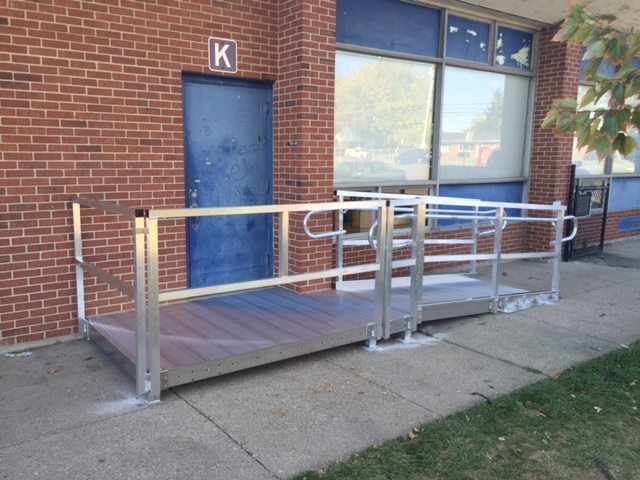
Permanent accessibility ramp with handrails at a school entrance, the standard our trailer ramps match
Four Accessible Units

The ADA fleet: restrooms, showers and the all in one suite.

Every unit below pairs accessibility with capacity (a full ADA suite never travels alone on our trailers). Expand any accordion for the photos, floor plan and the measurements that matter.

ADA Restroom Units 2 units

Wheelchair accessible restroom trailers that pair a full ADA suite with standard stations, so one placement serves the whole crowd.

ADA + 2 Restroom TrailerADA + 2 standard
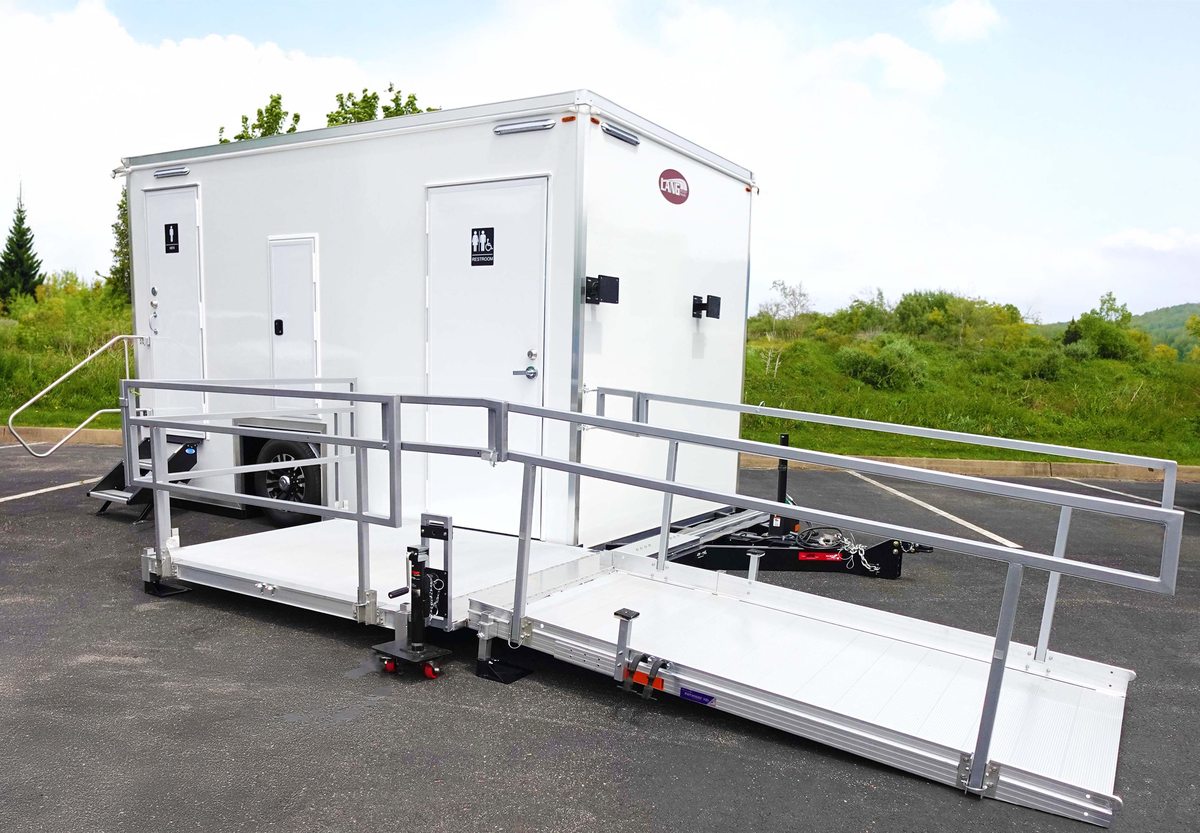
ADA plus two restroom trailer with wheelchair ramp deployed on the entry side
Exterior
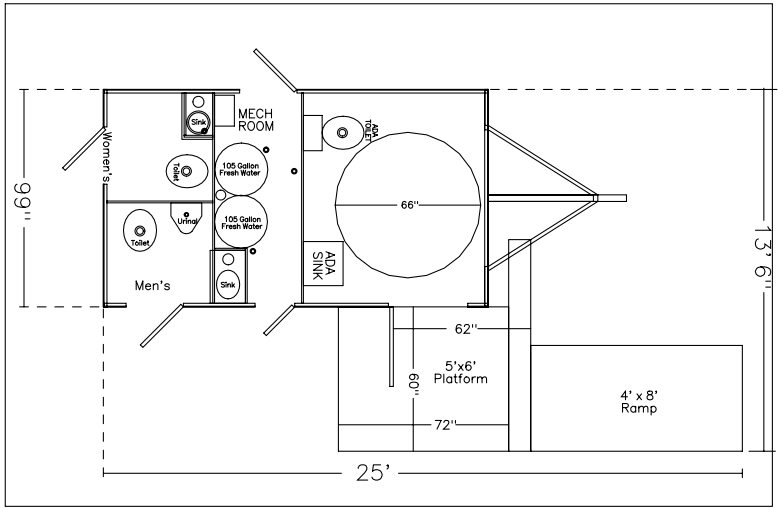
Measurement drawing of the accessible suite turning circle beside two standard stations
Floor plan

The compact answer to an accessibility requirement. One full ADA suite (ramp entry, wide door, interior turning radius, grab bars at every fixture, lowered sink) rides beside two standard restroom stations. So a small event or campus placement passes inspection and serves general traffic with a single trailer and a single power drop. Our drivers install the ramp, verify the landing and photograph the setup for your records. And when the fire marshal or the district risk manager walks the site, the paperwork is already in your inbox. It's the unit we send when someone calls two weeks before an event with the words "we just found out we need ADA." Happens every season. We've made it a painless phone call. Two weeks is comfortable, one week is routine, and we've turned a Friday call into a Saturday setup more times than the schedule board likes to admit. Late is only a problem if you spend another day deciding. Our record on a private event stands at 26 hours between first call and finished ramp install, set during a wedding week nobody involved will forget.

StationsWomen's: 1 · Men's: 1 · ADA Unisex: 1
Box Size8' 4" x 14' 7"
Length w/ Ramp25'
Width w/ Ramp13' 6"
Height w/ AC12' 6"
Fresh Water210 gal
Waste Tank300 gal
PowerTwo dedicated 120V-20 amp circuits
AC Units1
ADA + 6 Private Restroom TrailerADA + 6 standard
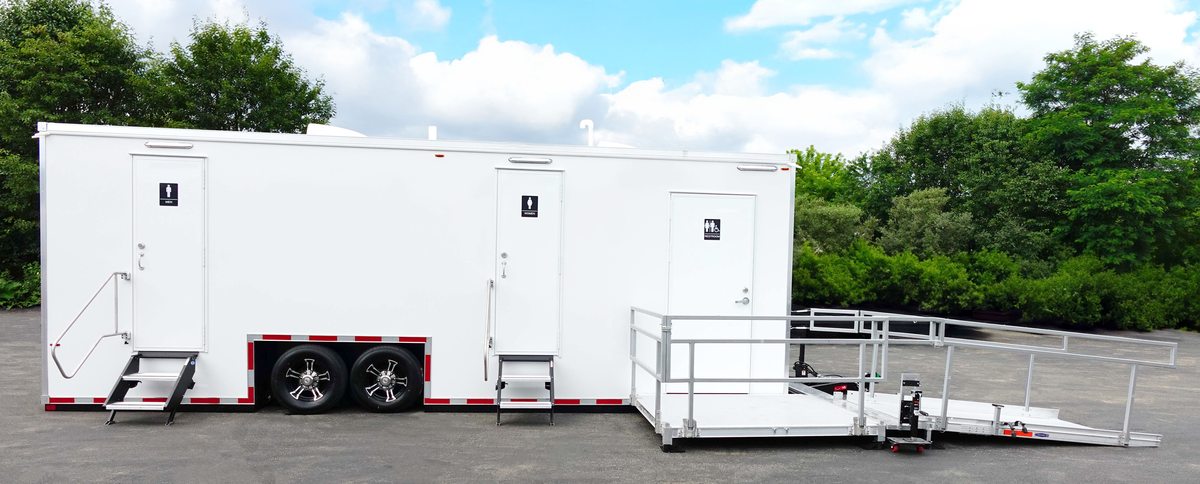
Six station accessible bathroom trailer rental with ramp system and standard doors down the side
Exterior
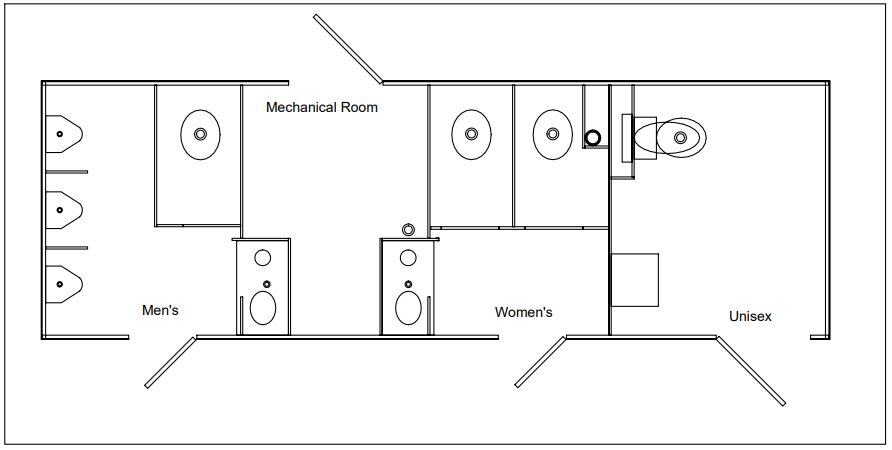
Floor layout locating the full ADA room at one end of the six standard private stations
Floor plan

Our highest capacity accessible bathroom trailer. Six standard private stations carry the crowd, and the seventh suite is a genuine ADA room, not a squeeze: full turning circle, grab bars, lowered fixtures and its own climate control. County fairs, graduations and municipal events run this unit as their complete restroom plan, because it answers volume and accessibility in one footprint. Inspectors count stations and check clearances on public sites (they measure, so we build to the measurement, not the vibe). The compliance documentation travels with the rental. But the thing clients mention afterward is simpler: nobody waited long, and everybody had a door they could use. That combination is rarer than it sounds. Volume units without accessibility strand people, and lone accessible units without capacity create lines. Seven doors on one chassis solves both at once, which is why this trailer books solid through fair season.

Stations7 total: 4 Men, 2 Women, 1 ADA Unisex
Box Size25' x 8' 4"
Length w/ Ramp31'
Width w/ Ramp13' 6"
Fresh Water200 gal
Waste Tank475 gal
PowerTwo 120V-20 amp circuits OR one 50-amp California twist lock
AC Units2

ADA Shower and Combo Units 2 units

Accessible bathing, because ADA coverage doesn't stop at the restroom door on sites where people sleep.

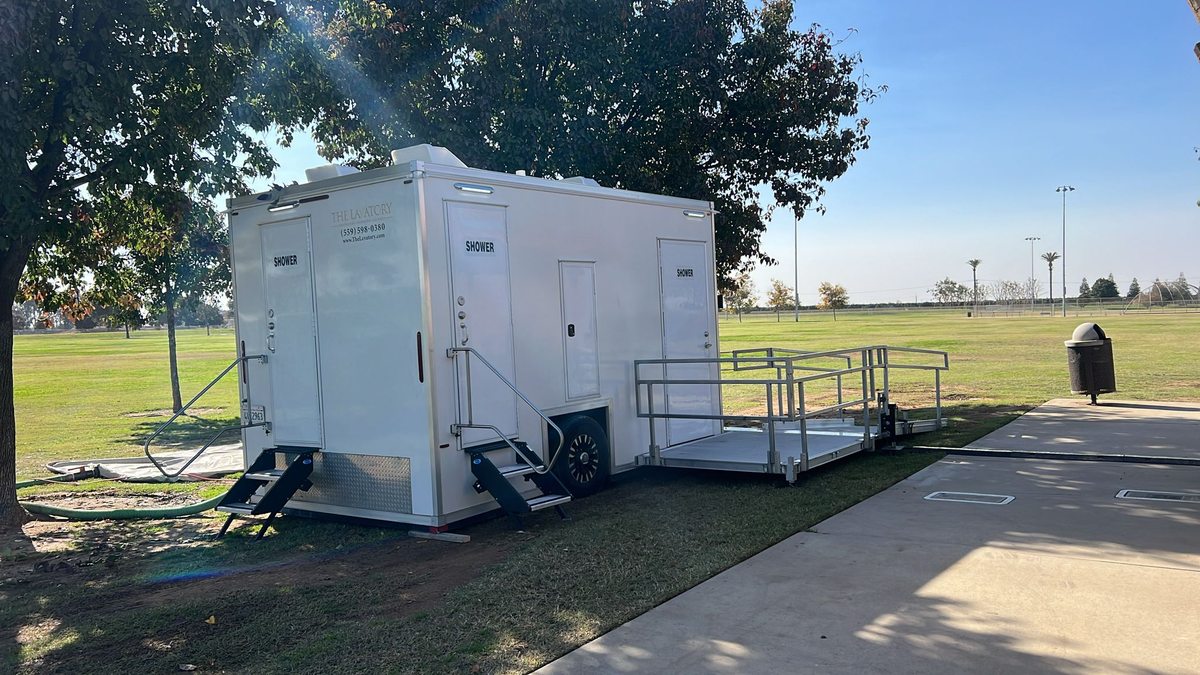
ADA + 2 Private Shower TrailerADA + 2 shower stalls
Roll in ADA shower trailer with ramp entry and two conventional stall doors
Exterior
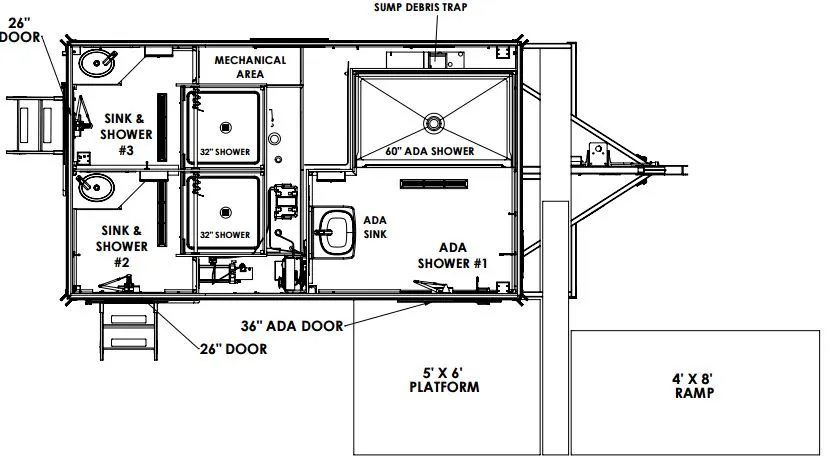
Diagram of the zero threshold shower suite, fold down seat and twin standard stalls
Floor plan

A roll in shower suite built for actual wheelchair use: zero threshold entry, fold down seat rated for real weight, grab bars through the wet area and a handheld fixture at seated height. Two standard private stalls share the chassis, which keeps the accessible suite free for the people who need it. Shelters and workforce camps book this unit whenever the population includes anyone with mobility needs, and public agencies book it because their sites get audited. One water line, one circuit, one ramp we install ourselves. The suite works the first time because we test it with the ramp deployed, not from the parking lot.

Stations2 unisex shower stations + 1 ADA unisex shower
Box Size8' 5" x 14.5'
Length w/ Ramp25'
Width w/ Stairs13' 6"
Height w/ AC12' 2"
Fresh Water105 gal
Waste Tank300 gal
PowerTwo dedicated 120V-20 amp circuits
AC Units1
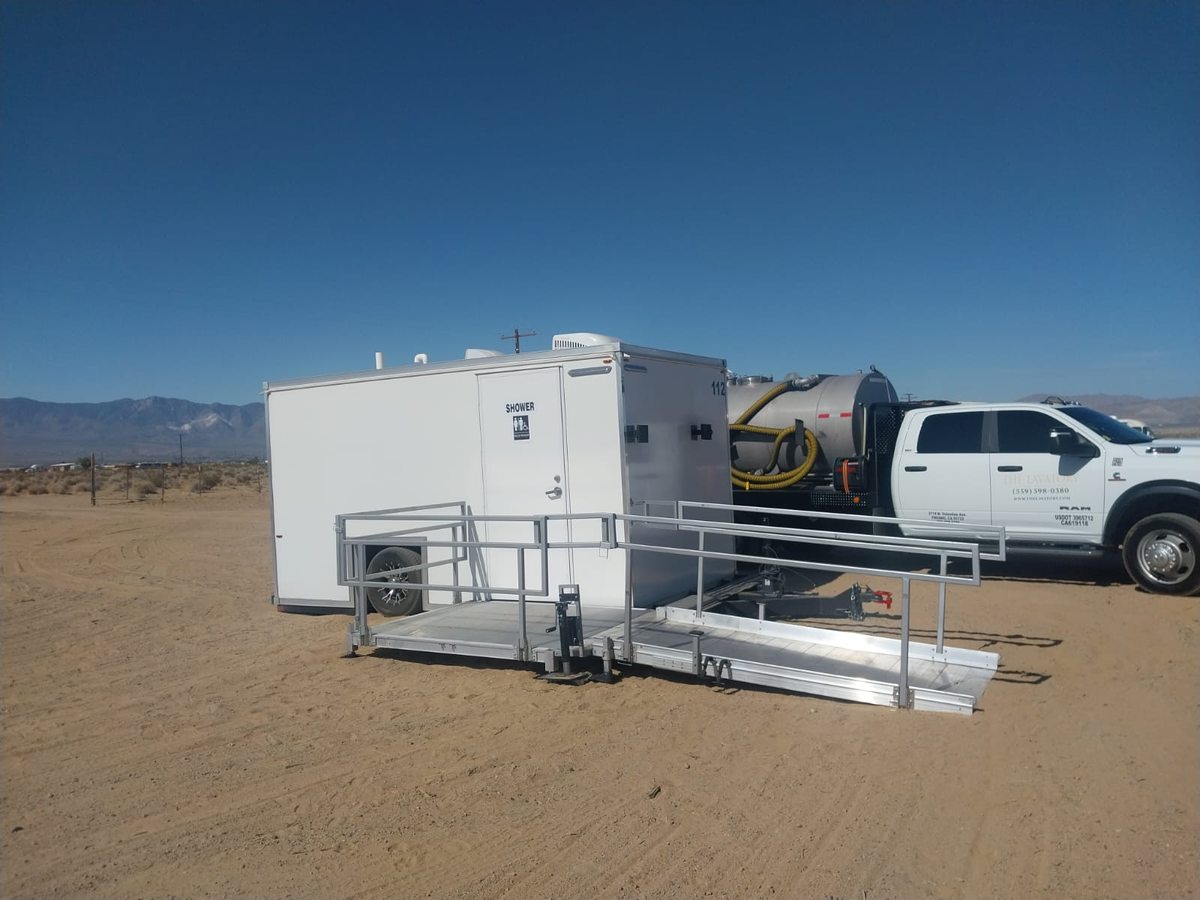
Single Station ADA Shower & Restroom ComboAll in one ADA suite
Single ramped suite combining wheelchair accessible shower, toilet and sink in one trailer
Exterior
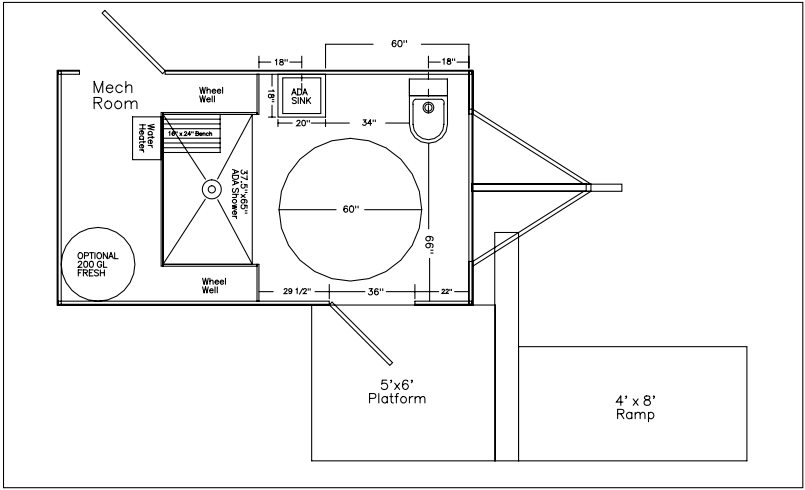
All in one accessible suite plan showing fixture spacing and grab bar runs
Floor plan

Everything behind one ramped door: an accessible shower you can wheel straight into, plus commode and sink in a single suite. This is the unit for sites that need one complete ADA hygiene point (workforce housing, shelters, long term projects) without dedicating two placements to get it. It draws like a small restroom trailer, drops into an existing utility plan without drama, and our service crews handle the greywater completely. Shelter operators tend to position it near medical or intake. Camp bosses put it close to the accessible sleeping quarters. Either way, the resident who needs it never has to ask twice.

Stations1 combined shower + toilet ADA room
Box Size8' 5" x 14.5'
Length w/ Ramp25'
Width w/ Ramp13' 6"
Fresh Water105 gal
Waste Tank300 gal
PowerTwo dedicated 120V-20 amp circuits
AC Units1
Pass The Inspection

What inspectors check on accessible units, and how we pre answer it.

"Assume the inspector was burned last month by somebody else's trailer," our operations lead tells new dispatchers, and it's the right posture. Here's the review, item by item.

The route, before the unit

Most failures happen before the ramp: gravel between parking and the trailer, a curb with no cut, a slope nobody measured. We review the accessible route on your site plan first, because a compliant trailer at the end of a non compliant path still fails. Curb cuts, cross slopes, surface firmness and lighting all count. Our dispatchers keep a nine point route checklist taped to the monitor, and it catches something on roughly every third plan we receive. The catch costs nothing before delivery. After delivery it costs a crane, a reschedule or an apology, and we prefer selling none of those.

Ramp slope and landing

Slope ratios and landing dimensions get measured, not eyeballed. Our drivers carry the setup standard and anchor every ramp to it. The placement photo record we take at install has settled more than one dispute without anyone driving back to the site. Time stamped, geotagged and filed the same afternoon. When a complaint reached one county client months later, their entire response was our four photos and a spec sheet. Case closed by email.

Inside the suite

Turning circle, transfer space at the toilet, grab bar heights, sink knee clearance, reachable controls. These are built into the unit, which is the point: the trailer passes because it was manufactured to pass, not adjusted on delivery morning.

The paperwork

Spec sheets with measurements, insurance certificates and the install record, formatted for your permit file or submittal package. On SAM.gov federal work and school district contracts, this folder is often the entire difference between a same week approval and a resubmittal cycle. Reviewers reward completeness. So we ship complete, every time, and let the folder do the talking.

Placement Guidance

Where accessible units go, by site type.

Events and fairs

On the accessible route near the main restroom bank, never off in a corner by itself. One ADA unit per cluster. That keeps travel distances legal, and more to the point, humane.

Campuses

Between the affected building and the accessible parking, with service timed before first bell so students never meet a pump truck. Badged, background checked crews come standard on district sites.

Shelters

Near intake and medical, with a lit, level path. ADA units ride the first delivery wave because shelter populations need them from hour one.

Construction and municipal

Beside the site office where the ground stays graded. City contracts increasingly write ADA sanitation into day one requirements, and we quote it that way.

Workforce camps

Adjacent to accessible sleeping quarters, doors facing the path. The combo suite covers restroom and bathing in one stop.

Anywhere off grid

Tanks, water delivery and generators keep accessible facilities running where nothing else exists. Remote doesn't suspend the requirement.

Event Day, Hour By Hour

How the accessible unit earns its keep at a county fair, timed from gates to close.

Gates open at 10 a.m. and the first wheelchair user reaches the accessible suite at 10:20, before the food row even has lines. Mid morning belongs to strollers and grandparents, the population planners undercount every single year. The ramp sees more walker and rollator traffic than wheelchair traffic by noon, which surprises first time event staff and surprises exactly zero access coordinators anywhere in the country. Accessibility serves a far wider crowd than the symbol on the door suggests, and fairs prove it by lunch. Early afternoon brings the service animal handlers, who need the interior turning room as much as anyone on wheels does, plus a floor their dog's paws can trust.

The crush lands between 4 and 7 p.m., when attendance peaks and the suite cycles continuously. This is the stretch that punishes bargain equipment. A grab bar that wiggles under real weight. A door closer that fights a weak grip until someone gives up and asks a stranger for help, which is its own quiet indignity. A threshold lip that catches a caster at exactly the wrong angle. Ours holds because our techs torque tested all of it at delivery. By the 9 p.m. fireworks, the suite has served a few hundred guests across every mobility profile the county owns, and the fair board's ADA file has a one page equipment record for the year instead of a complaint letter. One fairgrounds manager renewed for the following season by text message during the fireworks themselves. We saved the screenshot.

The Numbers

The measurements behind the word "accessible."

You don't have to memorize these (that's our job), but seeing them explains why a genuine ADA suite can't be improvised from a standard stall and a grab bar from the hardware store. The dimensions below are the ones our units are manufactured around and the ones review checklists actually cite.

Doorway and approach

A 32 inch minimum clear opening at full swing. Level maneuvering space on both sides. Our suite doors clear it with margin, because a wheelchair footrest doesn't negotiate with a doorframe. The approach path itself needs 36 inches of clear width the whole way there.

Turning and transfer space

A 60 inch turning circle inside the suite, plus clear transfer space beside the toilet. This is the requirement that kills most "accessible" retrofits: you can bolt on grab bars anywhere, but you can't bolt on floor area. Our ADA rooms are framed at manufacture around that circle.

Fixtures and reach

Toilet seat height in the 17 to 19 inch band, grab bars mounted 33 to 36 inches up and rated for 250 pounds of force, sink rim no higher than 34 inches with knee clearance beneath, and controls operable with one closed fist. Details, yes. Also the entire point.

Ramps, done right

Slope no steeper than 1:12 (one inch of rise per foot of run), with landings top and bottom and edge protection on the way up. Our drivers carry the ratio and anchor to it. A steeper ramp just becomes a barrier with extra steps, and inspectors treat it that way.

And one number people rarely quote: 61 million American adults live with a disability, per CDC figures. On a 3,000 person event day, statistics says hundreds of your guests benefit from that suite. It won't sit empty (it never does). Parents with strollers use it, older guests prefer it, and the runner who twisted an ankle at your 10K will be genuinely grateful for it. Accessible design serves far more people than the requirement that created it. That's the best argument for it we know.

From The Field

The graduation that almost wasn't.

A district facilities office called us on a Tuesday in May. Their stadium restroom renovation had slipped past graduation weekend, 4,000 guests were coming, and the fire marshal's walkthrough was Friday morning. The question wasn't really about trailers. It was "can we still hold this thing?"

We quoted the ADA + 6 plus two standard 9 station trailers that afternoon, placed everything Thursday, and our driver photographed the ramp install with the marshal's checklist in mind. Friday's walkthrough took 11 minutes. "The measurements were the fastest part of my morning," the marshal told the facilities director, who repeated it to our dispatcher, who has repeated it in every training since.

Graduation happened. Nobody in the bleachers knew there'd ever been a problem, which is exactly the standard: accessibility that works so smoothly it's invisible. That's what you're actually renting.

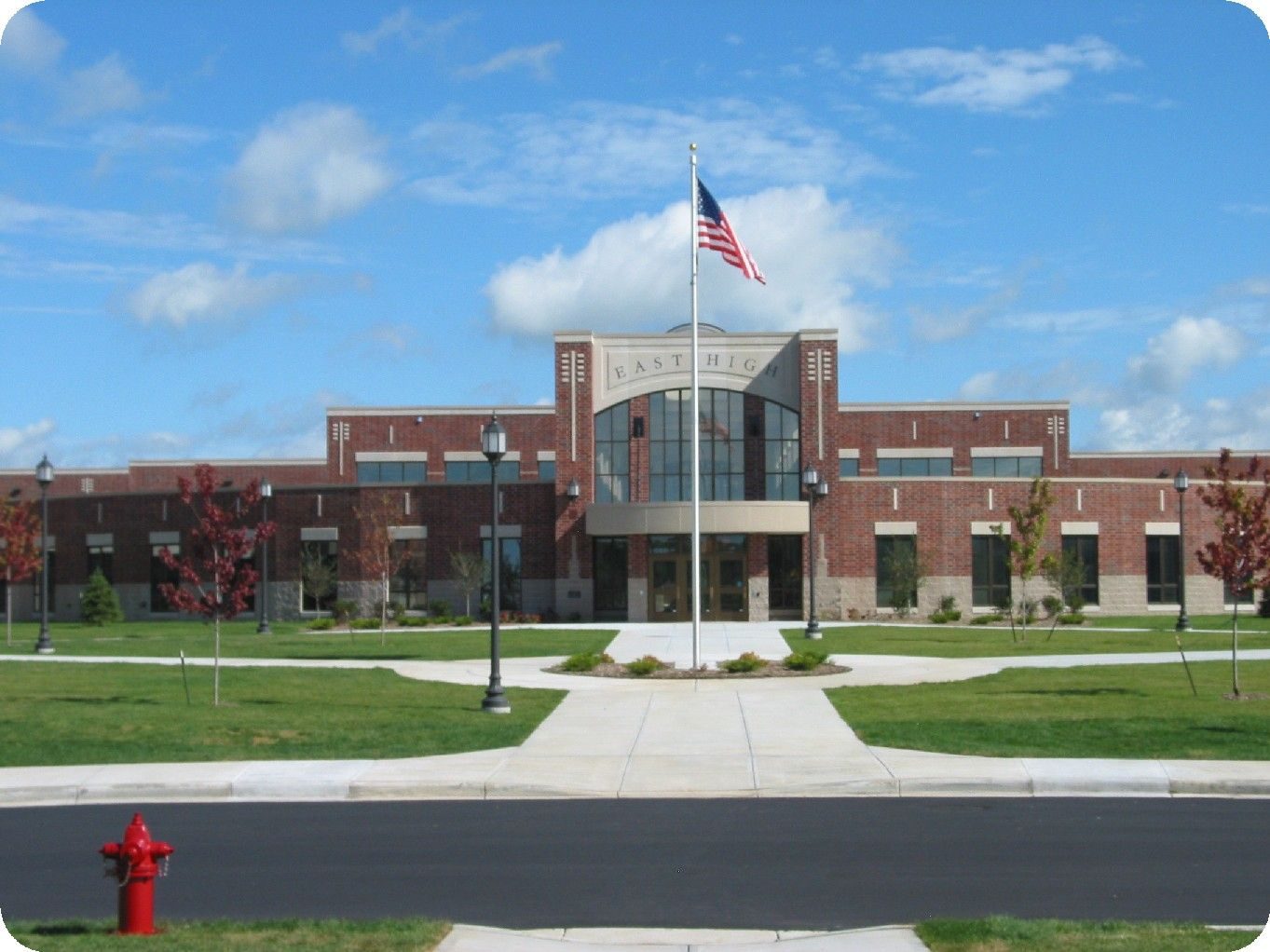
School campus on event day, the setting where accessible restroom planning gets tested for real
Beyond The Checkbox

Why agencies keep an ADA vendor on speed dial.

"Accessibility complaints don't arrive politely," a county risk manager told our operations lead once, and she wasn't wrong. Here's what the agencies who rent from us repeatedly have figured out.

Complaints are expensive

An accessibility grievance on a public event can mean formal review, remediation orders and a news cycle. One properly placed unit costs less than one afternoon of any of that.

Retrofits fail audits

Improvised fixes (a borrowed ramp, a widened stall) photograph badly and measure worse. Manufactured ADA suites pass because the compliance is structural, not decorative.

Documentation wins disputes

Our install photo record plus spec sheets have closed complaint files without a site visit. Paper beats memory, every time it's tried.

First wave, not afterthought

Emergency operations that stage ADA units in the opening convoy never have to explain a gap. The ones that don't, do. FEMA supported shelters taught everyone this lesson at least once.

Residents remember

Shelters and camps that serve mobility needs well are the ones people describe as "run right." Word travels through agencies faster than any capability statement we could write.

One vendor, whole answer

Unit, ramp, route review, paperwork and service on one contract. Splitting those across five vendors is how gaps get born. And gaps are the entire problem we're hired to delete.

By Sector

Accessible trailer rentals, sector by sector.

We keep notes on what each buyer type needs, because the requirements rhyme but never repeat. "Same suite, different paperwork," as our dispatcher puts it. Here's the field guide we work from.

Schools and universities

We schedule around bells and games, badge every crew member, and put the unit on the accessible route between buildings. Districts audit hard (we've sat through those audits), so the measurement documentation goes in before anyone asks. Graduation season books out weeks ahead, and we tell you that honestly in March, not May. Fall sports season runs a close second on the campus calendar, with homecoming weekends pulling the same crowds and the same accessibility review, so athletic directors who book both seasons at once get first pick of the fleet.

County fairs and public events

The 5 percent station rule, per cluster coverage and travel distance limits all get counted against your map by us. Fair boards that got flagged once tend to become our longest running clients, which says something about how much fun a flag is. Multi weekend runs get mid run service resets too, so weekend three looks like weekend one even after the livestock show did its worst.

Emergency management

ADA units ride the first convoy to every shelter we support. We've staged them ahead of hurricane landfall on FEMA supported operations, because a shelter that opens without accessible facilities has opened with a countdown attached. Our dispatchers plan them like generators: non negotiable, first out."

Municipal and federal projects

City halls, courthouses, parks departments and SAM.gov federal sites write accessibility into the contract line items. We quote it that way, deliver the compliance folder with the trailer, and keep service records that survive a public records request. Boring on purpose. Boring passes audits, renews contracts and keeps procurement officers coming back.

Construction programs

OSHA governs the jobsite, but the public edge of a project (sidewalk closures, community open houses, sales trailers) pulls ADA requirements in fast. Supers who've been caught out once add the accessible unit on day one the next time. We keep a few staged for exactly that phone call, and the supers who make it once tend to write us into the next bid's general conditions by name.

Workforce housing

Camps hire who they hire, and mobility needs show up without warning. A veteran welder with a knee that finally quit. A supervisor back from surgery three weeks early because the project needed her. The single station combo drops into an existing camp inside a week, serves restroom and bathing in one placement, and quietly solves what could have been a personnel crisis. We've watched that exact story more than a dozen times. The ending never varies much either: the worker keeps the job, and the phone call that made it possible took about ten minutes.

Whatever your sector, the pattern holds: we handle the measurements, the ramps, the route and the records, and you handle everything else your event or mission demands. That trade has worked out for every client on this page, and we'll put you on the phone with any of them.

Working With Access Coordinators

The professionals who grade us hardest, and how we've earned their shortlist.

Universities, big events and public agencies increasingly employ dedicated access coordinators, and they review equipment the way a building inspector reviews framing: with a tape measure, a checklist and no interest whatsoever in the brochure. We enjoy those reviews now, mostly because we've absorbed a decade of their feedback into the fleet. Coordinators taught us that ramp placement matters as much as ramp specs, since a perfectly compliant ramp aimed into a mulch bed helps precisely nobody. They also taught us to think in travel chains: the parking space, the path, the ramp and the doorway all have to work as one route, because the weakest segment decides whether the whole thing counts. They taught us that signage height and wayfinding from the parking area belong in the site plan, not as afterthoughts. And they taught us to document slope readings at installation, because the coordinator's own report needs numbers, not assurances.

The working relationship now runs both directions. Coordinators send us site drawings before their events, and we return placement recommendations with the measurements already annotated. Several keep our layout drawings on file year over year and simply update dates. "You're the vendor I don't have to educate," one university coordinator told our dispatcher, which might be the highest compliment this niche awards. Their students, guests and staff never learn any of this happened. That's the entire point of doing it well.

Seventy Two Hours

An ADA placement, told as a timeline.

Most accessible rentals follow the same 72 hour arc once the site plan lands in our inbox. Here's that arc, hour by hour, because knowing the rhythm makes your side of it easy.

Hour zero: the plan lands

You send the site plan (a napkin sketch works, we've built from worse). Our dispatcher marks the accessible route, flags any curb, slope or soft ground problem, and picks the unit: ADA + 2 for coverage, ADA + 6 for volume, shower or combo where people sleep on site. You get the markup back the same day with a quote attached.

Hour 24: paperwork moves

Insurance certificates go to your permit file or GC submittal packet. Spec sheets with the accessibility measurements ride along. District jobs trigger the crew badging process now, not on delivery morning. If your reviewer has questions, they call our line directly and skip you as the middleman entirely.

Hour 48: the unit ships

The trailer leaves the yard cleaned, stocked and function tested, with the ramp kit loaded for your specific approach side. Our driver has the marked site plan in the cab. Weather watch starts now too, because a ramp landing that was firm on Tuesday can be mud by Thursday, and we'd rather bring plate than excuses.

Hour 72: set, proven, photographed

Set and level, ramp deployed and anchored, suite walked with the door swung and the turning circle clear. The driver photographs the finished installation (those photos have ended more than one dispute by themselves) and the record lands in your inbox before the truck clears the gate. From there it's just service cadence until the mission ends.

Emergencies compress that arc to hours, and we've run the whole sequence between a morning activation call and a sundown shelter opening. The steps don't change. They just happen faster, with more coffee. One more habit worth knowing about: after every emergency placement, our dispatcher schedules a 48 hour follow up call to catch anything the rush obscured. A loose ramp anchor, a route that turned to mud, a resident count that doubled. Emergencies evolve, and the follow up call is how the accessible coverage evolves with them instead of behind them.

Cold Mornings, Hot Afternoons

Accessibility doesn't take weather off. Neither does the equipment.

Weather stresses accessible units differently than standard ones, and the differences matter to the people using them. A ramp with morning frost on it is a hazard for everyone but a hard stop for someone using a cane. So cold season deployments get traction surfacing checked at every service visit and de icing added to the schedule whenever the overnight forecast dips near freezing, without waiting for anyone to ask. Interior heat holds steady at a real temperature because a user who transfers slowly spends twice the minutes inside that a walking guest does, and a cold suite punishes exactly the person the unit exists to serve.

Summer flips the problem. That same longer dwell time makes air conditioning a genuine accessibility feature rather than a comfort line item, and our AC capacity is specced with it in mind. Shade placement matters, and so does orienting the door side away from the brutal afternoon sun. A drinking water point within a short roll rounds out the trio of site plan details we raise during every summer booking conversation, because heat stress hits mobility limited guests earlier and harder. None of this appears in the ADA standards as a numbered requirement. All of it appears in how a thoughtful deployment actually treats people, and the difference is visible from the first hot Saturday.

Signed Off

Four verdicts on accessible deployments.

Brett M., County events coordinator
Brett M.County events coordinator
★★★★★

Our fair got flagged on accessibility two years running before we switched vendors. First year with their ADA + 6? The inspector walked it, took two photos and signed off on the spot. And the ramp was already installed and anchored before I even got to the site that morning.

Ximena A., Disability services director
Ximena A.Disability services director
★★★★★

I test accessible facilities for a living, skeptically. The roll in shower actually rolls in: no lip, seat at the right height, controls reachable. Whoever specs their units has clearly watched a real person use one.

Nilson V., General contractor, public works
Nilson V.General contractor, public works
★★★★★

City contract required ADA sanitation from day one. Their documentation packet went straight into our submittals without a single RFI coming back. On a municipal job, that alone is worth the phone call.

Reina M., Emergency shelter operations
Reina M.Emergency shelter operations
★★★★★

We activated a shelter in nine hours and the ADA combo was there before the cots were. Residents with walkers and chairs had full facilities from night one. That's the difference between sheltering most people and sheltering everyone, and it's not a small one.

The Fine Print, Answered

ADA trailer rental questions we hear weekly.

Can I combine ADA units with your standard trailers?
That's the normal pattern. Most sites run standard restroom or shower trailers for volume plus one or two ADA units for coverage, all on one contract and one service schedule. The section above shows which combinations we quote most.
Who ends up renting ADA trailers most?
Public agencies, school districts, county fairs, municipal projects and emergency operations lead the list, because their sites carry legal accessibility obligations. But private events book them too, and the honest reason is simpler than compliance: guests remember being accommodated. A wedding with a grandmother in a wheelchair books the ADA unit for one person, and that one person's evening is the review the client writes afterward. We've read those reviews. They mention the ramp more than the food.
What makes a restroom trailer actually ADA compliant?
The real checklist: ramp access at the right slope, a 32 inch clear door, a five foot turning circle inside, grab bars at the fixtures, a lowered sink with knee clearance and reachable controls. Our ADA suites are built to those measurements, and we hand you documentation that says so. Plenty of units on the market call themselves accessible. Inspectors carry tape measures. If you've been burned by a unit that looked right and measured wrong, you already know why we lead with the numbers, and why your documentation packet includes them before anyone asks.
How many ADA stations does my event need?
The working standard: at least 5 percent of total portable stations, minimum one, on the accessible route. A 400 guest event with five standard stations needs one ADA unit. Big festivals need one per cluster. We'll count it against your site plan so the permit reviewer doesn't have to. And if your event spans multiple zones (a fairground with separate midway and grandstand clusters, say), each zone gets its own accessible coverage so no guest crosses the property to find a usable door.
Do you install the ramps?
Always. Our drivers place the trailer, deploy and anchor the ramp on the gentlest approach, and verify the landing. A ramp leaned against a doorway by whoever had a free hand fails inspection and worse, fails the person trying to use it.
Is there an accessible shower option, not just restrooms?
Yes, two. The ADA + 2 shower trailer pairs a roll in suite with standard stalls, and the single station combo puts a roll in shower, toilet and sink behind one ramped entrance. Both were specced around actual wheelchair transfer, seat height and control reach.
What documentation comes with an ADA rental?
Unit specifications with the accessibility measurements, insurance certificates and a placement photo record after setup. Districts, cities and federal sites each want it filed differently, and we've built the folder for all three enough times that yours already exists as a template. Ask for it early if your permit timeline is tight. Reviewers move faster when the accessibility exhibit shows up complete on the first submission, and more than one of our clients has watched a three week approval shrink to four days on the strength of a tidy folder.
Can ADA units run off grid like the standard fleet?
Completely. Onboard tanks, water delivery and generator packages work identically. Accessibility requirements don't pause because the site has no hookups, and neither do we. Your remote placement gets the same suite, the same ramp standard and the same service cadence as a unit parked next to a city water main.
Where should the ADA unit sit on my site plan?
On the accessible route, with a firm level approach and no stairs, curbs or soft ground between parking (or the shelter floor) and the ramp. Send us the site plan and we'll mark the spot. It's a five minute review that prevents the most common inspection failure we see, which has nothing to do with the trailer and everything to do with the 40 feet of gravel in front of it. We look at the whole path, because your guest in a chair will.
Do schools and universities have extra requirements?
Usually the requirements are about people, not units: background checked crews, badging, service scheduled outside school hours. We run all three as standard on campus placements, and the ADA unit goes on the accessible route between buildings, not wherever the truck found shade.
How fast can an accessible unit arrive in an emergency?
Same as the rest of the fleet: the line answers 24/7, and on declared incidents ADA units ride in the first wave, not the second. Shelter populations include people with mobility needs from hour one. Planning otherwise is planning to apologize. Our emergency staging keeps accessible units positioned regionally during hurricane and fire season for exactly this reason, and the dispatcher who takes your 2 a.m. call already knows which one is closest.
Plain Talk

Three things we tell every first time ADA renter.

"Book the route, not just the unit."

Our dispatch lead says this on nearly every scoping call, and it earns its repetition. The trailer is the easy half. The 60 feet between accessible parking and the ramp decides whether the placement works, so send the site plan and let us walk the path on paper first. Five minutes of route review has saved clients entire re inspections.

"If someone might sleep there, add bathing."

Restroom coverage feels complete until the first overnight guest with mobility needs asks about a shower. Shelters, camps and multi day operations should quote the roll in shower or the combo suite up front. Adding it later works too (we've done same week additions), but planning it first costs nothing and apologizes to no one.

"Keep the photos."

Our drivers photograph every finished installation, and that record has ended disputes, satisfied auditors and once settled an insurance question eight months after the trailer went home. File the pictures with your event records. You'll probably never need them. The one time you do, they're priceless, and they were free.

That's the whole philosophy, really. We treat accessibility like the load bearing part of the site plan it actually is, and we've built the fleet, the process and the paperwork so you can treat it as one solved line item. Everything else on your list is harder than this one. Let us prove it.

Get Covered

Send the site plan. We'll mark the ADA placements.

Accessibility review is free with every quote, and emergency requests move immediately. One call covers the unit, the ramp, the route and the paperwork.

Request Services Call (855) 687-1887