How to plan water station placement on a large Oahu base or training area
A big installation is not one site. It is dozens of small ones, spread across flight lines, piers, motor pools, ranges and assembly areas, each with its own schedule and its own gate. A water plan that treats the entire base as a single delivery address will leave some crews walking a long way for a drink.
Start with a map of where people actually stop. Mark the locations where crews take breaks, eat meals, gather for briefings and wait for transportation. Those are the places a water station earns its keep, and they are rarely the locations that are most convenient for a delivery truck to reach.
Then match the number of trailers to the spread, not just the head count. Two hundred people in one assembly area can share fewer stations than two hundred people split across four ranges. When the distance between work areas is more than a short walk, plan a unit for each area rather than one large central setup.
Get the access paperwork moving early. Installations want driver names, vehicle plates and delivery times ahead of the first visit, and some areas require an escort. Ask your security office what it needs from the vendor, and send it the same week you sign the order. A truck held at the gate is a crew without water.
Plan around closures. Ranges close for live fire, flight lines close for operations, and piers close for ship movements. Share those closure windows with your vendor, so fills happen before or after a closure rather than in the middle of one. Early morning service, before the first training block, usually works best on an active installation.
Choose the ground carefully. Windward areas can stay saturated for days after heavy rain, and a loaded water tank can gradually sink into soft soil. Select a gravel pad or a paved edge whenever possible, and keep a clear path for the service truck to back in and pull out.
Decide how units will move. Exercises shift from one training area to another, and construction phases move across the installation over time. Agree up front on how much notice the vendor needs to relocate a trailer, and identify who on your side can request the move.
Keep the records with the unit. A service log that stays on the trailer lets a safety officer, a range officer or an inspector review fills and cleanings without tracking anyone down. Request a monthly copy for your own safety files as well.
Think about the busiest hours. Water demand spikes at the end of a physical training block, after a long stretch on the flight line and at lunchtime. If two hundred people arrive at a single trailer at the same moment, the line grows quickly. Spreading units out, or adding a second trailer at the busiest location, keeps breaks reasonably short.
Remember the contractors. Many base projects bring civilian construction crews onto the installation for months at a time, and they need water just as much as service members do. Their sites often sit far from any building, so plan their trailers into the same placement map rather than handling them as an afterthought.
Call us with a rough map, the head count and the dates, and we will lay out a placement plan for your installation before the first delivery.
What to ask before you trust a drinking water source after an Oahu water advisory
Not every water advisory means the same thing, and the difference matters. A boil water notice usually means the water may carry germs that boiling will kill. A do not drink notice is more serious. It often means something is in the water that boiling cannot fix, such as fuel or an industrial chemical. Crew leaders and shelter managers should confirm which notice is in effect before they choose a backup plan.
Once the tap is off limits, you need another source, and not all sources are equal. These are the questions worth asking any vendor who offers to bring drinking water to your site during an advisory.
Where exactly is the water filled? The answer should name a potable source outside the affected area, not just a general location. If the vendor plans to fill from a hydrant down the street, ask whether that hydrant is connected to the same system that is under the notice. Surprisingly often, it is.
What standard does the source meet? Potable water in this country is judged against the EPA's National Primary Drinking Water Regulations or the state's own drinking water rules. A vendor should be able to tell you which public water system supplies the fill.
What touches the water on its way to the bottle? Tanks, hoses, pumps and taps should all be food grade and dedicated to drinking water only. A tank that once hauled anything else should never hold water for people, no matter how thoroughly it was cleaned afterward. Ask how often the lines are sanitized and whether each cleaning is written down with a date.
Is there a written record? A service log with each fill date and each cleaning date lets a safety officer or a health official check the chain without making a phone call. It also protects your organization if someone gets sick and the question of water quality comes up later in an investigation.
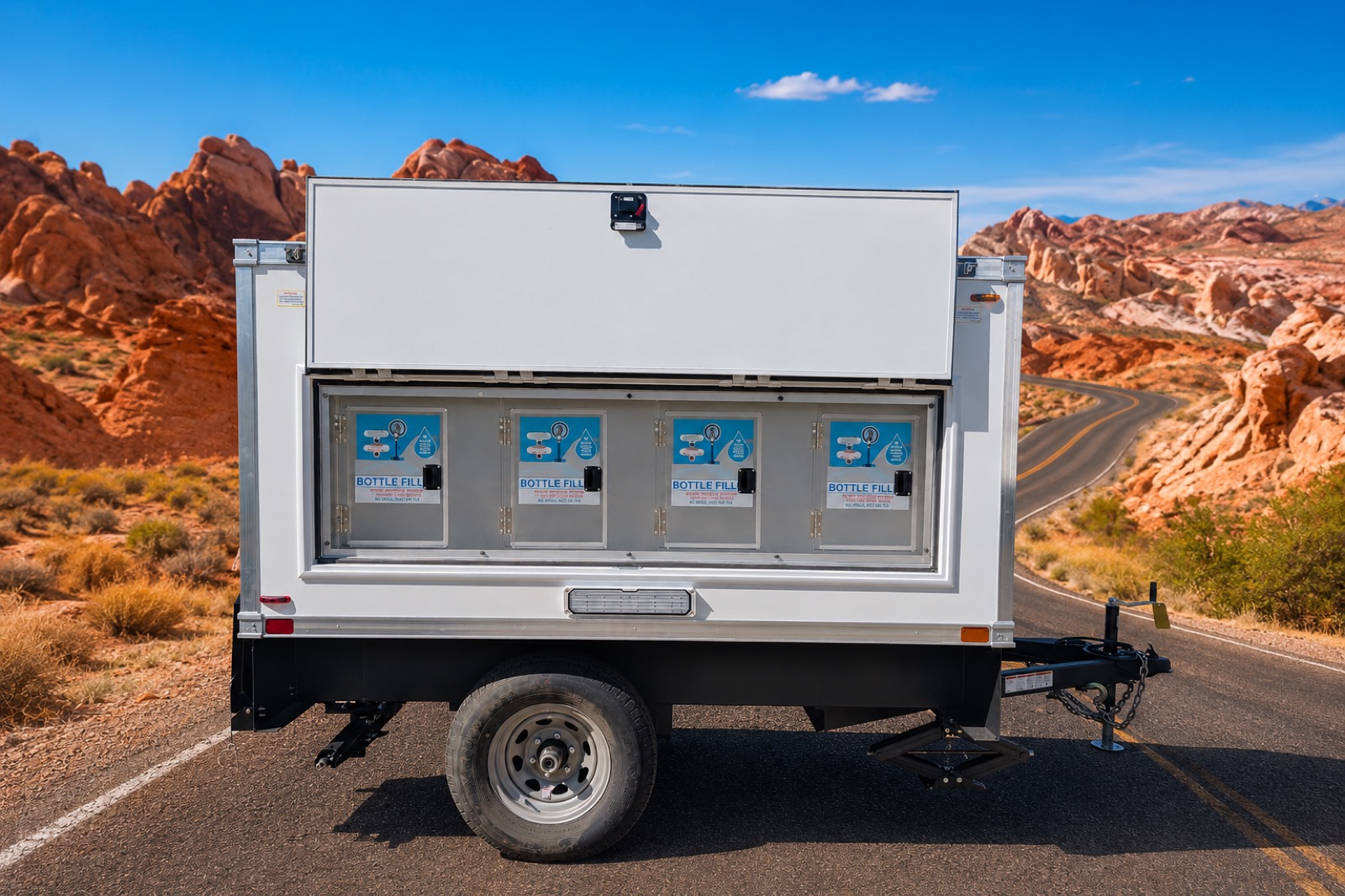
How is the water handed out? Open coolers and shared cups let germs spread quickly in a crowded shelter or a busy camp. Closed taps and bottle-fill stations keep hands out of the supply entirely, and people can refill their own bottles as often as they like throughout the day.
How cold is the water? This sounds like a comfort question, but it is really a safety question. People drink more water when it is cold, and in Oahu's humid heat, a crew that skips water breaks because the supply is warm is a crew heading toward heat exhaustion or something worse.
How long can the vendor keep service going? After a major event, flushing and testing damaged water lines can continue for many months. Ask whether the vendor can maintain service for the entire recovery period, and what happens if your head count grows along the way.
Our trailers are filled only from potable sources, use food-grade tanks and lines, carry an onboard filter and keep a service log on every unit. If your agency needs more detail on a fill, such as the source system, ask for it and we will add it to the log.
Sources: EPA National Primary Drinking Water Regulations
A hurricane season checklist for Oahu agencies that need drinking water on standby
Hawaii hurricane season has a predictable shape. Of the 71 tropical cyclones that have affected the state since 1949, close to half arrived in August, and very few showed up before July. August is the month to watch. That pattern gives emergency managers a clear window to get ready, and the preparation done in May and June largely decides how quickly drinking water reaches shelters in August.
Get the paperwork done first. The slowest part of an emergency order is often the vendor setup, not the truck. Confirm that your water vendor is registered in SAM.gov if federal money may be involved, and get any city or state agreement signed before the season starts. A standing agreement with a clear scope turns an emergency call into a simple order.
Name the sites before the season begins. List the likely shelters, staging areas and distribution points across the island, with street addresses or GPS pins. Walk them in person if you can, and note where a trailer could park on firm ground, where a delivery truck can turn around and where the nearest safe fill point is located.
Plan for road trouble. A strong storm can close coastal roads, flood low-lying intersections and slow traffic across the entire island for several days. Ask your vendor where its units will be positioned during the peak weeks, and which routes it will use to reach the windward side, the North Shore and the Waianae coast if the main highways are blocked.
Think about electricity. A water trailer's cooling unit needs either site power or a generator. After Hurricane Iniki in 1992, some parts of Kauai waited three to four months for power to return. Never assume the grid will be available, and make sure your vendor brings its own generator along with a realistic fuel plan for a long outage.
Set realistic head count numbers. Shelters fill quickly after a major storm, and they tend to fill well beyond the first estimate. Build your plan around a realistic high number for each location, and agree in advance on how quickly the vendor can add a second or third trailer if the count keeps climbing.
Decide who calls whom. Put the vendor's 24/7 number in your emergency operations plan, and name the person on your side who can approve an order at two in the morning. After a storm, many delays come from people waiting for approval, not from the delivery truck.
Line up a backup fill source. A strong storm can knock a water system offline or put it under an official advisory for several days. Ask your vendor which potable sources it can draw from if the nearest system goes down, and how far the service truck would have to travel to reach them.
Do not forget the winter months. Kona storms between October and April can bring days of flooding rain, and they rarely arrive with the long advance warning a hurricane provides. Write your agreement to cover the entire calendar year rather than only the summer, so the same setup works in January.
Practice at least once. A short tabletop exercise in June, with your vendor on the call, will uncover the gaps before a real storm does. HI-EMA's website tracks the state's current recovery programs, including the 2026 hurricanes Lala and Lowell, along with its emergency response structure, and it is a good place to check how the state is organized for the coming season.
Sources: Hawaii Emergency Management Agency (HI-EMA)
Setting up crew drinking water on an occupied Oahu school campus
School construction projects on Oahu rarely happen on an empty campus. Summer school, athletics, meal programs and office staff often keep buildings open while crews work nearby. That creates a simple problem. The crew needs drinking water all day, and the school does not want construction workers in its buildings or on its water lines.
Keep crew water outside the student area. The best location for a water station is inside the construction fence, close to the crew's staging area, with its own truck access from the street. Students and staff should never have to cross the work zone to reach it, and crews should never have to walk into the school to get a drink.
Do not tap campus lines unless the school says yes in writing. Renovation often isolates a wing's plumbing, and the lines that stay live were never sized to serve a crew as well. A self-contained trailer avoids that argument before it starts.
Time deliveries around the school day. Drop-off and pickup hours are the busiest periods on any campus, with buses, parents and crossing guards all competing for space. Ask your vendor to deliver and refill outside those windows and to check in at the front office every time a truck comes through the gate.
Think about heat on hard surfaces. Blacktop, rooftops and concrete courtyards hold heat well into the afternoon, and roofing crews in particular take the worst of it. Position the trailer close to where those workers climb down from the roof, not at the far end of the property behind the dumpsters.
Keep the records together. Ask your vendor for a copy of the service log each month, and file it with the project safety records. Both the school's own staff and the general contractor can point to it later if a question comes up. Hawaii's workplace safety agency, HIOSH, publishes its programs and contacts online if you want to check the details for your project.
Size the water to the crew, not to the campus. A small renovation crew needs far less than a large summer program, and one trailer usually covers it. A bigger job with several trades working at once may need a second unit near a different work area, so the painters are not walking across the entire site to reach the water the roofers use.
Keep the stations clear of dust. Demolition and saw cutting throw fine dust into the air, and a water station parked downwind of a cutting table will collect it on every tap. Place the unit upwind of the dustiest work, and ask your vendor to wipe down the stations on every service visit.
Plan for more than one building. Hawaii's public schools are one statewide district, so a single contract can cover several Oahu campuses in the same complex area. A vendor that can move trailers between sites as the phases shift saves you a second round of purchasing.
Think about the weekend schedule too. Many campus projects add Saturday shifts to stay on schedule before classes resume. Make sure the fill schedule covers those days, and that somebody with a key can open the gate for the service truck.
Finish on time. When the fountains come back online, the trailer should leave that same week. Agree on the pickup trigger at the beginning of the project, either a calendar date or a sign-off from the facilities team, so the unit does not linger on a campus that is getting ready for the first day of school.
Sources: Hawaii Occupational Safety and Health Division (HIOSH)
How Oahu agencies buy water station service, from SAM.gov to the purchase order
Buying drinking water for a crew should be easy. For a public agency, it often is not. The rules for spending public money come first, even in an emergency. Understanding how the purchasing process works on both sides can save days when the need is urgent.
Federal buyers usually need a vendor that is registered in SAM.gov, the System for Award Management. Registration gives the vendor a Unique Entity ID and confirms its basic business details. Mavirus Group is registered. A federal contracting officer can look us up and move ahead without waiting on a new vendor setup.
City and state buyers on Oahu follow their own rules. The City and County of Honolulu runs its own emergency management and public works departments, separate from state agencies such as HI-EMA, the Department of Education and the Department of Transportation. Each has its own purchasing office. Ask early which agency will lead, so the order does not bounce between desks.
Emergency buying works differently. When a disaster is declared, agencies can often use faster emergency purchasing steps. That speed only helps if the vendor is ready. A vendor with insurance papers, tax forms and registration already on file can go from call to delivery much faster.
What goes into a quote? We never publish prices. Every Oahu job has different requirements. The biggest factors are the head count, the length of the job and the refill frequency. Where on the island the site sits also matters, along with the distance to a safe fill point and whether we supply a generator.
Ask for a quote that spells out the service in detail. A good quote lists delivery, setup, the fill schedule, sanitizing, pickup and what happens if you need to add another unit midway through. That service section is what keeps water flowing, and it is exactly the part a thin quote leaves out.
Plan for change orders. Recovery work and training schedules shift constantly. Agree up front on how to add or remove a trailer, extend the rental period or relocate a unit, and decide who in your organization can approve that change. A short list of authorized names saves a long email chain.
Keep one point of contact. When several trailers serve several sites, it helps to have one person on each side who owns the schedule and answers questions from the field. We provide a direct line for that purpose, and our 24/7 emergency number stays open for anything urgent.
Know what the vendor needs from you. To prepare an accurate quote, we need the site address or a GPS pin, the expected head count, the start date and a best estimate of the end date. Any gate, badge or escort requirements help too, especially on military installations and at the airport.
Watch the insurance language. Many agencies require specific coverage and additional insured wording before a vendor's truck can enter a public site. Send those requirements along with the request for a quote, and the certificate can be ready by the time the order is signed.
Call us with the job details, including the site, the dates and the head count, and we will send a clear, itemized quote quickly.
Sources: SAM.gov entity registration