Figuring out how many restroom stations you actually need
The most common rental mistake is guessing at size. Size is the whole game. Order too small and lines back up at every break. Order too big and you pay for stalls that sit empty. Getting it right starts with two numbers: how many people are on site, and how fast they all need to go at once.
Peak load matters more than headcount. A crew of forty that trickles in over a morning needs far less than a crew of forty that all break at the same whistle. Shift changes, meal breaks, and shelter meal lines create short, hard rushes, and the unit has to clear that rush without a wait. When people bunch up, count the peak, not the average.
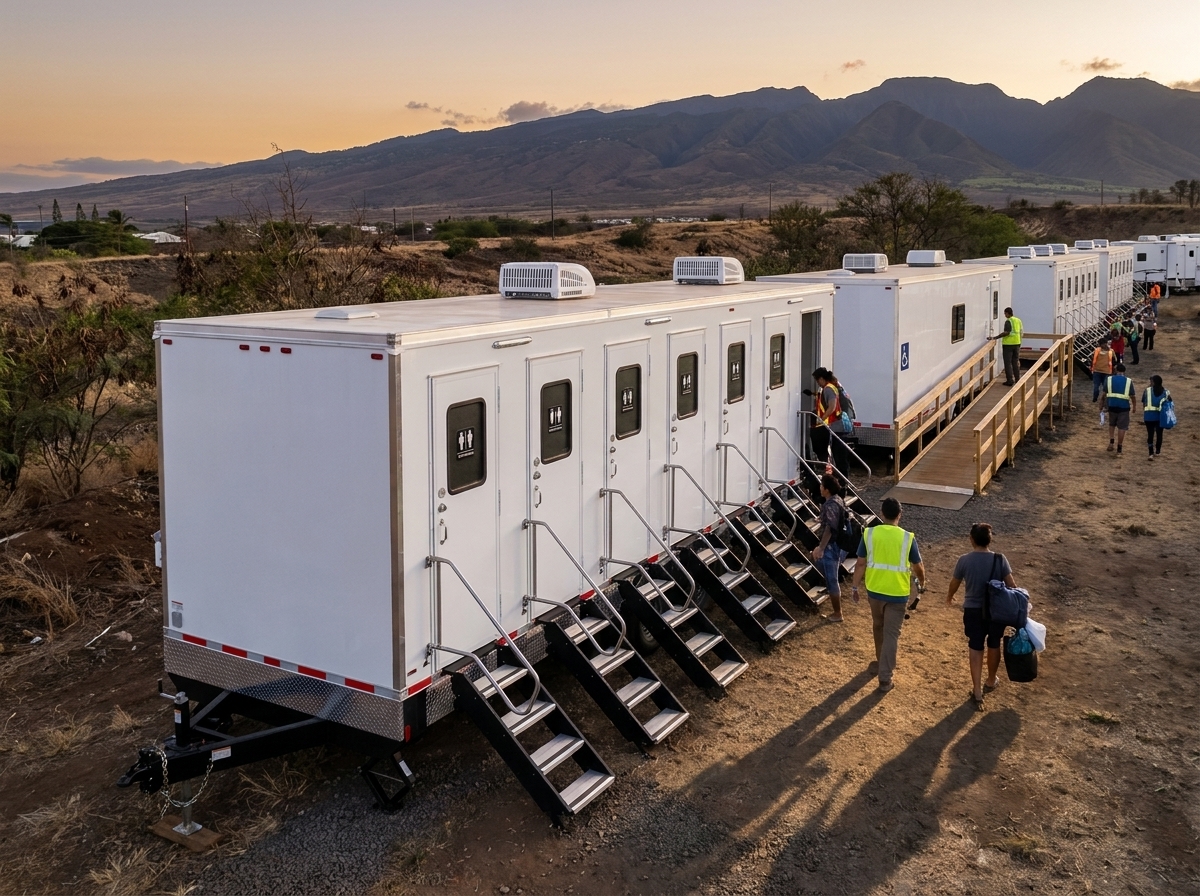
As a rough guide, a single stall carries a small crew through a normal day, while a busy site with steady in-and-out traffic needs more stalls than the raw headcount suggests. A 2-station suite fits a small specialty crew. A larger bank, up to eight stations, fits a full workforce site or a shelter that has to move a crowd through fast. Tell us the peak and we map it to stalls.
The mix of people on site changes the math too. A mixed crowd needs a balanced split, and a public-facing site needs enough stalls that no one waits long in view of guests or residents. For events open to the public, plan for heavier use than a job site. Visitors go more often than workers on the clock.
Always add at least one accessible stall on any public or government site. The ADA + 6 unit builds that in, with a ramped entrance, grab bars, and a roll-in stall next to six private suites. An accessible stall is not extra capacity you can trim. It is required, and it has to be there on day one.
Length of the job shapes the choice as well. A one-day event can run tighter than a months-long build, because a long job has more room for a bad day when one stall is down for service. On a long deployment, a little extra space keeps things smooth while units cycle through daily cleaning.
Combos save room when a crew needs more than a toilet. A restroom and shower combo, or a restroom and laundry combo, puts two functions on one footprint, which helps at a work camp or a long recovery site where space is tight. If your crew lives on site, factor those needs into the sizing, not just toilets.
When in doubt, tell us the peak crowd, the mix of people, and how long the job runs, and we size it for you. It is easier to size up front than to add a unit mid-job. A quick talk about your busiest hour saves money later.
Sources: Hawaii Emergency Management Agency · FEMA Maui Wildfires DR-4724-HI
What to ask before you rent: a checklist
Renting a restroom suite is easy to get wrong if you skip the questions that matter. A few minutes up front, before you sign, saves days of trouble later. Here is what to ask any provider before you book, in plain terms.
First, ask what is actually included. A clean quote covers delivery, setup, daily service, restocking, waste pumping, and pickup in one price. If service or waste handling shows up as a separate line, or an add-on, you can end up managing pieces of the job yourself. One partner, one bill. Aim for that.
Second, ask whether the units are real flushing suites or open portable toilets. For staff, guests, or displaced families, a private flushing suite is a big step up. Look for flushing china toilets, running-water sinks, lighting, fans, and climate control, not a plastic box. And ask to see photos of the exact unit, not a stock image.
Third, ask about hookups. A self-contained unit carries its own fresh water and holds all waste onboard, so it runs with no power or sewer line. Remote parcels, storm-hit sites, it still works. If a provider needs hookups, that limits where they can place a unit and what happens when the utilities go down.
Fourth, ask how often the unit gets serviced. Daily cleaning, restocking, and pumping are what keep a suite usable past the first few days. A unit that gets dropped and forgotten turns bad fast on a busy site. Confirm the service is daily and built into the price, not on-call.
Fifth, ask about accessible units. Any public or government site needs an ADA stall with a ramped entrance, grab bars, and a roll-in threshold, and it has to be there from day one. Ask whether the provider actually stocks ADA units and can place one at your site, not just promise one later.
Sixth, ask how waste is handled. In Hawaii, pumpings have to go to a permitted disposal site, and not every island has one nearby. A good provider handles the pumping and hauling and knows where waste can legally go, so you never have to find disposal yourself.
Seventh, ask about lead time and emergencies. On Oahu a provider can often move fast, but neighbor-island jobs ride on barge schedules, so more notice helps. For a storm or fire, ask whether there is a 24/7 line and how fast a unit can actually reach your island. Last, ask how the number of units flexes as a crew grows or winds down. Clear answers and an all-in price mean you are booking with the right partner.
Sources: US Army Garrison Hawaii · SAM.gov federal contracting
Inter-island delivery and service: how it works
Getting a restroom suite to a neighbor island is a different job from delivering across town, and it helps to know how it works before you book. Between most sites and our yard there is open ocean. So the unit rides a barge, and the barge sets the pace. Here is the path a unit takes from order to on-site.
It starts with the booking. Once we know the island, the site, and the crew size, we pick a sailing that lands the unit before your crew needs it. Barges run on fixed schedules with real cutoffs, so we work backward from the day you need it and reserve space on the right sailing.
Next comes staging on our end. The unit gets cleaned, stocked, and checked, then trucked to the harbor to meet its sailing. Miss a cutoff and delivery can slip several days, so this step runs on a tight clock. We build in a buffer for weather or a full barge, because a slipped sailing should not become your problem.
Then the unit ships. Inter-island freight moves through a regulated carrier, and demand tightens around holidays and after storms, which is exactly when restrooms are needed most. So we watch capacity and book early, so your unit is not bumped when the barge fills. When speed matters, we chase rush freight where it is available.
On the far side, the unit lands and moves to your site. We plan the port pickup and the drive so it does not sit at the harbor waiting on a truck. If the site is on state land, staging can need a permit, and we handle that ahead of time so nothing stalls at the dock.
Setup is the same as any job. We place the unit, level it, and get it running off its own tanks, then walk the site so you know how it works. Because the unit is self-contained, it does not wait on a hookup to go live.
Daily service is where the island part shows up again. Someone has to clean, restock, and pump the unit every day, and on a neighbor island that means a local service route, not a truck sent over from Oahu. We run those routes so the suite stays clean the whole rental, not just the first week.
Waste is its own step out here. Pumpings have to go to a permitted disposal site, and not every island has one close. On a smaller island the nearest legal site can be a barge ride away, so the waste plan and the freight plan get built together. We handle both, so you never chase disposal yourself.
Pickup closes the loop. When the job ends, we reverse the whole path: pull the unit, truck it to the harbor, book the return sailing. Plan the trip out and back, and the final bill holds no surprises.
Sources: Honolulu Authority for Rapid Transportation · Hawaii DOH Wastewater Branch
Setting up a restroom suite on a remote or off-grid site
A remote site adds steps a downtown job never sees. Before a unit ever ships, it is worth thinking through the ground, the access road, and how the unit gets kept running once it is out there. A little site prep up front prevents a stuck truck or a suite that cannot be serviced.
Start with the ground. A restroom suite needs a firm, roughly level pad. Soft dirt, loose gravel, or a slope can throw a unit off level, which changes how the fixtures drain. A compacted lot or a bed of gravel works well. If the spot is soft or uneven, tell us, and we plan the placement so the unit sits stable.
Access is next. The delivery truck needs a path wide enough to reach the pad and room to turn around. Low branches, tight gates, soft shoulders, sharp grades. Any of them can block a drop. A quick photo or a description of the approach lets us bring the right truck and skip a wasted trip to a spot we cannot reach.
Think about where people come from. Set the unit close enough to the work that a crew is not walking ten minutes each way, but on firm footing so the path does not turn to mud after rain. Lighting helps if crews work early or late, and our suites carry their own, so a dark corner of a site is still usable at night.
Water and waste are the heart of an off-grid setup. The unit lands with a full fresh tank and an empty waste tank, and how long that lasts comes down to the crowd. On a busy site the tanks turn over faster, so the daily service visit tops off water and pumps waste. Knowing your headcount lets us set the right service schedule from the start.
That daily visit is what makes a remote site work. A unit that gets dropped and left will run out of water or fill up, so someone has to reach it every day to clean, restock, and pump. On a far site, plan the service route as carefully as the delivery. A suite is only as good as its last service.
Weather and terrain matter more out here. A coastal site takes salt air and heat, while a high site can freeze overnight. Our suites carry fans and climate control so they hold up either way, but it helps to tell us the conditions so the unit arrives ready for them. Dust, mud, and wind all shape where it should sit.
Security is worth a thought on an open site. A unit far from any building can draw after-hours use or damage. Set it inside a fenced laydown area or within sight of a guard shack and it stays yours. Tell us the layout and we will suggest a spot that balances access with a little protection.
The takeaway for a remote job is simple. Plan the pad, the access, and the daily service before the unit ships. Get those three right and an off-grid site runs as smoothly as one in town. Send us photos and a headcount, and we handle the setup around the conditions you are working in.
Sources: Young Brothers interisland shipping · Hawaii DLNR