How to size laundry for a remote Nevada crew camp
Sizing laundry is mostly about time, not machines. Every camp has a rush, usually right after a shift ends, when half the crew wants to wash at the same moment. If the machines can't cover that rush, people wait, give up, or start driving back to town, and the whole point of on-site laundry is lost. The first thing we ask isn't how many people you have. It's when they all get off work.
Start with your roster, and count everyone who will actually sleep at camp rather than only the craft workers. Cooks, safety staff, mechanics, and security all wash clothes too. Then split that number by shift. A camp of 300 on two shifts has two rushes of about 150, and that's a very different problem than one rush of 300 people all at once.
Next, think about how dirty the work is. A drill crew in wet clay or a mine crew in heavy dust washes more often, and needs longer cycles, than a crew that spends the day in an office trailer. Fire crews come off the line with smoke, ash, and sweat worked into every layer they own. Those loads need full cycles, and crews want them done every day rather than twice a week.
Then decide who does the washing. Self-serve is simple. Workers load their own clothes on their own time. With wash-and-fold, camp staff run the machines and hand back bags by name, which keeps the machines busy around the clock and flattens the rush at shift change. It also lets fewer machines serve more people. Plenty of big camps use both, with self-serve for personal clothes and staff-run loads for towels and bedding.
A small example helps. Fire crews often travel in groups of about 20, and the BIA's Eastern Nevada Agency, for one, has fielded 20-person crews on fire assignments of up to about 20 days. Twenty people, twenty days, dirty clothes every day. That adds up to hundreds of loads from a single crew before they head home, and a large camp may hold several crews like it.
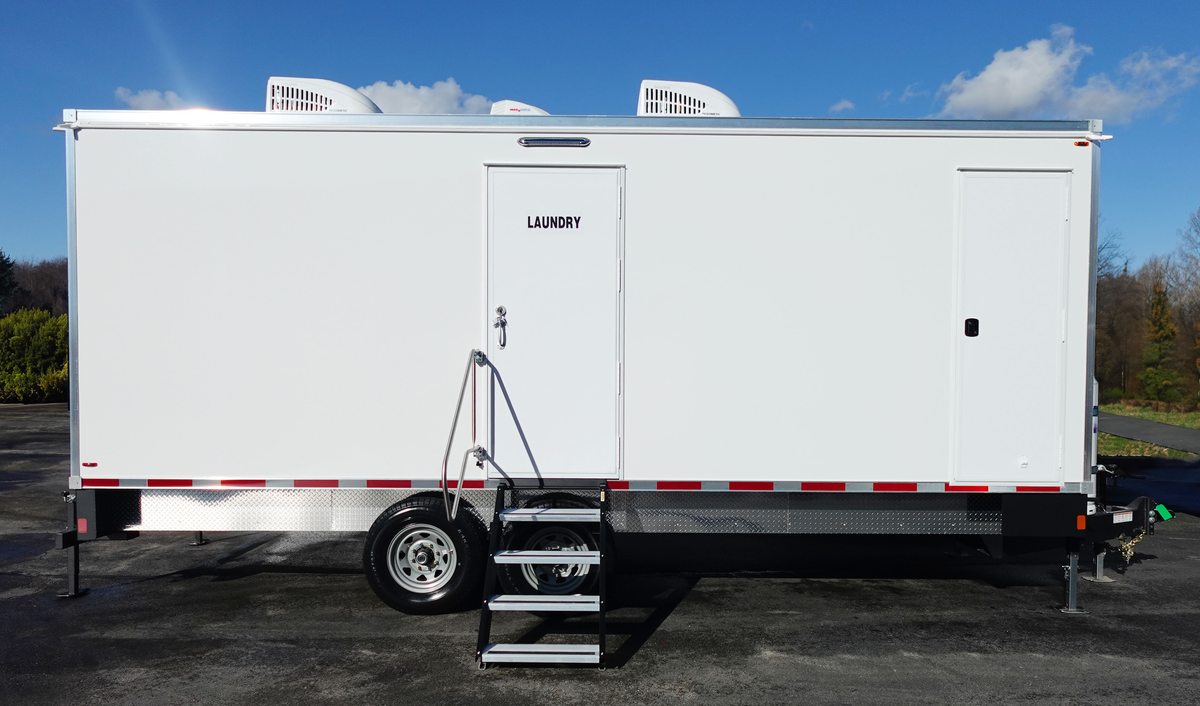
Dryers are usually the bottleneck. Jeans, canvas, and heavy layers take longer to dry than to wash, so the line forms at the dryers long before anyone waits on a washer. Our 8-Station unit gives every washer a matching dryer, which helps a lot, but on a busy camp we still plan the count around drying time rather than washing time.
Leave room to grow. Camps rarely shrink in the first month. A fire grows, a construction phase adds a trade, or a second rotation shows up early. It's far easier to plan space and power for one more unit on day one than to rework the pad in week three with the camp already full.
When you call, have four numbers ready: people at camp, number of shifts, days on site, and whether you want self-serve or staff-run loads. With those four numbers we can quote a setup that keeps up at shift change. Once we see how your crew actually uses it, we adjust.
Setting up a laundry unit on a remote Nevada site: ground, power, water, and waste
Most Nevada camps aren't built on a paved lot. They sit on a graded pad, a gravel yard, or a patch of flat sagebrush someone cleared that morning with a dozer. A laundry unit is heavy once the machines are loaded and running, and it has to sit level to work right. Ground is the first thing we look at.
Look for firm, level ground with working room on every side of the trailer. The 8-Station is a bit over 26 feet long with the tongue, and the stairs push its width past 12 feet, so add room for our truck to back in and pull out again. Soft ground after a storm can swallow a trailer jack. We level on blocking, but a firm base saves everyone time on delivery day.
Power comes next. The 8-Station needs two dedicated 240 volt circuits within reach of the trailer, and on a camp with a central generator plant that's usually a simple tie-in. On a bare site, we plan a generator big enough for the machines and the HVAC together, and we plan fuel on the same calendar as the rest of our service visits.
Water comes from wherever the camp gets its water. Some sites have a well or a town line nearby, while many remote camps truck water in and store it in tanks. We look at your source and your flow before delivery. Washers need steady pressure to finish a cycle. If the camp is already tight on water, we talk that through up front. Laundry is one of the thirstier jobs at any camp.
Every gallon that goes in has to come out. Rinse water collects in the trailer's waste tank, and we pump it and haul it off on a schedule that follows how busy the machines are. Put the unit where a pump truck can reach it without driving through the middle of camp.
Placement comes down to daily habits. Put the laundry near where people sleep or eat, and they'll use it on the way to dinner. Put it at the far end of the yard, and they'll not. Keep it well away from haul roads and crusher areas, or clean clothes come out coated in dust, and give the night shift a lit path to the door.
Nevada wind is real. Afternoon gusts in the high desert push hard on a trailer door and throw grit into anything left open, so when the site allows we turn the door away from the usual wind. If your camp kitchen needs cold storage too, our freezer trailer rentals in Nevada for camp kitchens can ride on the same delivery trip.
If your camp has a medical unit or first aid station, plan a separate drop point for contaminated items. Those follow stricter handling rules than crew laundry, and a marked bin plus a short written rule keeps them apart from everything else.
Send us a few photos and a rough sketch of the camp before delivery day. That short step catches most problems while the truck is still in the yard.
What to ask before you sign a long-term laundry contract in Nevada
A laundry unit on a two-year mine build isn't the same deal as one on a ten-day fire. Long contracts live or die on service, and small problems that would not matter over a week can wear a camp down over a year. Before you sign, get clear answers to a handful of questions.
Who services the unit? Ask whether the company that delivers the trailer is the same one that services it. Some vendors rent the unit and hand service off to a third party you never meet. With us, our own team delivers it, services it, and picks it up at the end.
How often will a tech visit? Get the service calendar in writing, and make sure it covers restocking, machine checks, and waste pumping. It should also change when your headcount changes. A camp that doubles in size can't live on the schedule it started with.
What happens when a machine breaks? Ask for the response plan in writing. On a remote site, one washer down out of eight just means a slower laundry day, but three down at shift change is a real problem for a tired crew. Ask who answers the phone at night, and how fast someone can reach your gate.
What is the winter plan? For any job in northern or central Nevada that runs past October, ask how the vendor handles freezing nights. Placement, water line protection, and pump-out timing all change once the cold sets in.
What changes the quote? None of it's a mystery. Distance from the nearest yard, the number of units, contract length, service frequency, whether you need a generator, and how hard the site is to reach all play a part. A longer contract usually brings a steadier service rhythm, and that's easier for both sides to plan around.
Is the vendor ready for your paperwork? Agency buyers need a vendor that's registered and ready to go on day one. Check that the company is active in the federal System for Award Management, carries the insurance your contract requires, and can work with purchase orders. We keep our SAM.gov registration current for exactly this reason.
Can the contract grow with the job? Big projects rarely hold one headcount for long. Ask whether you can add a unit, swap in a combo, or change the end date without starting new paperwork, and then ask to see that written into the contract language itself.
Sources: SAM.gov, System for Award Management
Timing laundry deliveries around Nevada winter roads
Winter changes the schedule. Across northern and central Nevada, hard freezes are routine from about November through March, with Elko sitting around 5,000 feet and Ely around 6,400. A job that starts in the fall can be deep in winter weather before it wraps up.
The roads matter as much as the cold. Interstate 80 carries most freight across the north, but Donner Summit on the California side closes or goes to chain controls in storms, and Mount Rose Highway and Spooner Summit near Tahoe often need chains or four-wheel drive. US 50 crosses several passes above 7,000 feet between Fallon, Austin, Eureka, and Ely. Any of them can stop a delivery for hours.
We move early instead. For a job we know will run into winter, we try to place the unit before the first big storm rather than after it. Backing a heavy trailer onto a snowy pad is slow and hard on everyone, while setting up on dry ground in October is easy.
Service visits need slack too. A pump truck that can't get over a pass on Tuesday may make it on Wednesday, so in winter we leave extra room in the waste tank. That way a one-day road closure doesn't fill it to the top.
Fire camps can run into the cold months as well. A laundry plan built only for August heat won't hold up at a November camp with ice on the access road, so we ask about the likely end date on every fire order, even when nobody knows it yet.
Check the roads before you lock a delivery date. The Nevada Department of Transportation posts road conditions and closures, and we watch the same reports, so if a storm is coming we'll call you and suggest moving the date up.
Down south the calendar flips. A unit in the Las Vegas Valley deals with heat rather than ice, and the HVAC works hard to keep the room usable through the afternoon. Crews on those jobs also lean on our chilled water station trailer rentals for Nevada heat. Same 8-Station laundry trailer, very different planning, which is why we ask where your job is before anything else.
Give us your start date, your likely end date, and the route in. We'll tell you straight whether the timing is easy or tight, and what we would do about it.
Sources: Nevada Department of Transportation
Adding laundry to a Nevada evacuation shelter: a checklist for emergency managers
Shelters open fast and rarely close on schedule. In Washoe and Douglas Counties, wildfire evacuations have opened shelters again and again in recent years, and families arrive with whatever they could grab on the way out. Within a day or two, clean clothes turn into one of the first requests at the front desk.
Nevada's emergency planning treats sheltering, feeding, and clothing displaced residents as core short-term recovery work, coordinated through the Division of Emergency Management and the state emergency operations center. Laundry fits right into that clothing piece. Planning it before fire season makes it far easier to stand up during one.
Pick the spot ahead of time. Walk each likely shelter site, whether it's a school gym, a church hall, or a fairground building, and mark a flat, reachable place outside for a trailer. Note the nearest power source and water connection. A simple sketch in the shelter binder saves an hour on the worst day of the year.
Plan for access. Nevada law requires emergency planning to make sure people with disabilities who use service animals can be sheltered together with those animals, and it makes sense to think about access to the laundry the same way. That means a level path to the stairs, good lighting, and a spot close to the door. The combo unit, with private baths and a laundry room in one trailer, is often the easiest fit for a shelter lot.
Decide who runs it. Some shelters let residents wash their own clothes on a sign-up sheet, while others have volunteers run loads and return bags by name. Either one works. Post the schedule either way, so the machines stay busy and nobody waits all afternoon.
Keep the first aid station separate. Any laundry with blood or body fluids has to be bagged where it's used and kept apart from regular loads, so give it its own marked bin and one trained person to handle it.
Think about bedding. Blankets and pillowcases need washing on a cycle too, especially once a shelter passes its third or fourth night, and staff-run bedding loads overnight keep the daytime machines free for residents.
Put a vendor on file. Your shelter plan should name who you call for a laundry unit, with a quote already on paper. When the call comes at 3 a.m. you want one number and an arrival time rather than a bid process. We are glad to be that number and to walk your team through a site visit before fire season.
Sources: Nevada Division of Emergency Management