Home / Services / San Francisco, California
San Francisco, California

Cold Water Station Rentals in San Francisco, CA

When a festival, a race, a convention, or a job site in San Francisco needs to hydrate a crowd, we are the first call. We bring the refillable water station, keep it cold and full all day, handle every refill, and pick it up when you are done. You get a hydration team that keeps a crowd supplied and keeps you compliant with the city's event rules.

The Name SF Events Trust

A trusted name in San Francisco event hydration

Festival producers, race directors, convention teams, and contractors across San Francisco count on us for cold, filtered drinking water that keeps a crowd moving. In SF the challenge is not heat, it is scale and the rules: the city bans the sale and distribution of packaged water at large permitted events, so refillable water stations are the compliant, sustainable way to hydrate a crowd of thousands. We have supplied Golden Gate Park festivals, waterfront events, and downtown job sites, we are a SAM.gov registered contractor, and we know how the city permits and runs its events. Rent a water station from us and you are hiring the team that keeps SF crowds hydrated the right way.

No plasticMeets SF's event bottle ban
ColdFiltered, refillable water
1M+Crowds at SF's biggest events
24/7Booking and emergency line
Our Signature Series Trailer

Meet our Signature Series water station trailer, built for San Francisco

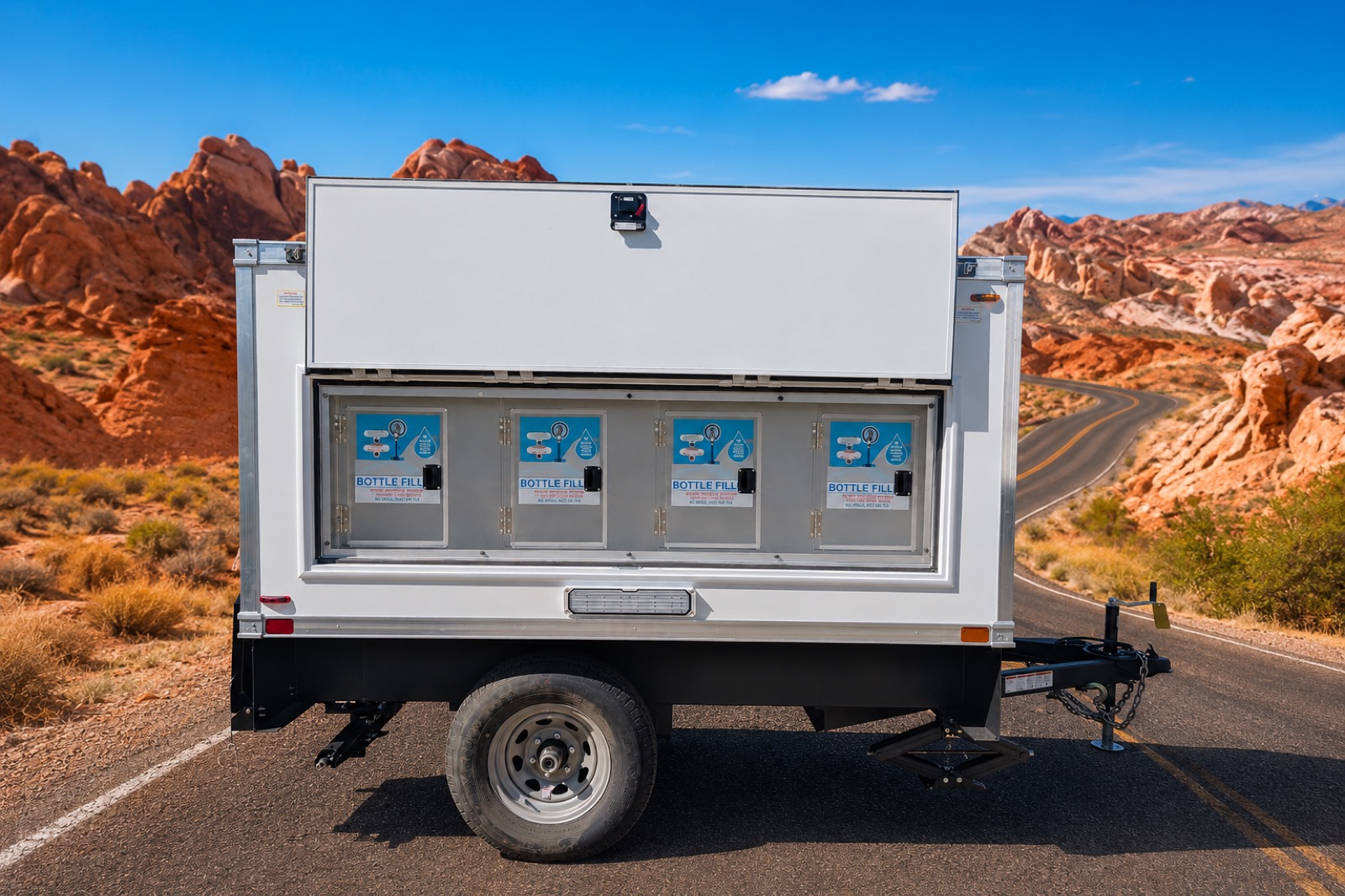
Our Signature Series water station trailer with four bottle-fill stations, ready for San Francisco delivery
The Signature Series water station trailer, our flagship hydration unit

The Signature Series is a road-towable water station trailer with a large tank, an onboard chiller and filter, and a row of fast bottle-fill stations along the side. It holds hundreds of gallons of cold, filtered drinking water and keeps it cold all day, whatever the weather does. People fill bottles, jugs, and hydration packs right at the stations, and several can fill at once without waiting.

The trailer is self-contained. It runs off a hose bib, a hydrant, or its own tank that we top off by truck, and the chiller runs on site power or a generator we bring, so it works at a downtown event or a remote site with no hookups. Lowered ADA-height stations come standard.

Everything that touches the water is food grade, filled only from potable sources, and sanitized between rentals, and we keep a service log with every unit. Delivery, setup, scheduled refills, sanitizing, and pickup are all part of the rental.

Every Use Case

Trusted across San Francisco for every kind of hydration job

From a 200,000-person festival in Golden Gate Park to a downtown convention to a waterfront job site, keeping a crowd hydrated has a lot of jobs to do in San Francisco, and we handle all of them. Here is where our hydration stations go to work across the city.

Festivals & Big Events

Festivals, parades, and city events

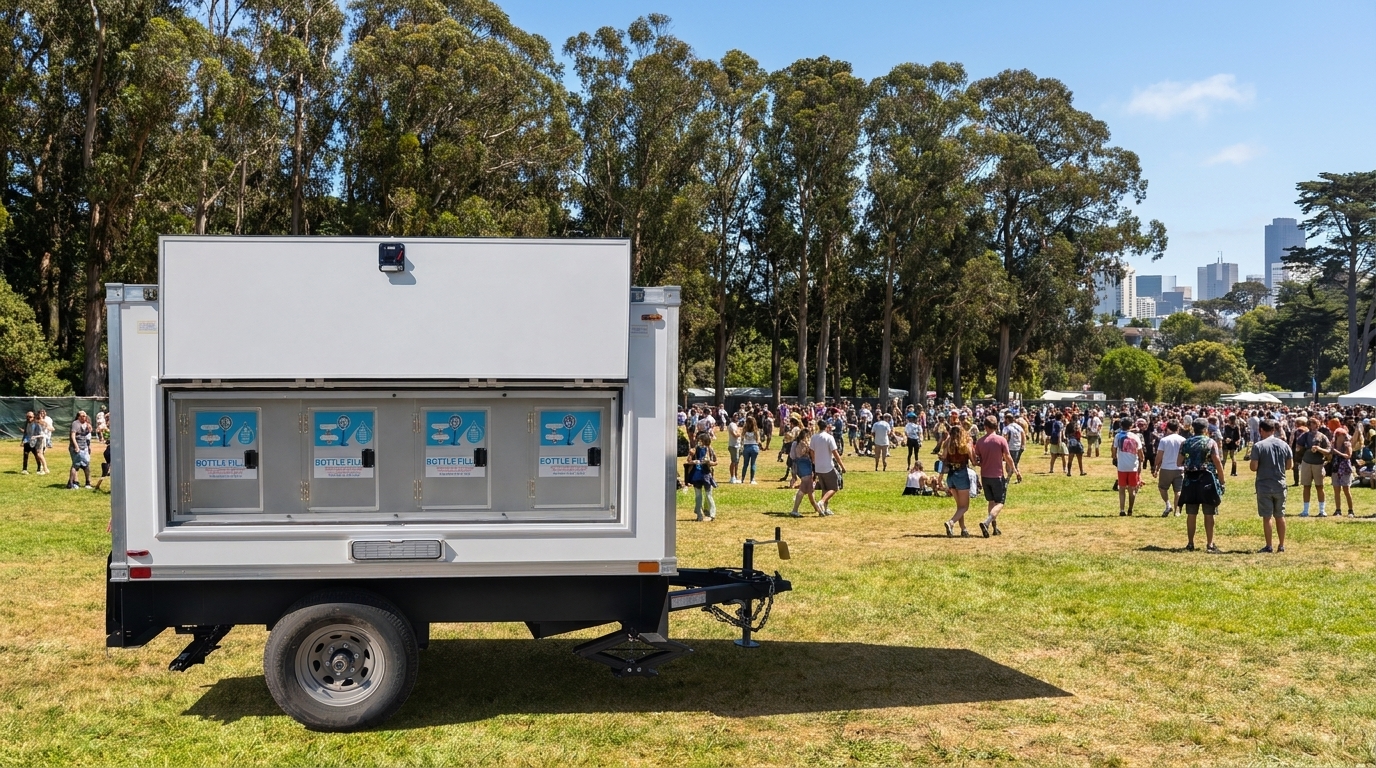
San Francisco packs huge outdoor crowds all year, from Outside Lands and Hardly Strictly Bluegrass in Golden Gate Park to Pride, Fleet Week, the Chinese New Year Parade, and the Folsom and Castro street fairs. Several of these draw crowds around a million people to the city, and a packed festival field moves through hundreds of gallons of water a day even at 65 degrees.

The city's rules make refill stations the only practical option. San Francisco bans the sale and distribution of packaged water at large permitted events on city property, so handing out plastic bottles is not allowed. A bottle-fill water station keeps a huge crowd hydrated, meets the ban, and cuts the plastic and hauling to nearly nothing, which fits the sustainability story every SF event wants to tell. We place stations along the crowd paths and at the medical tents and keep them filled through the busiest hours.

Golden Gate Park festivals draw crowds in the hundreds of thousands
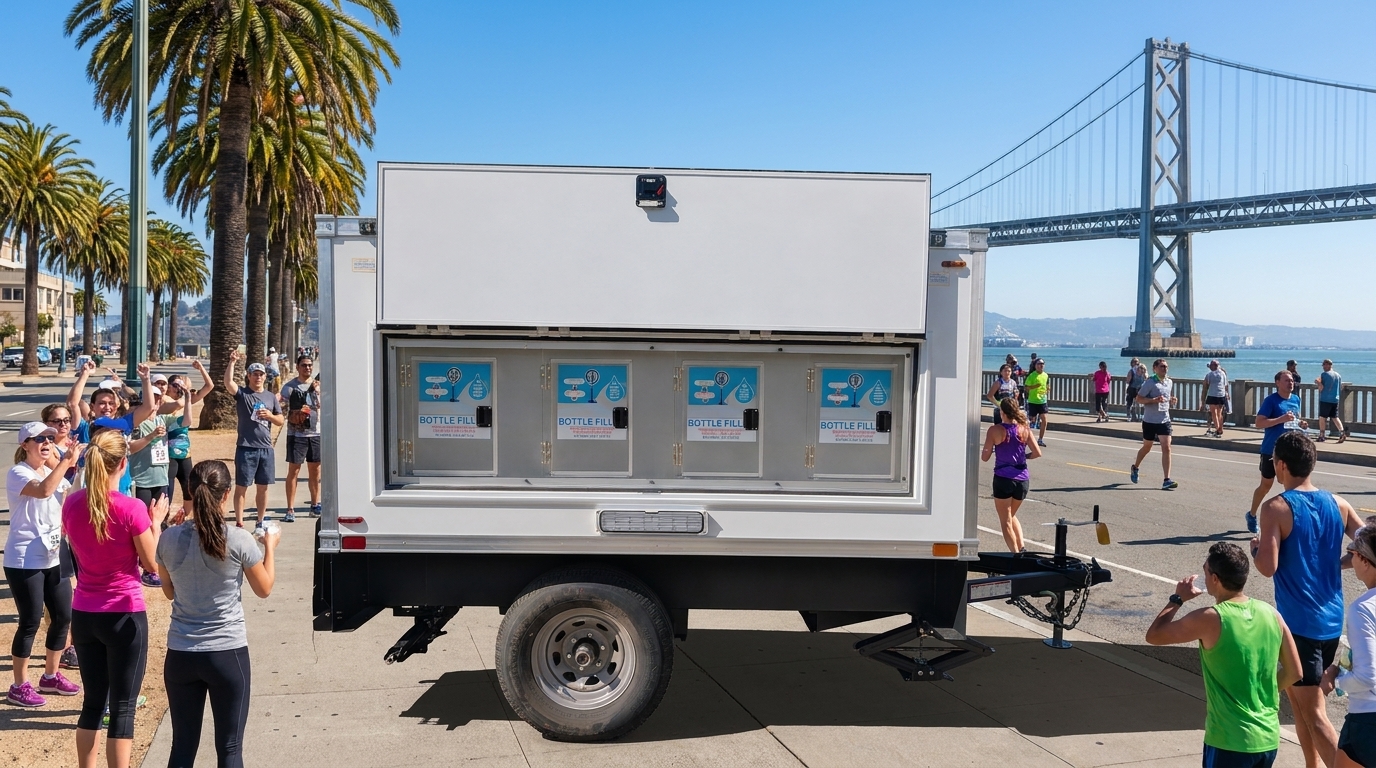
The Embarcadero and downtown host conventions and waterfront events
Conventions, Tech & Waterfront

Conventions, tech campuses, and the waterfront

Downtown San Francisco runs on conventions and tech. Dreamforce fills Moscone Center and spills across downtown every fall, and RSA, GDC, and the J.P. Morgan Healthcare Conference pack the city on their own dates. Tech campuses in SoMa and Mission Bay run product launches, all-hands, and employee events, and the Embarcadero and the piers host waterfront activations, Fleet Week, and race starts and finishes.

These clients want branded, sustainable hydration that matches the city's no-plastic optics, and a refillable water station delivers exactly that. It gives a convention crowd or a corporate campus cold, filtered water without a mountain of single-use bottles, and we handle delivery, refills, and pickup so your team never manages the water.

More Uses

Races, construction, tourism, and remote events

Marathons and races

The San Francisco Marathon crosses the Golden Gate Bridge with about 33,000 runners, Bay to Breakers fills the streets in May, and Escape from Alcatraz draws endurance athletes. The bottle ban exempts athlete water but still bars packaged water for spectators, so refill stations cover both.

Construction and job sites

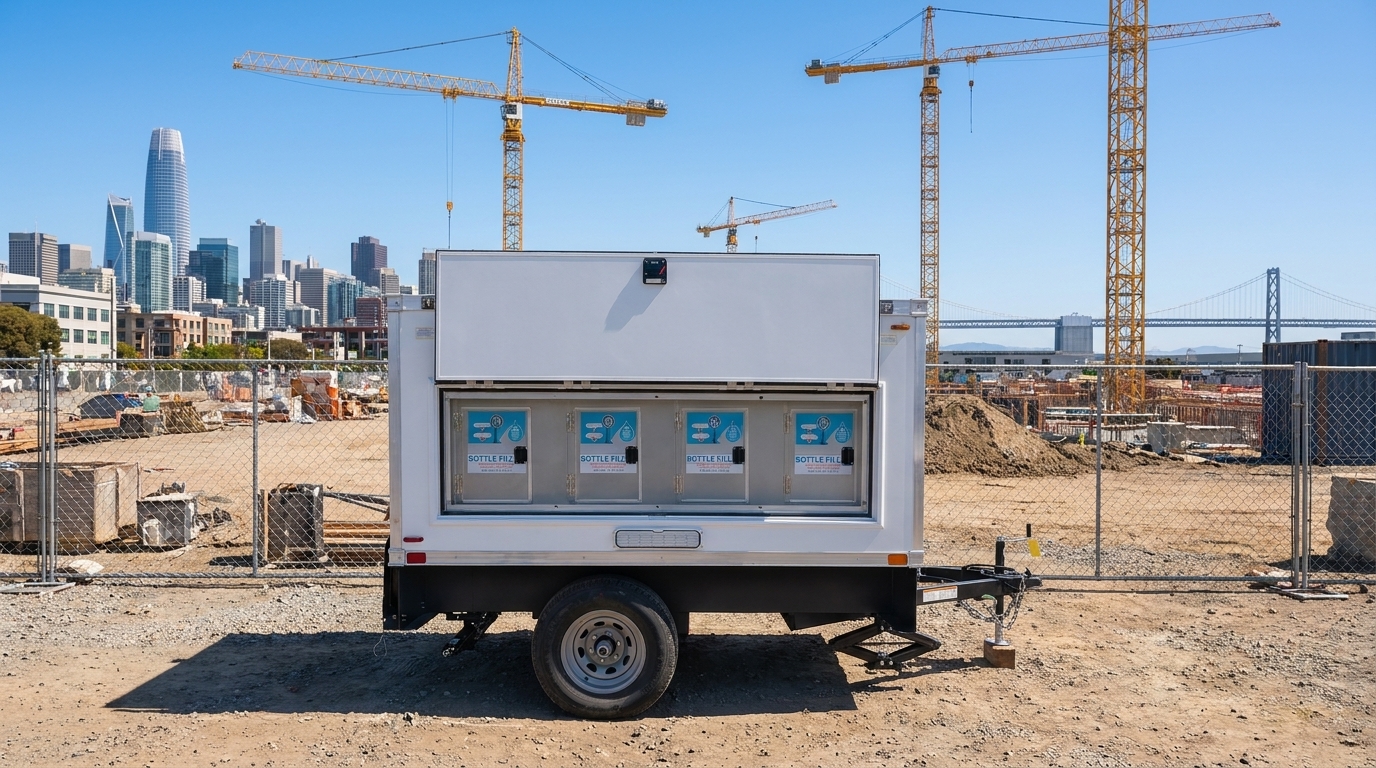
Mission Rock, Pier 70, the Central Subway district, and the Transbay high-rises keep crews working year-round. Cal/OSHA still requires accessible potable water on every job site, and a clean bottle-fill trailer serves a big crew without pallets of plastic.

Tourism and public spaces

SF drew more than 23 million visitors in 2024, and Fisherman's Wharf, the Ferry Building, and the Embarcadero host high-footfall events and pop-ups that need hydration built to the city's rules.

Corporate campus events

Tech HQs and campuses in SoMa and Mission Bay run outdoor launches, all-hands, and appreciation days that want sustainable, refill-station hydration on brand.

Remote and trail events

The Presidio, Lands End, Ocean Beach, and the Marin Headlands host trail races and outdoor gatherings away from any city tap, where a self-contained station is the practical water source.

Government and agencies

As a SAM.gov registered contractor we support city agency events, public works crews, and emergency response across San Francisco and the nearby Peninsula and East Bay.

Why Choose Us

What sets our water stations apart

We keep you compliant

San Francisco bans packaged water at large events, and our refillable stations are the clean, sustainable way to hydrate a crowd of thousands within the rules. No plastic, no violation, no waste.

Cold, clean water on demand

The chiller keeps the water cold and the filter keeps it clean, so a crew or a crowd drinks more and stays safe. Cold water is the whole point, and warm bottled water never keeps up.

Self-contained, goes anywhere

The trailer carries its own tank and runs on a hose bib, a hydrant, or a generator we bring, so it works at a downtown event or a remote site with no water or power.

Delivery, refills, and service included

We deliver and set up, refill and sanitize on a schedule, and pick up when you are done. You never assign anyone to manage the water or haul anything.

Filtered and sanitary

Food-grade tanks and lines, filled only from potable sources and sanitized between rentals, with bottle-fill stations that keep a big crowd moving without a shared cup in sight.

Built for scale and emergencies

From a single job site to a large festival or a disaster staging area, and a 24/7 line for emergencies. As a SAM.gov registered contractor we also work with government agencies.

Accessible for everyone

Lowered, ADA-height stations come standard so every worker or guest can reach the water, and event accessibility coordinators clear the layout without a fuss.

Customer Stories

A few San Francisco jobs we have handled

A Golden Gate Park festival and the bottle ban

A festival producer needed to hydrate a crowd in the tens of thousands without handing out plastic bottles, which the city does not allow. We placed refillable water stations along the main paths and by the medical tent, kept them filled through the weekend, and the event met the ban while cutting its plastic waste to almost nothing.

A downtown convention week

A convention team needed cold, sustainable water for attendees spilling out of Moscone across downtown. We staged stations at the key gathering points, refilled them through the busiest days, and gave the show a no-plastic hydration story that matched its sustainability goals.

A waterfront job site through the year

A contractor on a Mission Bay project rented a station for the duration. We parked it at the staging area, handled the refills and sanitizing, and kept the crew supplied with clean water year-round without pallets of bottled water piling up on a tight urban site.

Around the Region

Hydration across San Francisco and the Bay

Golden Gate Park & the Avenues

The park hosts Outside Lands, Hardly Strictly Bluegrass, and the Bay to Breakers finish, huge crowds in the foggy Sunset and Richmond. Big festivals here need refill stations by the dozen.

Downtown / SoMa / Mission Bay

Moscone conventions, tech campuses, Chase Center, and Oracle Park draw convention and sports crowds, and the district's high-rise construction runs year-round.

The Waterfront & Embarcadero

Fleet Week, Pride, and race starts and finishes fill the Ferry Building and the piers, and the Wharf's heavy tourist traffic keeps public events flowing.

The Mission & Potrero

The city's sunniest, warmest neighborhoods host Carnaval and street fairs, and Pier 70's redevelopment keeps crews on site.

The Presidio & Lands End

The national park in the city hosts lawn events, weddings, and trail races away from municipal taps, where a self-contained station is the practical source.

The Peninsula & East Bay

We reach south to Daly City and South San Francisco's biotech campuses and across to Oakland and Berkeley, where warmer inland weather adds a real heat angle.

Rules & Planning

San Francisco's event bottle ban and permits

The rule that shapes most SF event hydration is the city's packaged-water ban. San Francisco prohibits the sale or distribution of packaged water in containers of one liter or less at large permitted events, generally those with 100 or more participants, on city property. That means you cannot hand out plastic water bottles at a festival, race, or public event, and a refillable water station is the compliant way to hydrate the crowd.

On the permitting side, the City, Rec and Park, the Presidio, and the Port each have their own event rules and lead times, and Cal/OSHA still requires accessible potable water on any job site. We build the water plan to fit all of it. For an event, we place refill stations that meet the ban and work around your permit timeline. For a job site, the station meets the water requirement and we keep the service logs. Tell us the head count and the layout and we will size it.

Service Area

Our San Francisco service area

We deliver water stations across San Francisco and into the nearby Peninsula and East Bay. Here are some of the areas we serve.

Downtown / SoMaFinancial DistrictMission BayMissionPotrero HillDogpatchGolden Gate ParkSunsetRichmondMarinaEmbarcaderoFisherman's WharfNorth BeachCastroCivic CenterPresidioDaly CitySouth San FranciscoOaklandBerkeley
Reviews

What San Francisco customers say

Katherine H., Festival producer, San Francisco
Katherine H.Festival producer, San Francisco
★★★★★

The city does not let us hand out bottled water, so refill stations are a must. Theirs were delivered on time, kept the crowd hydrated all weekend, and cut our plastic to nothing. They are the only hydration company we use now.

Jadan R., Convention services, San Francisco
Jadan R.Convention services, San Francisco
★★★★★

We needed a sustainable water setup for a downtown convention and they nailed it. Cold, clean, and on brand, with no pallets of plastic. First company we recommend for city events.

Viviana R., Race operations, San Francisco
Viviana R.Race operations, San Francisco
★★★★★

For a big road race the bottle-fill stations kept runners and spectators supplied and kept us within the city rules. Setup and pickup were quick and easy.

Harold M., Site safety, San Francisco
Harold M.Site safety, San Francisco
★★★★★

On a tight urban job site the station kept the crew in cold water without pallets of bottles taking up space. Reliable refills, no fuss. We book them for every project now.

FAQ

Frequently asked questions

How much does it cost to rent a water station trailer in San Francisco?
The price depends on how long you need it, how many stations, and where the site is. A one-day festival and a long job-site rental are very different, so we quote each job. Tell us your dates, your head count, and the location, and we will send you a quote.
Can I hand out bottled water at a large event in San Francisco?
No. San Francisco bans the sale and distribution of packaged water in containers of one liter or less at large permitted events, generally 100 or more participants, on city property. A refillable water station is the compliant way to hydrate the crowd, and it cuts the plastic waste too.
How many water stations do I need for a festival or race?
A common planning benchmark is one fill point per 50 to 75 people for an outdoor event, with no guest more than about 100 feet from water. For a big festival we place several stations along the crowd paths and at the medical tents.
Do the stations provide chilled and filtered water?
Yes. The water is filtered and chilled on board and stays cold all day, and the bottle-fill stations let a large crowd refill their own bottles quickly.
Do I need a permit for a water station at a Golden Gate Park or Presidio event?
The trailer itself does not, but your event will. The City, Rec and Park, the Presidio, and the Port each have their own permit rules and lead times. We work around your permit timeline once your date and site are set.
Does the trailer need a water hookup, or does it arrive filled?
It can connect to a hose bib or hydrant, or arrive filled from its own tank that we top off by truck. The chiller runs on site power or a generator we bring, so it works at parks and remote sites with no hookups.
Can you deliver to a construction site to meet Cal/OSHA water rules?
Yes. Cal/OSHA requires accessible potable water on every job site, and a clean bottle-fill station serves a big crew without pallets of plastic. We deliver, refill, and keep service logs for your records.
Is a water station more sustainable than handing out bottles?
Yes, and in SF it is required at large events. The refill model eliminates single-use plastic and the hauling and cleanup that come with it, which matches the city's bottle ban and every event's sustainability goals.
Do you serve the Peninsula and East Bay too?
Yes. We deliver across San Francisco and into Daly City, South San Francisco, Oakland, and Berkeley. The East Bay also gets hotter than SF, so the heat angle is more real across the bridge.
How far ahead should I book for festival and convention season?
For the August-to-October festival and convention stretch, as early as you can, since demand peaks then. Reserve once your date and site are locked in.
Can the stations be branded for our event or company?
Ask us about branding options when you request a quote. Many event and corporate clients want the stations to match their look.
Do you work with city agencies?
Yes. We are SAM.gov registered and support city agency events, public works crews, and emergency response across San Francisco and the nearby Bay Area.
Resource Library

Water station guides for San Francisco

San Francisco's Event Bottle Ban Explained, and How to Hydrate a Crowd Legally

If you are planning a large event on San Francisco city property, there is a rule that catches organizers off guard every year. The city's Environment Code restricts the sale and free distribution of drinking water in single-use plastic bottles of one liter or less at large permitted events held on city property. It is not a suggestion or a green marketing goal. It is written into local law, and event permits routinely reference it. If your plan for keeping people hydrated is a pallet of half-liter bottles, that plan does not clear the permit.

The intent behind the ordinance is straightforward. San Francisco produces an enormous amount of single-use plastic during festivals, races, and street fairs, and much of it never makes it into a recycling stream. By pushing organizers away from packaged water and toward refillable options, the city cuts the waste at the source instead of trying to clean it up afterward. For an event producer, that means the question is no longer whether to comply, but how to hydrate hundreds or thousands of people without handing out bottles.

This is where refill infrastructure becomes the answer. The ordinance is satisfied when attendees can fill their own reusable containers from a permanent or temporary water source. A refillable bottle-fill water station is compliant because nothing packaged is being sold or given away. People bring or buy a reusable bottle, walk up, and fill it with cold, filtered water. The station does the work that a truckload of plastic used to do, without triggering the part of the code that bans the plastic.

A filtered water station trailer is built for exactly this situation. Instead of a single spigot that creates a line, a trailer offers multiple bottle-fill points running at once, so a crowd moves through quickly. The water is filtered on board, so it tastes clean and consistent regardless of the hose it connects to. And because the unit is self-contained, it can be placed where the crowd actually is, rather than forcing everyone to hunt for a building fountain that was never designed to serve thousands.

Planning the number of stations matters as much as having them. A rough working figure many event operators use is one fill point for every 50 to 75 people expected on site at peak. A single trailer with several taps can therefore cover a few hundred attendees on its own, and larger footprints are handled by spreading multiple units across the grounds so no one has to cross the whole site for water. Placement near entrances, stages, and any area where people gather and stay tends to relieve the most pressure.

It is worth knowing what the ban does not cover, because the exemptions shape your plan. The restriction targets packaged water in small containers. It does not prohibit water itself, and it does not stop you from providing all the water you want through refill stations, larger dispensers, or hydration for participants such as athletes where safety requires it. The goal of the code is to eliminate the single-use plastic, not the hydration. Understanding that distinction keeps you from over-correcting and under-serving your crowd.

For organizers, the cleanest path is to build refillable water into the site plan from the start rather than bolting it on after the permit office raises a flag. Decide where the crowd will concentrate, count your peak attendance, and place enough fill points to keep lines short. A refillable station approach also plays well with the sustainability messaging that sponsors and city partners increasingly expect, so the compliant choice and the good-optics choice are the same choice.

Mavirus Group provides filtered, refillable bottle-fill water station trailers built for permitted San Francisco events, so your hydration plan meets the Environment Code instead of fighting it. We serve San Francisco along with Daly City, South San Francisco, Oakland, and Berkeley, and we can help you size the number of fill points to your expected crowd.

Sustainable Hydration for Dreamforce and San Francisco Conventions

San Francisco runs on conventions. Dreamforce alone brings tens of thousands of attendees into Moscone Center and spills them across downtown every fall, and it shares the calendar with the RSA Conference, the Game Developers Conference, and the J.P. Morgan Healthcare Conference. Moscone offers roughly 504,000 square feet of exhibit space, and when a major show fills it, the surrounding blocks turn into an extension of the venue. Keeping that volume of people hydrated is a logistics problem, not an afterthought.

The challenge is not the weather. San Francisco is mild and often foggy, with typical summer highs around 67 degrees, so the pressure does not come from heat. It comes from density. Convention attendees are on their feet for long days, moving between sessions, expo floors, keynotes, and off-site activations, often without a natural moment to sit down and drink. Add packed after-hours receptions and corporate campus events, and the demand for accessible water is constant even when the temperature is not.

There is also a strong optics and policy dimension. The companies that anchor these conventions publish sustainability commitments and are increasingly unwilling to hand out cases of single-use plastic bottles at their events. Bottled water on a corporate expo floor now reads as off-brand. A refillable water station, by contrast, signals exactly the values these sponsors want associated with their name, and it does so in front of thousands of witnesses who take photos of everything.

A filtered bottle-fill water station trailer fits both the volume and the values. Multiple fill points let a stream of badge-wearing attendees top off reusable bottles without forming a bottleneck between sessions. Because the water is filtered on board, it tastes clean and consistent, which matters when the same people come back to the same station a dozen times a day. And the trailer can be positioned outside a venue entrance, in an activation footprint, or on a corporate campus where indoor fountains cannot keep up.

For activations that spread across downtown, placement is the strategy. Attendees rarely stray far from the path between the venue, their hotels, and the sponsor experiences. Positioning stations along those corridors and at the entrances to the busiest activations captures people at the exact moments they are looking for water. A single trailer with several taps handles a steady convention crowd, and multiple units cover a campus or a multi-block footprint without leaving any zone dry.

Branding is part of the appeal for corporate hosts. A clean, professional water station becomes a natural place for a sponsor to reinforce its sustainability story, and it gives attendees a practical reason to stop, refill, and linger. Instead of a forgettable stack of bottles in a recycling bin, the host gets a visible, reusable amenity that supports the message it is already paying to promote across the rest of the event.

The practical planning steps mirror any large gathering. Estimate peak concurrent attendance in each zone, place enough fill points to keep lines short, and cluster them where people naturally pause. Because convention foot traffic surges around session breaks and keynote start times, having extra capacity ready for those spikes prevents the short, intense lines that frustrate attendees more than a slow, steady flow ever would.

Mavirus Group supplies filtered, refillable bottle-fill water station trailers for San Francisco conventions and the corporate activations that surround them, from Moscone-area footprints to company campuses. We serve San Francisco plus Daly City, South San Francisco, Oakland, and Berkeley, and we can scale the number of units to match a single booth or a downtown-wide program.

Hydration Logistics for Golden Gate Park Festivals

Golden Gate Park is where San Francisco holds its biggest gatherings, and the numbers are staggering. Outside Lands draws more than 200,000 people across three days each August, and Hardly Strictly Bluegrass, which is free, pulls upward of 750,000 over its early October weekend. Crowds of that size do not fail because of the heat, since San Francisco stays cool, but because tens of thousands of people in one green space all need water at roughly the same times. That is a distribution problem, and it rewards planning.

The first thing to understand is scale of consumption. A common planning benchmark for all-day outdoor events is on the order of half a gallon to a gallon of drinking water per person over the course of a day, more if the event runs long or people are active. Multiply even the conservative end by a six-figure crowd and the total volume is enormous. That is why bottled water cannot realistically carry a park festival, and why the city's rules push organizers toward refill infrastructure in the first place.

Because packaged water in small plastic bottles is restricted at large permitted events on city property, refillable stations are not just the sustainable choice at Golden Gate Park, they are the compliant one. A filtered bottle-fill water station trailer lets festival-goers refill reusable bottles all day from clean, cold, on-board-filtered water. Nothing packaged changes hands, the plastic waste that a park this size would otherwise generate is avoided, and the permit requirement is met at the same time.

Placement across a park footprint is where festivals win or lose the hydration battle. A useful rule of thumb is one fill point for every 50 to 75 people in a given area at peak, which for a park-scale crowd means many taps spread deliberately rather than one big station in a corner. Stations belong near stage clusters, along the main circulation paths, and close to food areas where people already stop. Spreading capacity keeps any single point from becoming a choke point during a headliner set.

Multiple trailers, each with several fill points, are how large festivals actually cover the ground. Rather than forcing 200,000 people toward a handful of spigots, operators distribute units so that no attendee has to walk across the entire park to drink. The self-contained design matters here, because Golden Gate Park does not offer convenient plumbing at every stage, and a trailer brings filtered water to wherever the crowd concentrates.

Timing the demand is as important as the map. Water use spikes in predictable waves, around midday, during marquee performances, and as people arrive and leave. Building in extra capacity for those peaks, and positioning staff or signage so people can find the nearest station quickly, prevents the long lines that form when everyone reaches for water in the same fifteen minutes. Smooth flow at peak is the real test of a hydration plan.

There is a safety dimension underneath all of it. Reliable, accessible water keeps a massive crowd healthier and calmer over a long day and reduces the strain on medical and first-aid teams. For a free event like Hardly Strictly Bluegrass, where attendance can swell unpredictably, having distributed refill capacity that scales is the difference between a comfortable crowd and a stressed one.

Mavirus Group provides filtered, refillable bottle-fill water station trailers sized for Golden Gate Park festivals, with the multiple fill points and distributed placement that six-figure crowds require. We serve San Francisco along with Daly City, South San Francisco, Oakland, and Berkeley, and we can plan station counts and locations around your stage map and expected peak attendance.

Meeting Cal/OSHA Water Requirements on San Francisco Construction Sites

San Francisco is building constantly, and the biggest job sites are enormous. Mission Rock is transforming 28 acres of China Basin, Pier 70 is redeveloping another 28 acres in Dogpatch, the Central Subway reshaped the transit spine, and the Transbay district keeps rising with new high-rises. On sites like these, one requirement is not optional and does not flex with the forecast: workers must have access to clean, potable drinking water. Cal/OSHA requires it, and a mild San Francisco climate does not change that.

This is the point contractors sometimes underestimate because the city is cool and foggy. Cal/OSHA's drinking water rules are not triggered only by high heat. The requirement to provide accessible potable water applies to the job site regardless of temperature, and the state's heat illness standard adds specific water obligations on top of that when conditions warrant. A crew doing physical labor needs water whether it is 67 degrees or higher, and the responsibility to supply it sits with the employer.

The regulations are specific about access. Potable water must be provided, it must be fresh and suitable to drink, and where it is not plumbed in, it has to be supplied in sanitary containers or dispensers designed to keep it clean, with single-use cups or a sanitary drinking method. On a sprawling active site, meeting that standard with scattered coolers that run dry and get contaminated is a losing battle, especially when the water source is far from where crews are actually working.

A filtered bottle-fill water station trailer solves the access problem directly. It brings a clean, filtered, high-capacity water source onto the site itself, with multiple fill points so a full crew can refill personal bottles or containers without crowding. Because the unit is self-contained, it can sit where the work is happening on a large footprint rather than forcing workers to walk to a distant building tap, which matters on sites measured in acres.

Consistency is the practical advantage. Coolers need constant refilling, they warm up, and their sanitation depends on whoever remembers to service them. A dedicated station keeps filtered water flowing throughout the shift, keeps it clean, and keeps it in a fixed, known location that every worker can rely on. On a site with a large or rotating crew, that reliability is what actually keeps the operation in compliance day after day, not just on inspection day.

There is a real cost to getting this wrong. Cal/OSHA can cite and fine employers who fail to provide adequate drinking water, and beyond the penalty, a dehydrated crew is a slower and less safe crew. On high-profile San Francisco developments where schedules and safety records are scrutinized, treating water access as core infrastructure rather than an afterthought protects both the workers and the project.

Positioning is part of the plan on large sites. As the work moves across a 28-acre parcel or up the floors of a Transbay tower, the water source should stay reasonably close to the active crews. A trailer can be repositioned as the job progresses, and multiple units can cover separate work zones so no crew is ever far from clean drinking water regardless of where the day's work is concentrated.

Mavirus Group provides filtered, refillable bottle-fill water station trailers for San Francisco construction sites, giving contractors an accessible, clean potable water source that supports Cal/OSHA compliance across large footprints. We serve San Francisco plus Daly City, South San Francisco, Oakland, and Berkeley, and we can position units to follow the work as your site progresses.

Water Stations for San Francisco Races and the Waterfront

San Francisco's endurance events are woven into the city's identity. The San Francisco Marathon sends roughly 33,000 runners across the Golden Gate Bridge in late July, Bay to Breakers turns the city into a moving party each May, and the Escape from Alcatraz Triathlon puts athletes in the bay each June. Add the waterfront's massive spectator gatherings, Fleet Week and Pride drawing crowds along the Embarcadero, and you have a category of events where hydration has to serve two very different groups at once.

That split is the key planning insight, and it connects directly to city rules. San Francisco's restriction on selling or distributing small packaged water bottles at large permitted events on city property carves out water for athletes where safety requires it, but it does not give spectators a pass. So a race can keep runners supplied on the course, yet still cannot hand cases of plastic bottles to the crowds lining the route or filling the waterfront. Refill stations are what serve those spectators legally.

For the athletes, the demand is intense and time-compressed. Even in cool, foggy conditions, runners crossing the Golden Gate Bridge or triathletes coming out of the bay are working hard and need reliable water at predictable points. The weather does not lower the requirement, it just changes its shape, since the exertion, not the heat, drives the thirst. Course hydration has to be positioned where athletes reach it at the right moments and never runs dry mid-field.

For the spectators and the waterfront crowds, the challenge is volume and duration. Fleet Week and Pride each draw well over a million people to the Embarcadero over their runs, and those crowds stand around for hours. A filtered bottle-fill water station trailer serves them the compliant way, letting people refill reusable bottles from clean, on-board-filtered water instead of relying on the packaged bottles the city restricts. Multiple fill points keep a dense waterfront crowd moving through quickly.

Placement along a race route and a waterfront promenade follows the flow of people. On a course, stations belong at the points where athletes and their supporters converge, near start and finish areas and along stretches where spectators cluster. Along the Embarcadero, units belong where foot traffic concentrates and where people settle in to watch. A working figure of one fill point per 50 to 75 people at peak helps size how many taps each zone needs.

The self-contained design is what makes waterfront and course coverage practical. The Embarcadero, a bridge approach, and a bay-side transition area do not offer convenient plumbing wherever a crowd happens to form, so a trailer brings filtered water to the spot instead of forcing thousands of people to search for a fountain. Multiple units spread across a long route or a mile of waterfront keep everyone within a short walk of clean water.

Reliability under peak load is the whole game for these events. Race hydration failures make headlines, and a waterfront crowd of a million reaching for water in the same window will overwhelm anything undersized. Building in extra capacity for the surges, positioning stations where people naturally gather, and keeping filtered water flowing all day is what turns a crowded, active event into a comfortable one for athletes and spectators alike.

Mavirus Group provides filtered, refillable bottle-fill water station trailers for San Francisco races and waterfront events, serving spectators the compliant way while supporting the athlete hydration these events demand. We serve San Francisco along with Daly City, South San Francisco, Oakland, and Berkeley, and we can place and scale units across a race course or the length of the Embarcadero.

More Rentals

Other trailers we rent in San Francisco

We rent more than water stations. If you are setting up a job site, an event, or a base camp, we can bring the rest of the trailers too.

Get a Quote

Rent a water station trailer for your San Francisco event or site

Tell us your dates, how many people, and where the site is, and we will send you a quote. Delivery, refills, and service are all included, and the stations meet the city's event rules.

Get a Quote Call (855) 687-1887