Water for Cast and Crew on Los Angeles Film and TV Sets
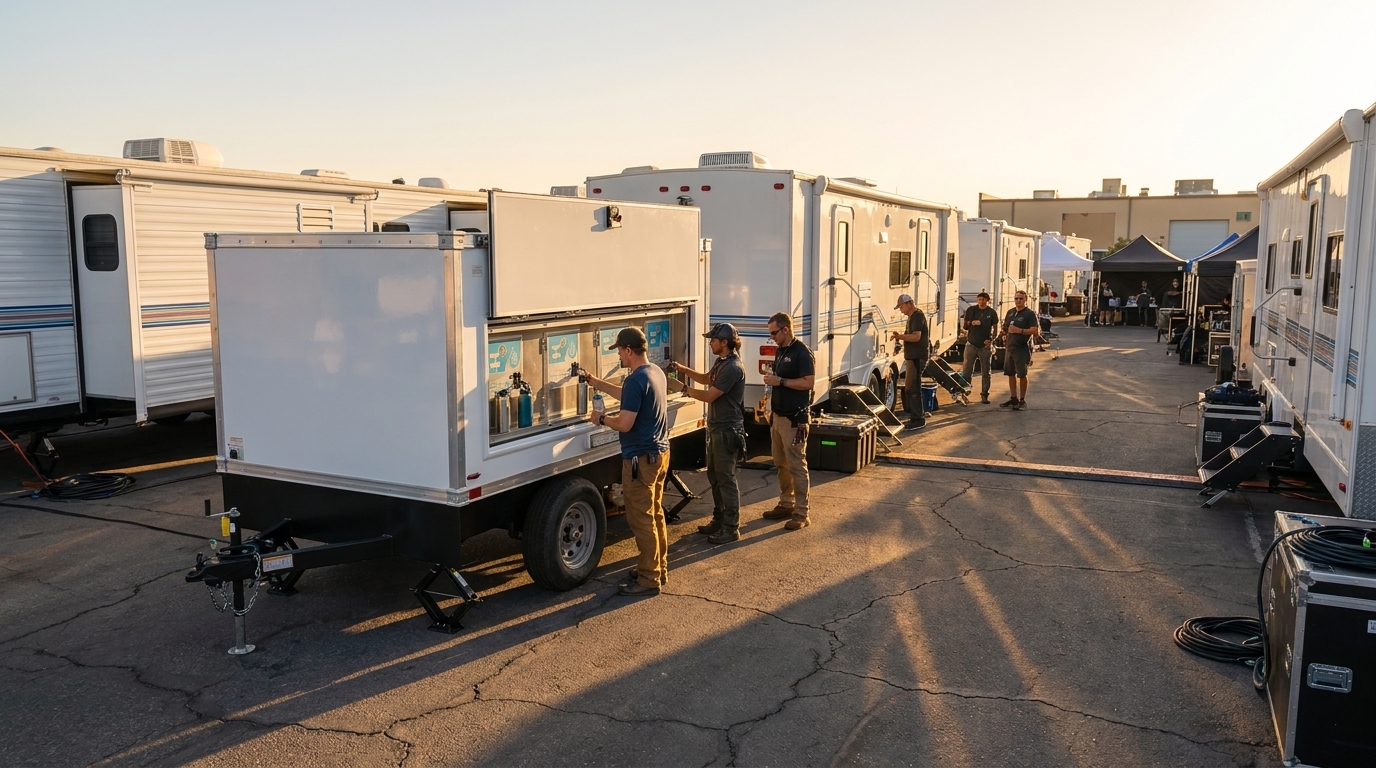
Film and television production in Los Angeles runs on long days and hot locations. A single feature or series shoot can put a hundred or more people on their feet for twelve to fourteen hours, and many of those hours happen outdoors under direct sun. Craft services is the department that traditionally handles food and drink on set, and part of that job is keeping cast and crew supplied with cold water from the first call through wrap. After years of staging water for LA productions, we can usually tell from the call sheet which days will be the hard ones: an inland location, a company move after lunch, and exteriors scheduled straight through the afternoon burn off. When the water supply runs thin on a day like that, the whole production feels it, because dehydrated people work slower, make more mistakes, and are more likely to need a medical break.
The two-climate reality of Los Angeles shapes how much water a production actually needs. A shoot on the coast in Santa Monica or along the beach cities might sit in the low eighties for most of the day. Move that same shoot inland to the San Fernando Valley, downtown, or the San Gabriel Valley and the temperature can climb into the upper nineties or above. Basecamps, where the trailers, wardrobe, and holding areas cluster, are often set up on asphalt lots that trap and radiate heat. Cast members in heavy costumes, period wardrobe, or prosthetics feel that heat far more than the numbers on a thermometer suggest.
Industry safety guidance has repeatedly flagged that productions tend to under-invest in water on hot exterior days. It is easy to plan for the camera package and the catering and forget that on a triple-digit afternoon a crew can go through water faster than a few cases of bottles can be restocked. When the nearest store is a long drive from a canyon or desert location, that gap becomes a real problem rather than an inconvenience. Running out of cold water on a remote shoot is not just uncomfortable, it can shut a scene down.
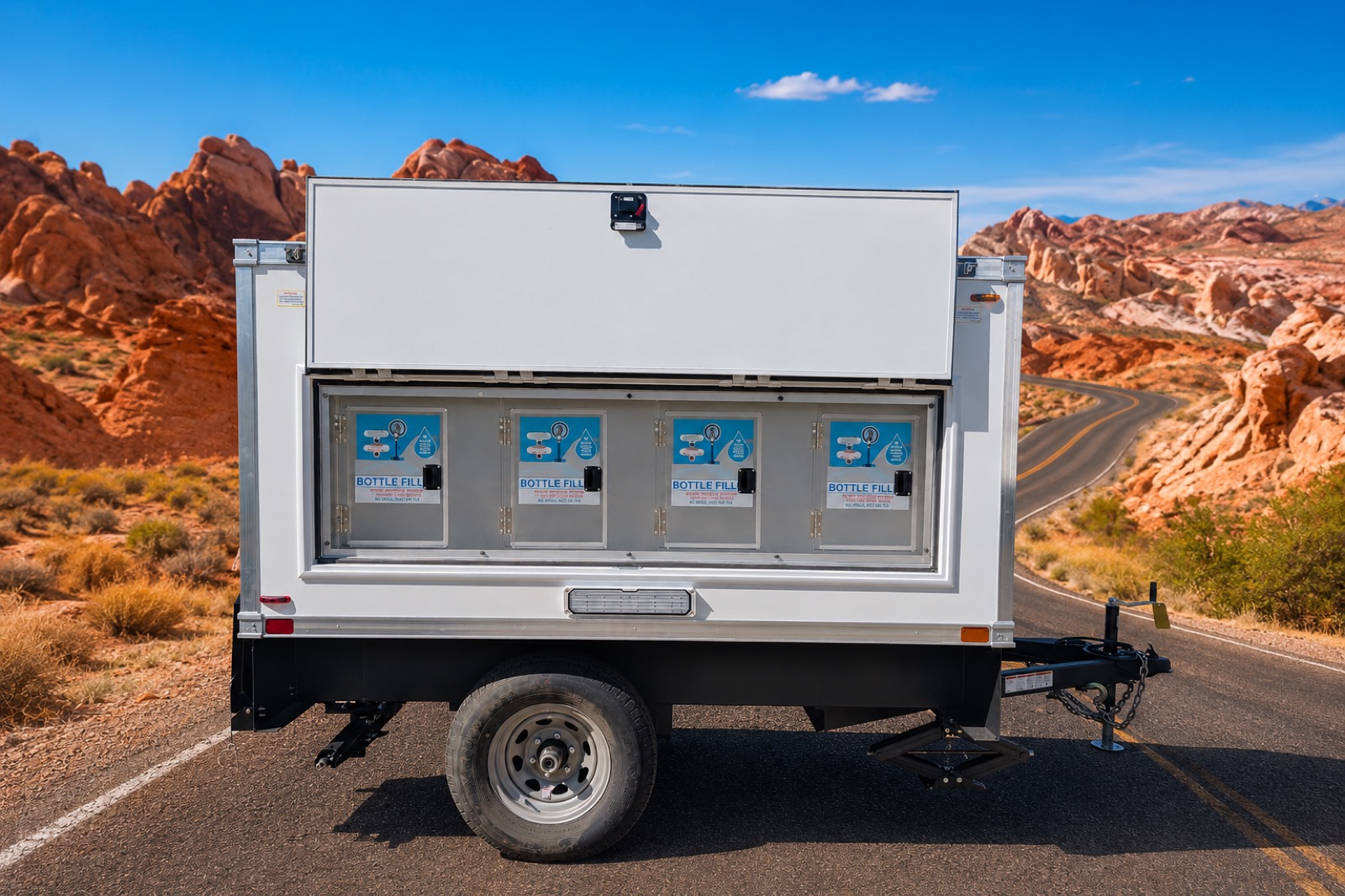
Remote canyon and backcountry shoots are where Los Angeles productions face the hardest hydration math. Locations in Malibu Canyon, the hills above the Valley, and the high desert around the county edge often have no plumbing, no reliable power, and no nearby water source. A production that wants realistic wilderness or open-road footage has to bring everything in, and that includes drinking water for everyone on the call sheet. A chilled bottle-fill water station trailer solves this by carrying its own filtered, cooled water supply to the location, so a crew can refill personal bottles all day without a caravan of runs to the nearest town.
California is also drawing more production back into the state, which means more shoots competing for the same locations and the same summer weeks. The state expanded its Film and Television Tax Credit program effective July 1, 2025, a change designed to keep more projects filming in California rather than leaving for other states and countries. As more productions book Los Angeles locations, more of them will land on hot inland days and remote sites where a dependable cold-water setup is part of running a safe set.
Permits and public health rules are part of the picture too. FilmLA administers film permits across the City of Los Angeles and much of the county, coordinating where and when productions can shoot. The Los Angeles County Department of Public Health regulates service vehicles that operate on location, including the mobile units that provide food and water to a set. A water station trailer brought onto a permitted shoot needs to fit within those frameworks, which is why productions value working with a provider that understands how on-location service is handled in this county.
For a location manager or a craft services lead, the practical value of a dedicated water station is predictability. Instead of guessing how many cases to order and hoping the ice holds, a crew gets a steady source of chilled filtered water that keeps up with demand from morning through wrap. That reliability matters most on the days that are hardest to staff and stage, which are exactly the hot, far-flung shoots that Los Angeles is known for. Mavirus Group provides chilled bottle-fill water station trailers across Los Angeles County for productions that need water they can count on.
Planning ahead is the whole game. The productions that avoid heat problems are the ones that treat water as core logistics, booked and scheduled alongside the trucks and the generators, rather than an afterthought handled with a last-minute store run. On a Los Angeles summer shoot, that planning is the difference between a crew that stays sharp through golden hour and one that is dragging by lunch.
Sources: California Film Commission - Film and Television Tax Credit · FilmLA - Film Permits
Preparing for the 2028 Olympics: Large-Event Hydration in Los Angeles
Los Angeles will host the 2028 Summer Olympic and Paralympic Games, and the scale of that event puts hydration planning near the top of the operations list. The Games will bring millions of spectators, tens of thousands of athletes and workforce, and international attention to a city whose summers run hot inland. Unlike past host cities that built large new facilities, LA28 is committed to using existing and temporary venues rather than constructing new permanent ones. That approach keeps costs down, but it also means the city is adapting venues it already has to handle Olympic-scale crowds in peak summer.
The venue plan reads like a tour of Los Angeles landmarks. SoFi Stadium in Inglewood and the Los Angeles Memorial Coliseum are both central to the Games, with the opening ceremony split across the two sites. SoFi is being reconfigured to serve as the largest Olympic swimming venue ever, seating roughly thirty-eight thousand spectators for the swimming program. The Coliseum, which has hosted the Olympics twice before, returns as a marquee venue. Spreading events across venues like these means spreading crowds, workforce, and water demand across many sites at once.
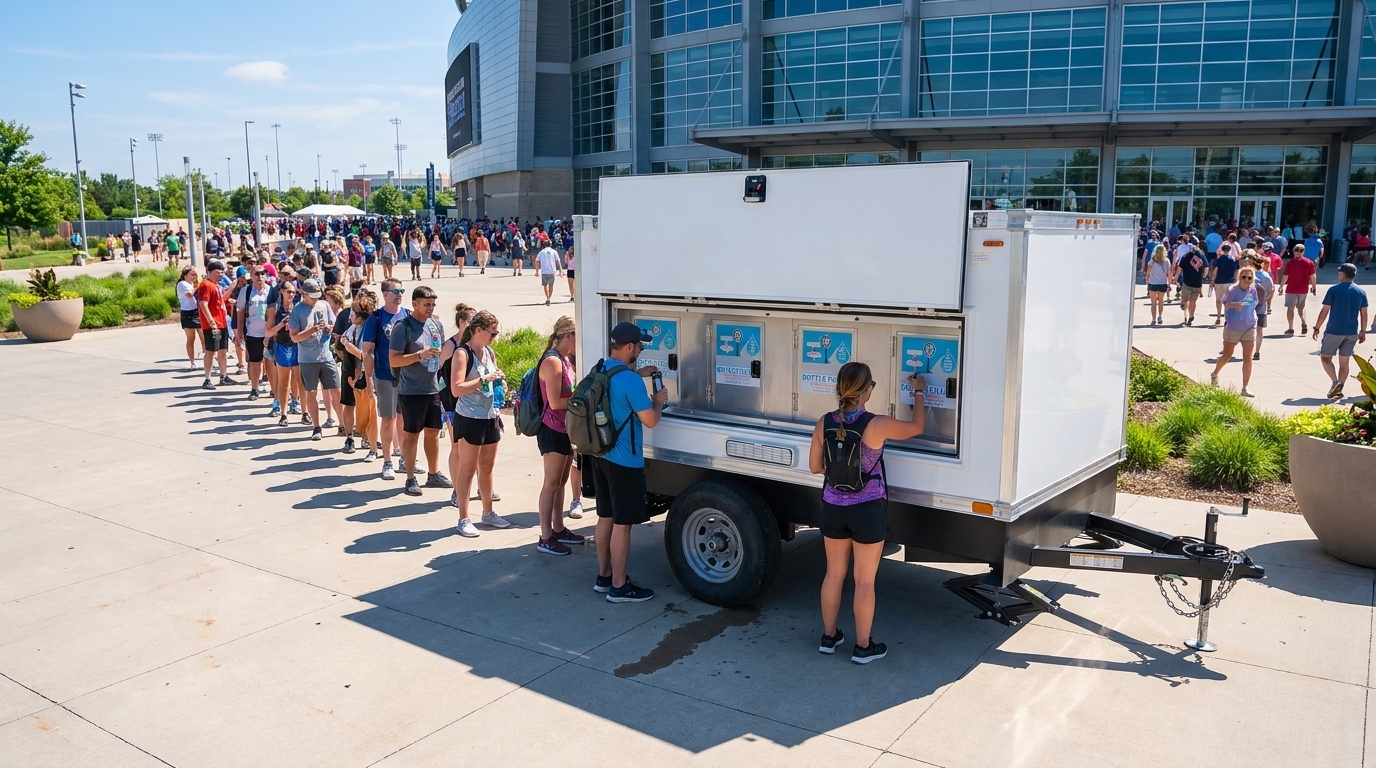
Peak summer is the operative phrase. The Games take place in the heart of the season when inland Los Angeles regularly sits in the mid to upper nineties and higher. Venues away from the coastal breeze, and the transit hubs, fan zones, and queuing areas around them, will see large numbers of people standing in heat for extended periods. Spectators waiting to enter, volunteers directing crowds, and workers staffing concessions and security all need reliable access to drinking water throughout the day, not just at a few fixed fountains.
The workforce side of the Games is easy to overlook but just as demanding as the spectator side. A modern Olympics runs on an army of paid staff, contractors, and volunteers who arrive before the crowds and leave after them. Setup and teardown crews work in the hottest parts of the day, often on hardscape and in areas without permanent water infrastructure. Keeping water on that workforce is both a safety requirement and a practical necessity, because an event this size cannot function if its people are going down with heat illness.
Temporary and reconfigured venues create a specific gap that portable water stations are built to fill. When an event takes over a stadium parking lot, a park, or a street closure for a fan zone or a start and finish area, the built-in plumbing rarely matches the sudden concentration of people. A chilled bottle-fill water station trailer can be positioned exactly where the crowd forms, at an entry plaza, a transit drop-off, or a workforce staging area, and can serve filtered cold water without tapping into stressed venue systems.
Los Angeles already runs large events every year that preview the 2028 demand. The Los Angeles Marathon brings roughly twenty-six thousand runners on a course that stretches from Dodger Stadium to Century City each March, along with the crowds and volunteers who line it. Events at that scale show how quickly water needs concentrate at start areas, finish areas, and along a route, and how much planning goes into meeting them. The Olympics will multiply that challenge across many venues on the same days.
For organizers, vendors, and contractors preparing for 2028, the lesson is to treat hydration as scheduled infrastructure rather than a supply-closet detail. Water stations placed by plan, sized to the expected crowd, and stationed where people actually gather will carry far more of the load than a scramble for bottled cases once the heat sets in. Mavirus Group provides chilled bottle-fill water station trailers across Los Angeles County and is positioned to support the large-event demand that the Games and the events leading up to them will generate.
The window to plan is open now. Los Angeles has years of major test events between today and the opening ceremony, and each one is a chance to work out how crowds move, where they bottleneck, and how to keep them supplied with water. Getting hydration logistics right at those events is the most direct way to be ready when the world arrives in 2028.
Sources: LA28 - Competition Venues · Los Angeles Times - Olympics Coverage
Why Inland Los Angeles Heat Makes Cold Water On Site Essential
People who only know Los Angeles from the coast tend to think of it as a mild place, and along the shoreline that is fair. Beach cities and the coastal strip often top out in the low eighties even in summer, cooled by the ocean breeze. But Los Angeles is really two climates in one county, and the inland half tells a very different story. Move a few miles east into the San Fernando Valley, downtown, or the San Gabriel Valley and summer temperatures routinely climb into the mid nineties and past one hundred degrees. We plan every inland delivery around that split, because years of LA work have taught us the coastal forecast is the most misleading number in the county. Any operation planning around it is planning for the wrong city.
The record makes the point in stark terms. On September 6, 2020, Woodland Hills in the western San Fernando Valley reached one hundred twenty-one degrees, the hottest temperature ever recorded in Los Angeles County. That was an extreme, not an average, but it shows what the inland valleys are capable of. Even a normal summer week puts the Valley, the downtown core, and the eastern county well above anything the coast experiences on the same afternoon. Crews and event staff working those areas feel a heat load the beach never sees.
This split matters because so much of the work in Los Angeles happens inland, exactly where it is hottest. Warehouses and logistics yards, construction sites, film locations, outdoor events, and industrial facilities cluster in the valleys and the inland basin, not on the expensive coastal land. The people doing physical work in those settings are exposed to the highest temperatures in the region, often on asphalt and concrete that push the effective heat even higher than the air temperature suggests.
Cold water is not just a comfort in that environment, it is a functional requirement. Cool water is easier to drink, more appealing when someone is already hot, and more effective at helping the body shed heat. When the only option on a site is water that has been sitting in a warm truck all day, people drink less of it, and drinking less is exactly the wrong response to heat. A chilled supply keeps consumption up, which is what actually protects people through a long, hot shift.
Warm bottled water and melting ice chests are the usual fallback, and on an inland Los Angeles summer day they fall short fast. Cases of water baking in the sun turn tepid within hours, and coolers depend on ice that vanishes right when demand is highest. Restocking means someone leaves the site to make a store run, which costs time and often still cannot keep pace. The result is a supply that fails at the worst possible moment, in the middle of the hottest part of the day.
A chilled bottle-fill water station trailer is designed for exactly this problem. It brings its own filtered water and keeps it cold on site, so a crew or an event can refill personal bottles all day without depending on ice or store runs. Because it is mobile, it can be positioned right where the work is happening, whether that is a construction site in the Valley, an outdoor event downtown, or a facility in the San Gabriel Valley. The water stays cold from the start of the day to the end, which is the whole point.
For any operation working inland, the smart move is to plan hydration around the real local climate rather than the mild coastal reputation. The valleys and the inland basin are hot, sometimes extraordinarily so, and treating cold water as core infrastructure is how responsible operators keep their people safe and productive. Mavirus Group provides chilled bottle-fill water station trailers across Los Angeles County, sized for the inland heat that defines most of the region's working days.
The bottom line is simple. Los Angeles is not one temperature, and the number that matters for a work site or an event is the inland number, not the beach forecast. Building the hydration plan around that reality, with cold water available where people actually are, is the difference between a site that runs smoothly through a heat wave and one that has to slow down or stop.
Sources: National Weather Service - Los Angeles/Oxnard · Los Angeles Times - Woodland Hills Record Heat
Water for Los Angeles Construction Crews Under Cal/OSHA Section 3395
Construction in Los Angeles is booming, and much of it happens in the open under the sun. From the Metro D Line extension pushing west along Wilshire Boulevard, to the modernization of Los Angeles International Airport and its Automated People Mover, to the high-rise towers going up downtown, crews across the region spend their days on exposed sites doing hard physical work. We have staged water on enough of these sites to know the failure mode by heart: it is never the first hour of the shift, it is two in the afternoon, when the ice is gone and the crew is deepest into the work. For every one of those crews, keeping water within reach is not optional. It is written into California law.
The rule is Cal/OSHA Title 8, Section 3395, the state's heat illness prevention standard, and it applies squarely to outdoor construction. The core requirement is that employers provide enough fresh, pure, and suitably cool drinking water for each employee to drink at least one quart per hour, which works out to four eight-ounce glasses every hour worked. On a full shift in the Los Angeles summer, that adds up fast, and it has to be water the crew can actually reach without leaving the work area for long.
The standard also sets temperature triggers that raise the bar as the day heats up. When the temperature reaches eighty degrees, the employer must provide access to shade and encourage workers to take rest breaks in it. At ninety-five degrees, high-heat provisions kick in, adding requirements around observation, communication, and more frequent breaks. Given that inland Los Angeles construction sites in the Valley, downtown, and the San Gabriel Valley regularly blow past both of those thresholds in summer, these are not edge-case rules. They apply on ordinary working days.
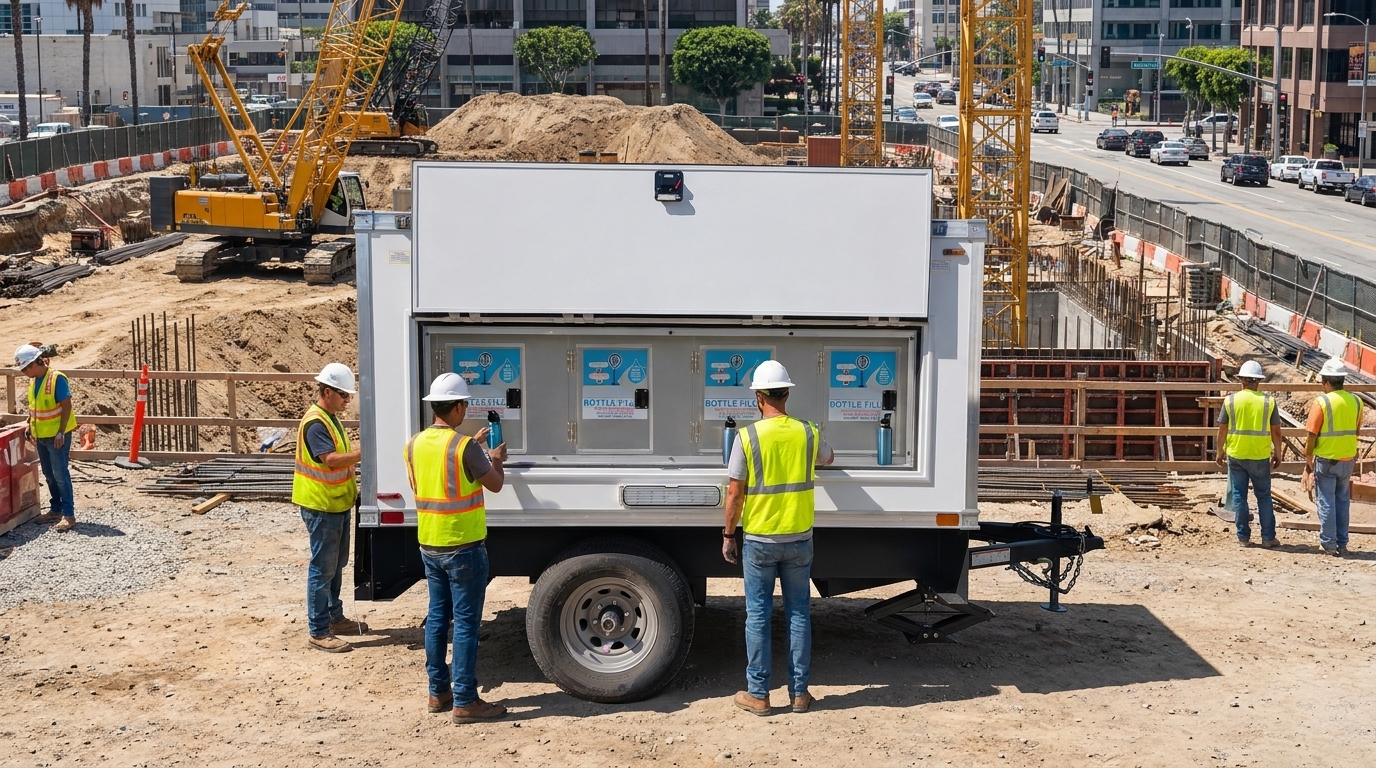
Meeting the water requirement sounds simple until you scale it to a real site. A crew of thirty people on a hot day needs many gallons of cool water available continuously, replenished throughout the shift, and kept cool enough that people will actually drink it. Coolers and bottled cases can technically hit the number on paper, but they depend on ice that melts and on someone constantly restocking. When the ice runs out at two in the afternoon, the water stops being suitably cool, and the site is out of compliance at the exact moment the heat is worst.
Large infrastructure projects add their own wrinkle. Sites like a subway extension, an airport people-mover, or a downtown tower are big, spread out, and often lack convenient plumbing where the crews are actually working. Workers may be far from any building or fixed water source, deep in an excavation or high on a structure. Getting cool water to those positions reliably, hour after hour, is a logistics problem that a stack of cases in a job trailer does not really solve.
A chilled bottle-fill water station trailer is built to meet the Section 3395 standard directly. It supplies filtered, genuinely cool water in volume and keeps it cool on site all day, so a crew can refill throughout the shift without relying on melting ice or store runs. Positioned near the work, it makes the required quart-per-hour easy to actually deliver rather than something a foreman has to scramble to maintain. For a general contractor, that turns heat compliance from a daily worry into a solved piece of the setup.
The stakes go beyond citations. Heat illness on a construction site can put a worker in the hospital and a project behind schedule, and the human cost is the part that matters most. Reliable cool water is the single most direct control the standard emphasizes, and it is the one most within an employer's power to get right. Mavirus Group provides chilled bottle-fill water station trailers across Los Angeles County, sized to keep large construction crews supplied and compliant through the hottest part of the year.
For any contractor bidding or running work in the Los Angeles summer, hydration should be planned into the site the same way power, sanitation, and site security are. Building the water supply around the real requirement, delivered cool and available where the crew is, keeps people safe and keeps the project moving, which is what everyone on the site is there to do.
Sources: Cal/OSHA - Title 8 Section 3395 Heat Illness Prevention · Cal/OSHA - Heat Illness Prevention Resources
Wildfire Base-Camp and Emergency Hydration in Los Angeles County
Los Angeles County lives with wildfire as a fact of life, and every fire season the region stands up large emergency operations to fight it. When a major fire breaks out, agencies including Cal Fire and the Los Angeles County Fire Department build base camps and staging areas to support crews on the line. These camps house hundreds or thousands of firefighters, support personnel, and equipment, often in remote or hastily chosen locations with no existing water infrastructure. Keeping everyone at those camps supplied with water is a basic, non-negotiable part of the response.
The January 2025 firestorm showed how large and sudden this need can be. The Palisades and Eaton fires burned across Los Angeles County that month in one of the most destructive fire events in the region's history, forcing enormous emergency mobilizations and displacing tens of thousands of residents. Events on that scale put extraordinary demand on every part of the support system, including drinking water for the crews doing the physical, exhausting work of fighting fire in dry, hot conditions.
Firefighting is among the most physically punishing work there is, and it happens in exactly the conditions that drive dehydration hardest. Crews wear heavy protective gear, carry equipment, and work near active fire where the ambient heat is extreme, often for many hours at a stretch before they rotate back to camp. When they come off the line, base camp has to be able to rehydrate them fast and reliably. A camp that cannot keep cool water flowing cannot keep its crews in the fight safely.
The remote, improvised nature of fire camps is the core logistics challenge. These operations get set up wherever the fire dictates, frequently in areas with no plumbing and no dependable water source nearby. Everything the camp needs has to be brought in and sustained for as long as the incident runs, which can be days or weeks. Drinking water in that setting is not a convenience to be sorted out later, it is a core supply line that has to hold up under heavy, continuous demand.
Wildfire is not the only emergency that drives hydration need in Los Angeles County. During heat waves, the county and its cities open cooling centers where residents can escape dangerous temperatures, and outreach teams work to reach vulnerable people. That work matters especially for the region's large unhoused population. The Los Angeles Homeless Services Authority has counted roughly forty-five thousand unhoused people in the city and around seventy-five thousand across the county, and many of them face extreme heat with little shelter and no easy access to drinking water.
A chilled bottle-fill water station trailer fits both of these emergency roles. At a fire base camp, it delivers a self-contained supply of filtered, cool water that firefighters can use to refill throughout their rotations, without depending on a fragile chain of bottled cases in a remote location. At a cooling center or a heat-wave outreach staging area, it provides accessible cold water to people who need it most during a dangerous stretch of weather, in the exact spots where crowds and outreach efforts gather.
Because these trailers are mobile and carry their own water, they can be positioned quickly where an incident or a heat response demands, which is what emergency operations require. When a fire camp moves or a cooling operation expands, the water source can go with it. Mavirus Group provides chilled bottle-fill water station trailers across Los Angeles County, ready to support base-camp operations and emergency hydration efforts when the county needs to move fast.
The through-line across wildfire response and heat-wave relief is the same. Los Angeles County faces recurring emergencies where large numbers of people, whether working crews or vulnerable residents, need reliable access to cool water in places that have none built in. Planning that supply as core emergency infrastructure, deployable on short notice, is how the region keeps its responders effective and its people safe when conditions turn dangerous.
Sources: Cal Fire - Incidents · Los Angeles Homeless Services Authority