Home / Services / Utah
Utah

Mobile Private Portable Shower Trailer Rentals in Utah

Mavirus Group runs portable shower trailers across Utah, from Wasatch Front jobsites to remote well pads, fire camps, and base camps. Self-contained units with continuous hot water, delivered, set up, and serviced daily anywhere in the state.

Portable showers in Utah

Why Utah crews and response teams call us for showers

Mavirus Group is a national provider of portable sanitation, shower, laundry, water, freezer, and support trailers built for large-scale, government, disaster, construction, and commercial operations. We are a SAM.gov registered federal contractor with a 24/7 booking and emergency dispatch line. Utah is a core service state for us. Whether the crew is pouring foundations at Point of the Mountain, drilling in the Uinta Basin, or staging for a fire in the Uinta-Wasatch-Cache, we deliver, set up, service daily, handle greywater and waste, and pick up. You get a local level of service anywhere in the state.

24/7emergency dispatch
8-stallhigh-output units
ADAaccessible suites
Off-gridno hookups needed
Our Shower Trailer Fleet

Meet the private shower trailers we deliver to Utah

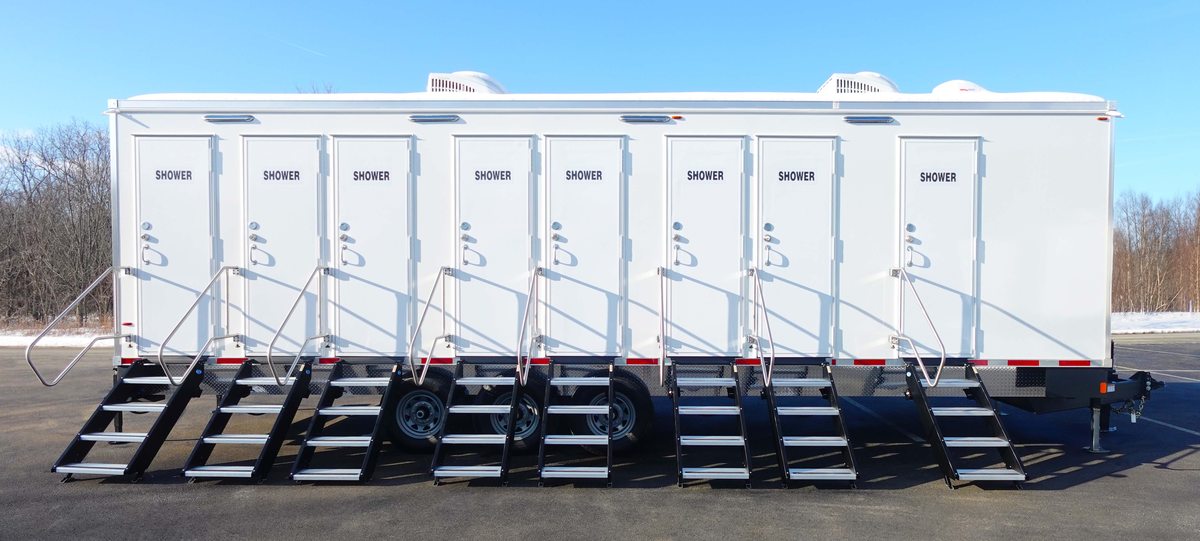
A Mavirus private shower trailer with individual locking stalls, ready for Utah delivery
A Mavirus private shower trailer, individual locking stalls with continuous hot water

Our shower trailers give every person a private, locking stall with a bench, hooks, ventilation, and continuous hot water. The fleet runs from a single accessible suite to an eight stall unit, plus combos that fold private showers in with restrooms or laundry. With disciplined flow a large unit turns over dozens of showers an hour, which is what a fire camp or a workforce site needs at shift change.

The trailers are self-contained. Continuous water heating, onboard tanks, and full greywater capture let a mobile shower unit run at a remote site with no hookups, and it connects to water and power when the site has them. We size the number of stalls to your crew so the line clears before the next shift rolls in.

Every stall is sanitized between rentals and serviced daily where the mission demands it. Delivery, setup, hot water, greywater handling, restocking, and pickup are all part of the rental, and an ADA-accessible shower suite with ramp entry and grab bars comes standard as an option. For a shift change at a Uinta Basin well pad or a fire camp in southern Utah, a single large unit turns over dozens of showers an hour. It runs off-grid too, with onboard water, heating, and full greywater capture when the site has no hookups.

Where they go to work

Portable shower units built for Utah's biggest jobs

Utah runs on construction, energy, mining, and a full-time response mission. In every one of them, people work far from a locker room. Here are the three places our temporary shower units earn their keep across the state.

Commercial construction

Temporary showers for the Wasatch Front build-out

The Wasatch Front is in the middle of a construction cycle that does not let up. The Point, the 600-acre district rising on the old Utah State Prison site at Point of the Mountain in Draper, broke ground on its 104-acre downtown core in June 2026, with the Mountain America Event Center, the Chroma residential blocks, and the two-thousand-foot Promenade all under way at once. That is thousands of trade workers on one footprint, and many of them are on site before the permanent facilities exist.

Up and down the Silicon Slopes corridor from Lehi to Draper, and out at the Salt Lake City International Airport, it is the same story. The airport rebuild is the largest project in Utah history, and its final Concourse B gates are still being finished into 2026 and early 2027. Big vertical work means big crews, long shifts, and a real need for clean, private showers that do not depend on a drive back to town.

Then there are the data centers, which have become their own construction sector here. The QTS campus in Eagle Mountain is a five-building, 193-acre build. Larger sites in Box Elder County and the Delta area are measured in tens of thousands of acres. These campuses sit on the edge of town with limited utilities during the shell phase, so a self-contained mobile shower unit is often the only way to give crews a place to clean up.

For general contractors and workforce basecamps, we place portable shower trailers that run off-grid on onboard water and heating, capture all greywater, and connect to site water and power once it is available. We deliver, set up, service daily, restock, and handle the waste. Your superintendent makes one call to one crew, and the showers are covered from the first pour to final closeout.

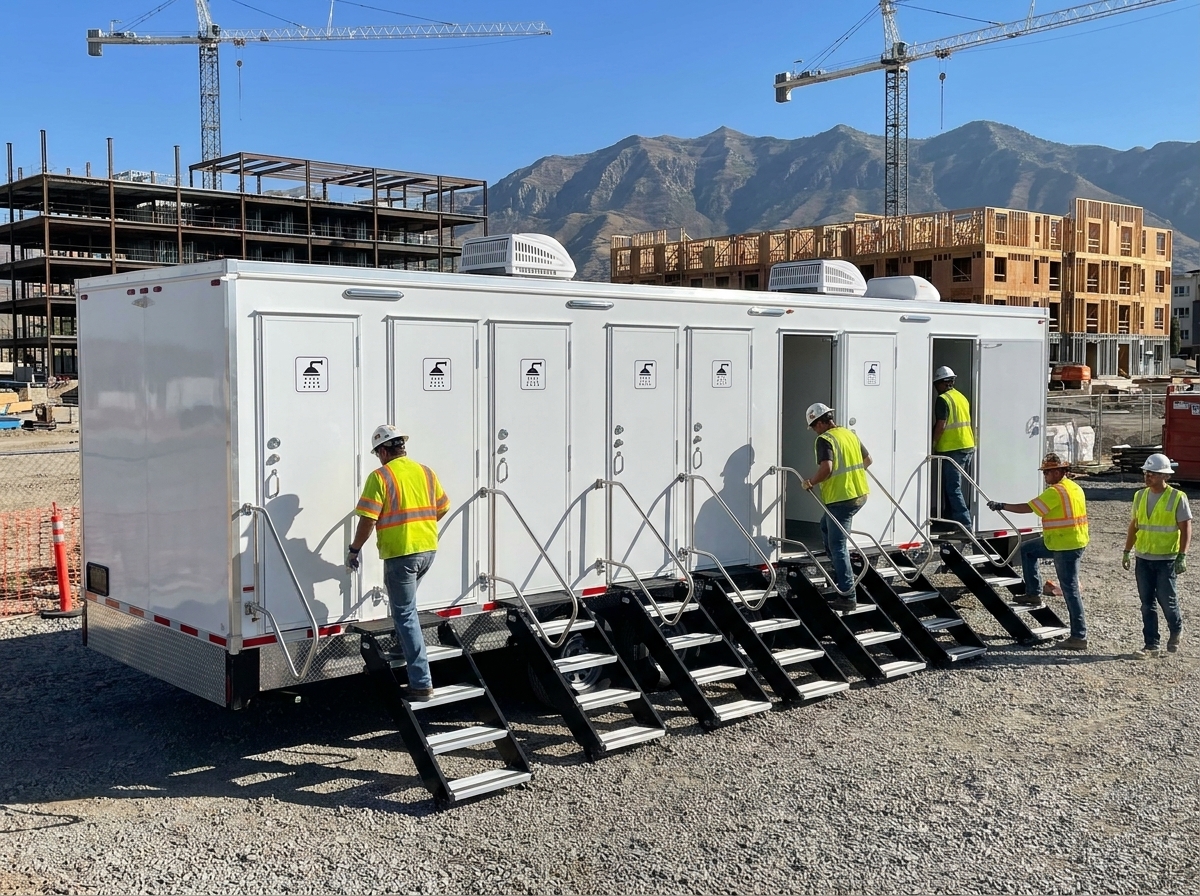
Construction workers in hard hats and hi-vis vests stepping into a clean multi-stall shower trailer at a large Wasatch Front jobsite, cranes and framed buildings behind, Point of the Mountain ridgeline in the distance
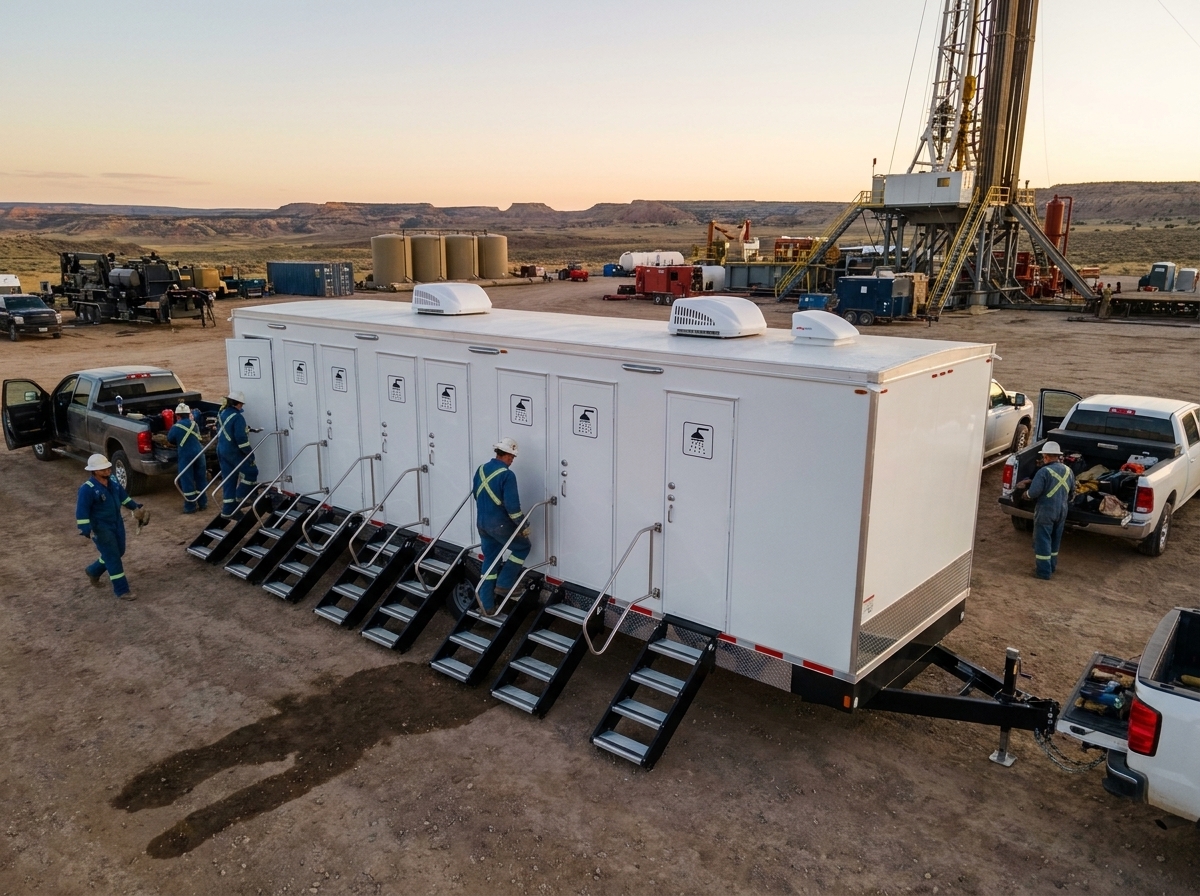
Oilfield and mining workers in coveralls at a remote Uinta Basin well pad, a self-contained shower trailer parked beside pickup trucks and equipment, high desert plateau and drilling rig in the background at dusk
Energy and mining

Off-grid shower units for Uinta Basin and Kennecott crews

Eastern Utah's Uinta Basin is oil and gas country. Operators are landing horizontal laterals in the stacked pay of the Monument Butte Field and across Uintah and Duchesne counties, and a lot of that work happens on remote pads with the nearest motel an hour of gravel road away. When crews are living close to the job, staying clean is not a luxury, it is how you keep a rotation healthy and on schedule.

West of Salt Lake City, Rio Tinto Kennecott's Bingham Canyon operation is one of the largest private employers in the state, with more than two thousand workers and an active South Wall Pushback in progress. Large industrial sites like this run around the clock, and contractors brought in for expansion and maintenance turns often need their own clean-up facilities separate from the permanent plant.

Our units are made for this. A large private shower trailer runs entirely off-grid, carrying its own water and heating and capturing every gallon of greywater, so it drops onto a pad or a laydown yard with no hookups required. When shift change hits, continuous high-output hot water means the whole crew cycles through fast instead of waiting in line at a single stall.

We handle the parts that slow a field operation down. Delivery to remote coordinates, setup, daily service and restock, greywater pump-outs, and pickup when the job moves. For energy and mining operators already juggling water hauling and waste logistics, letting one provider own the shower side keeps the camp clean and the paperwork simple.

Military and emergency response

Mobile shower banks for fire camps and base camps

Utah's 2026 fire season started early and hard. By the first week of July the state had already seen close to 390 wildfires and nearly 296,000 burned acres, on the back of a record-warm winter and record-low snowpack. The Great Basin Coordination Center in Salt Lake City mobilizes crews and equipment across the region, and when an incident management team stands up a camp in the Uinta-Wasatch-Cache or out on BLM ground, decon and shower capacity is part of the base plan from day one.

A large mobile shower unit is built for exactly that tempo. One unit turns over dozens of showers an hour, which is what a fire camp needs at shift change when two hundred tired crew members come off the line at once. It runs off-grid with onboard water and greywater capture, so it works at a spike camp with no infrastructure, and it gets sanitized between rentals and serviced daily while it is deployed.

The military mission here is just as steady. Hill Air Force Base in Davis County is launching a multiyear, billion-dollar East Campus build for the F-35 and T-7A. Camp Williams is absorbing roughly two thousand Army Reserve soldiers and hundreds of full-time staff relocating from Fort Douglas, and it runs annual training surges and exercises like Wolverine. Dugway Proving Ground sits far out in the west desert. All of these create moments when troop hygiene has to be stood up fast and off-grid.

As a SAM.gov registered federal contractor with a 24/7 emergency dispatch line, we are set up to answer that call. We stage temporary shower units for National Guard annual training, base camps, disaster shelters, and post-event response, with delivery, setup, daily service, greywater handling, and pickup all included, so the incident commander or the unit is not managing a vendor, just getting clean crews back to work.

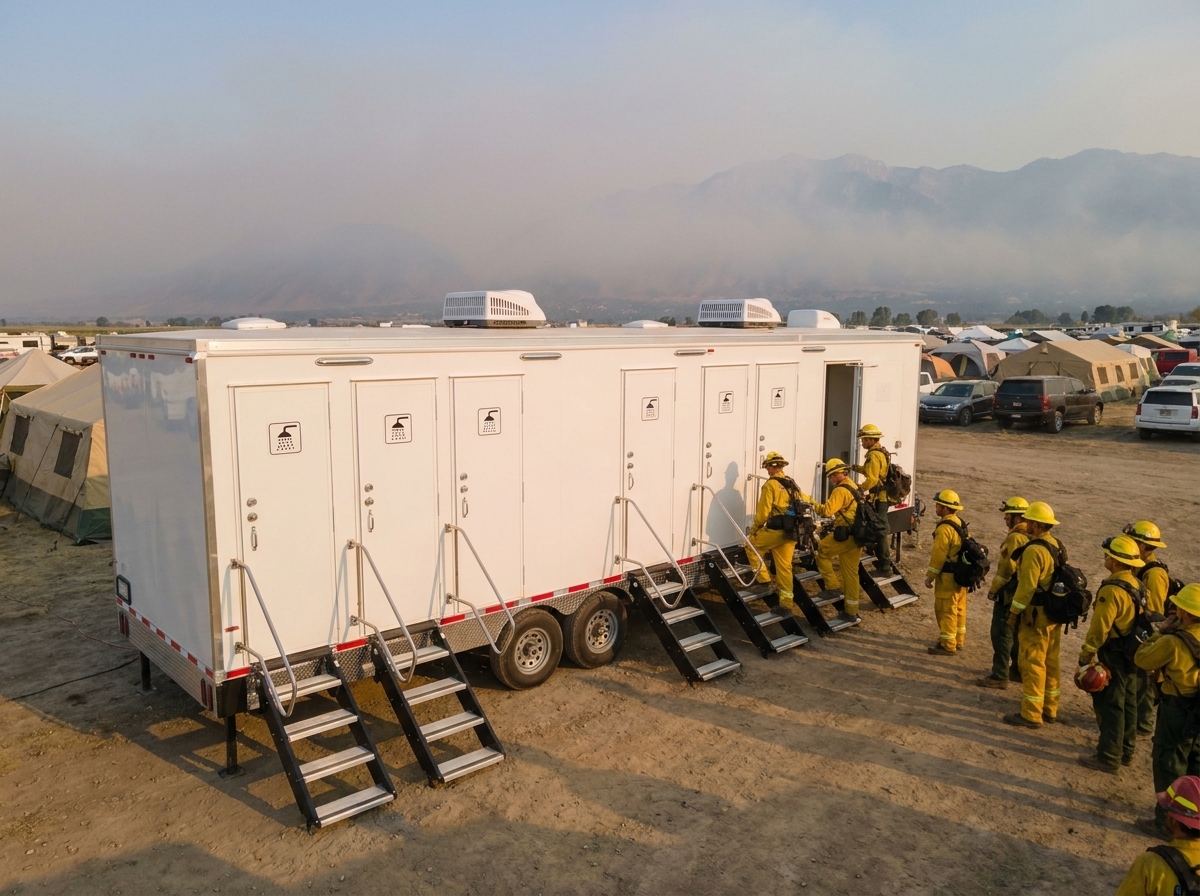
Wildland firefighters in yellow Nomex coming off the line at a Utah fire camp at dusk, lined up at a large multi-stall shower trailer, incident tents and the Wasatch range smoke haze behind them
More ways Utah puts them to work

Agencies and institutions across Utah that book us

Government and agency contracts

We are SAM.gov registered and set up to serve state and federal work, from US Forest Service and BLM Utah projects to Utah Division of Emergency Management activations. Delivery, service, and greywater handling are all in scope.

School districts and campus projects

Utah passed some of the largest school bonds in the country, including Alpine's nine new schools and Davis and Jordan district rebuilds. When a campus is torn up for modernization, we keep clean facilities on site for the crews and staging teams.

Disaster and emergency shelters

When flooding, fire, or a mass-care event forces a shelter to stand up, we bring shower capacity that runs without hookups. Units are sanitized between rentals and serviced daily throughout the deployment.

Corporate and industrial campuses

Manufacturing plants, distribution hubs, and energy facilities across the Wasatch Front use our units for shutdowns, expansions, and turnaround work where the permanent locker rooms cannot absorb an extra contractor crew.

Public lands and national parks

Trail, road, and facility crews working in and around the Mighty 5 and the national forests often sit hours from any hookup. Our off-grid shower suites travel to the work and keep remote crews clean and productive.

Events and gatherings

For the occasional large gathering that needs real showers, we can supply clean, private stalls. This is a smaller part of what we do, and our core focus stays on construction, government, and response work.

Oilfield and mining workers in coveralls at a remote Uinta Basin well pad, a self-contained shower trailer parked beside pickup trucks and equipment, high desert plateau and drilling rig in the background at dusk
Why demand runs year round

Every Utah season keeps our units busy

Utah does not have a single busy season, it has four. Summer and early fall belong to wildfire, when crews stage camps across the high country and the desert on almost no notice. The 2026 season made that plain, with hundreds of fires burning before the middle of July.

The building season runs long here, and the Wasatch Front cranes rarely stop. Data center shells, the airport, and the Point of the Mountain district push crews through spring, summer, and fall, and much of that work starts before permanent facilities exist on site.

Winter shifts the map to the mountains. Resort expansions in the Cottonwood canyons and around Park City, including Deer Valley's multiyear base-village and terrain build, keep contractors working through the cold at elevation. A deluxe shower suite that carries its own heat and water keeps that work going when the ground is frozen and there are no hookups.

Why Choose Us

What sets our shower trailers apart

One provider from the Wasatch Front to the west desert

Utah jobs do not stay in one county. A single project can pull crews from Salt Lake to a Uinta Basin pad to a Dugway range road. We run the whole state as one service area, so you get the same delivery, daily service, and greywater handling whether the unit lands in Draper or two hours out on gravel.

Private, individual stalls

Every person gets a locking stall with a bench, hooks, and working ventilation, not an open bay. A crew that showers in private tonight works tomorrow.

Hot water sized for shift change

Continuous, high output water heating means the last person in line gets the same hot shower as the first, so sixty crew clear through a bank of stalls without the water running cold.

Greywater handled completely

Onboard capture and managed disposal mean a shower line runs at a remote camp with no drain, and nobody on your team deals with wastewater.

Self-contained, goes anywhere

Onboard water tanks and heating let a mobile shower trailer run fully off grid at a fire camp or staging area, and it connects to hookups when the site has them.

Built for scale and agencies

From a small shelter to a large fire or disaster deployment, with a 24/7 line for emergencies. As a SAM.gov registered contractor we work with Cal Fire, the US Forest Service, FEMA, and other agencies.

ADA accessible

A wheelchair-accessible shower suite with ramp entry, a roll-in threshold, a fold-down seat, and grab bars is available for any placement, so shelters and public agencies clear inspection.

Customer Stories

A few Utah jobs we have handled

General contractor, Point of the Mountain district

A GC staging trade crews on the downtown core at the Point needed showers before the permanent buildings were dried in. We set two multi-stall private shower trailers on the laydown yard, ran them off site water once it was live, and serviced them daily through the framing phase so the crews stayed on site instead of losing time driving off to clean up.

Incident management team, southern Utah fire

When a fast-moving fire pushed a base camp onto BLM ground with no infrastructure, the team needed shower capacity for a couple hundred crew at shift change. We rolled in a large off-grid unit that turned over dozens of showers an hour, kept it sanitized and serviced through the deployment, and pulled it once the camp demobilized.

Energy operator, Uinta Basin well pad

A drilling operator running a remote pad in Duchesne County wanted clean facilities for a rotating crew living close to the work. We delivered a self-contained mobile unit to the coordinates, handled greywater pump-outs on a schedule, and kept the unit running through the rotation so the crew stayed healthy and on the job.

Around the Region

Utah regions we cover

Wasatch Front

Salt Lake City, Ogden, Provo, Lehi, and Draper hold most of the state's people and most of its big construction. This is where data centers, the airport, and the Point of the Mountain district are pulling large crews that need clean facilities on site.

Uinta Basin

Vernal, Roosevelt, and Duchesne anchor Utah's oil and gas country. Remote well pads far from any lodging make self-contained, off-grid shower units a practical necessity for the crews working them.

Wasatch Back

Park City, Heber, and the Cottonwood canyon resorts drive winter and shoulder-season construction at elevation. Deer Valley's multiyear base-village and terrain build keeps contractors working through the cold with no easy hookups.

Southern Utah and Dixie

St. George, Cedar City, and the corridor to the Mighty 5 national parks combine fast growth with heavy wildfire exposure. Fire camps and remote public-lands crews both lean on units that travel to the work.

Tooele Valley and the west desert

Tooele, Grantsville, and the vast range around Dugway Proving Ground put crews far off the grid. When there is no infrastructure for miles, an onboard-water shower unit is the only clean option that makes sense.

Cache Valley

Logan and the northern valley bring their own construction, campus, and agricultural work. We reach it as part of the same statewide service, with the same daily service and greywater handling.

The Utah rules we work within

Greywater, health department, and access rules we handle for you

Utah regulates greywater under Administrative Code R317-401. Greywater is defined as wastewater from showers, tubs, bathroom washbasins, and laundry, and it specifically does not include waste from toilets or kitchens. The regulatory authority is the Utah Division of Water Quality or the local health department with jurisdiction, so a unit's captured water has to be handled and disposed of correctly, not dumped on the ground.
For mobile units, local health departments apply their mobile establishment guidance, which sizes the onboard greywater tank larger than the potable tank so a unit can operate through a shift without overflowing. We size, capture, and pump out greywater on a schedule that keeps every placement compliant, and we coordinate with the county health department when a site or event requires plan review.

Accessibility matters too. For any public-facing or worksite placement, we can supply an ADA-accessible shower suite with ramp entry, a roll-in threshold, a fold-down seat, and grab bars. Tell us where the unit is going and what agency oversees it, and we make sure the placement meets the rules before anyone steps in.

Service Area

Serving all of Utah, statewide

From the Wasatch Front metros to the Uinta Basin and the west desert, we deliver and service portable shower units across the whole state. These are some of the communities we cover.

Salt Lake CityWest Valley CityOgdenProvoOremSandyWest JordanSouth JordanDraperLehiLaytonBluffdaleHerrimanTooeleGrantsvillePark CityHeber CityLoganVernalRooseveltDuchesneSt. GeorgeCedar CityEagle Mountain
Reviews

What Utah crews and coordinators say

Ryan T., project superintendent, Draper
Ryan T.project superintendent, Draper
★★★★★

We had crews on the Point of the Mountain site before the permanent facilities were in. Mavirus dropped shower units on the laydown yard and serviced them every day. Zero drama, and my guys stopped burning an hour driving to clean up.

Marisa H., logistics lead, Salt Lake City
Marisa H.logistics lead, Salt Lake City
★★★★★

Standing up a base camp on short notice is stressful. Their dispatch line actually answered, the unit showed up when they said it would, and the greywater was handled without me having to think about it.

Cole B., field supervisor, Duchesne County
Cole B.field supervisor, Duchesne County
★★★★★

Our pad is a long way from anything. They delivered to the coordinates, kept the hot water running for the whole rotation, and pumped the greywater on schedule. Exactly what a remote crew needs.

Angela M., facilities coordinator, Ogden
Angela M.facilities coordinator, Ogden
★★★★★

During a campus project we needed clean, private showers for the crews without touching the permanent buildings. The ADA suite they brought was clutch and everything stayed serviced start to finish.

Derek S., operations manager, Tooele
Derek S.operations manager, Tooele
★★★★★

Off-grid means off-grid out here. Their trailer ran on its own water and heat with no hookups for weeks. One provider, one call, and the whole shower side was covered.

FAQ

Frequently asked questions

Do your portable showers work off-grid with no hookups?
Yes. Every unit carries onboard water tanks, its own water heating, and full greywater capture, so it runs completely self-contained. That is what makes it work on a remote Uinta Basin pad, a spike fire camp, or a data center shell before utilities are live. When a site does have water and power, we connect to it, which extends how long the unit runs between service visits.
How fast can you get a unit to a Utah site?
We run a 24/7 booking and emergency dispatch line specifically because construction and response work does not keep business hours. For a planned project we schedule delivery around your timeline. For an emergency activation or a fire camp, call the dispatch line and we move as fast as the roads and logistics allow, anywhere in the state.
Can a single unit handle a large crew at shift change?
Yes. A large mobile shower unit turns over dozens of showers an hour, which is built for the moment when a full crew comes off the line or off shift at once. Continuous high-output hot water means people cycle through fast instead of waiting on a single stall. For very large camps we can place multiple units.
Do you handle the greywater and waste, or is that on us?
We handle it. Delivery, setup, daily service, restocking, greywater and waste handling, and pickup are all included in the rental. Utah regulates greywater under Administrative Code R317-401, so it has to be captured and disposed of correctly, and we manage that as part of the service so you stay compliant.
Do you have ADA-accessible shower units?
Yes. We can supply an ADA-accessible shower suite with ramp entry, a roll-in threshold, a fold-down seat, and grab bars for any placement. For public-facing sites, shelters, and worksites that require accessible facilities, just tell us and we bring the right configuration.
Are you set up for government and federal contracts in Utah?
Yes. Mavirus Group is a SAM.gov registered federal contractor, and we serve state and federal work regularly, from US Forest Service and BLM Utah projects to National Guard training and emergency activations. We understand agency logistics and staging and can coordinate directly with your contracting or incident team.
Can you serve remote parts of Utah like the Uinta Basin or the west desert?
Yes, and it is a big part of what we do. Off-grid units are made for remote coordinates far from lodging, whether that is an oil and gas pad in Duchesne County, a range road near Dugway, or a public-lands crew in southern Utah. We deliver to the site, service on a schedule, and pick up when the job moves.
Do you offer combo trailers with restrooms or laundry?
Yes. Alongside private shower stalls we offer combo units that pair showers with restrooms or laundry, plus our broader fleet of restroom, water, freezer, and support trailers. For a workforce camp, combining functions in fewer units can simplify your footprint and your logistics.
What sizes of shower unit are available?
The fleet runs from a single ADA-accessible suite up to an eight-stall unit, with combos in between. We match the size to the crew and the site. A small crew on a short job might take one suite, while a fire camp or a large construction workforce gets one or more of the high-capacity units.
How are the units kept clean between users and rentals?
Each unit is sanitized between rentals and serviced daily while it is deployed. Every stall is a private, locking space with a bench, hooks, and ventilation. On multiday jobs our service crew restocks and cleans on a set schedule so the trailer stays in the same condition it arrived in.
Do you serve ski-resort and mountain construction sites?
Yes. Winter work at elevation in the Cottonwood canyons and around Park City is a real season for us. Because the units carry their own heat and water, they keep working when the ground is frozen and there are no hookups, which is exactly the condition on a mountain base-village build.
Do we need to be based in Utah to book?
No. Plenty of our clients are national GCs, agencies, and operators mobilizing crews into Utah from out of state. We handle the local delivery, service, greywater, and pickup on the ground here so you can manage the project from wherever your office is.
Resource Library

Utah portable shower resource library

Off-grid shower logistics for Wasatch Front construction jobsites

Utah's Wasatch Front is building faster than its own infrastructure can keep up. On a large jobsite, crews often show up before the permanent facilities exist, and that gap is where portable shower logistics matter. Get it right and your workforce stays clean, on site, and productive instead of losing hours to off-site clean-up runs.

Start with the phase of the build. During excavation and early structure work, most big sites have no usable plumbing. A self-contained shower unit that carries its own water and heating and captures all greywater is the only thing that works, because there is nothing to hook into. As site utilities come online, that same unit can connect to water and power, which stretches the interval between service visits and cuts hauling.

Placement is the next call. Put the unit near the laydown yard or the crew parking, close enough that workers actually use it at the start and end of shift but clear of crane swing and haul routes. On a tight urban infill site the footprint is small, so a single high-capacity mobile unit that turns over dozens of showers an hour usually beats several smaller ones. On a sprawling data center build, a unit near each active zone saves crews a long walk and gets more of them cleaning up instead of skipping it.

Think about shift patterns. A site running one day shift has a single peak. A site running double shifts or around-the-clock pours has two or more, and the shower capacity has to absorb each one without a line forming. Size to the peak, not the average headcount. If you add a second shift halfway through the schedule, revisit the shower plan then, before the line at the trailer turns into a daily complaint.

Greywater is a compliance question, not just a convenience. Utah regulates greywater under Administrative Code R317-401, and disposal has to go through the proper channels rather than onto the ground. A provider that captures and pumps out greywater on a schedule keeps the site clean and keeps the general contractor out of a regulatory problem.

Service cadence separates a good rental from a bad one. Daily service, restocking, and sanitizing while the unit is deployed keeps it in the condition the crew expects. On a multiyear project like a data center campus or the Point of the Mountain district, that consistency over many months is the whole point. A trailer that shows up clean and then degrades because nobody services it is worse than useless, because crews stop trusting it and stop using it.

Consolidate vendors where you can. One provider that owns delivery, setup, daily service, greywater, and pickup means the superintendent makes one call instead of chasing three. On a complex site with dozens of subs, that simplicity is worth as much as the equipment. It also gives you one point of accountability when something has to change, whether you add headcount, move the unit to a new pad, or extend the schedule by months.

The bottom line is to plan the shower side with the same seriousness as the rest of site logistics. Do that, and clean facilities are one less thing a busy superintendent has to worry about on a Wasatch Front build.

Shower and decon capacity for Utah wildfire base camps

Utah's wildfire seasons keep getting longer and more intense, and 2026 made the point early, with hundreds of fires and hundreds of thousands of acres burned before the middle of summer. Behind the crews on the line is a base-camp operation that has to feed, rest, and clean a large workforce in a place that had no infrastructure the day before. Shower and decon capacity is a core part of that plan.

The Great Basin Coordination Center in Salt Lake City coordinates the mobilization of resources across Utah and the wider region. When an incident management team stands up a camp, the logistics section builds out sleeping, feeding, medical, and hygiene from scratch, often on BLM or Forest Service ground with no water or power for miles.

That is exactly the condition an off-grid shower unit is built for. Onboard water tanks, onboard heating, and full greywater capture let a unit drop at a spike camp and run without a single hookup. When the site later gets a water source, the unit connects and runs longer between service visits. In terrain like the Uinta-Wasatch-Cache National Forest, where a camp can sit at the end of a rough forest road, that self-contained capability is the only thing that works.

Capacity has to match the tempo of a fire camp. At shift change, a whole division can come off the line at once, tired, dirty, and due back out in a few hours. A large mobile unit that turns over dozens of showers an hour keeps that rotation moving instead of stacking people in a line. For a big camp, run multiple units in parallel. Getting crews cleaned up and rested faster feeds directly into how sharp and safe they are on the next operational period.

Sanitation between users and between rentals is not optional on an incident. Crews live in close quarters, and a hygiene failure can pull firefighters off the line as surely as the fire can. Units that are sanitized between rentals and serviced daily hold the standard the camp needs through a long deployment. On a fire that runs for weeks, that daily discipline keeps a small problem from spreading through a camp of hundreds.

Speed of response is the other half of the job. Fires do not schedule themselves, so a 24/7 emergency dispatch line and the ability to move fast to remote coordinates is what makes a shower vendor useful to an incident management team. The unit has to arrive as the camp is forming, not days later.

Demobilization matters too. When the incident winds down, the camp breaks apart fast, and the equipment has to come out just as fast so it is not stranded. A provider that owns delivery, service, and pickup end to end keeps the demob clean and coordinates the pull with the logistics section, so the shower units are not the last thing holding up the release of the ground.

For agencies and contractors supporting Utah's fire mission, the takeaway is simple. Treat shower and decon as base-camp infrastructure, plan it into the incident from the start, and work with a provider that can stand it up off-grid and keep it serviced until the last crew rolls out.

Workforce hygiene on remote Uinta Basin energy sites

Eastern Utah's Uinta Basin is one of the state's most productive oil and gas regions, with operators drilling horizontal laterals in the Monument Butte Field and across Uintah and Duchesne counties. It is also remote. Many pads sit a long way down gravel from the nearest town, and that distance shapes how crews live and how they stay clean.

When workers are on a multiday rotation close to the pad, staying clean is tied directly to safety and retention. A crew that cannot wash up at the end of a shift gets worn down and starts making mistakes. Reliable showers are part of keeping a rotation healthy and productive, not a comfort add-on.

The catch is that these sites usually have nothing to hook into. That is where a self-contained portable shower trailer earns its place, carrying its own water and heating and capturing all greywater so it runs at the coordinates with nothing else in place. It is the same off-grid capability that makes these units work at a mine expansion or a fire camp, so a shower plan for the basin has to start from the assumption that there is no infrastructure at all.

Water logistics are already a fact of life in the basin, where produced water and hauling are constant considerations. Adding a unit that captures greywater and gets pumped out on a schedule folds right into an operation used to managing water in and water out. A provider that handles the greywater side keeps one more thread off the operator and coordinates deliveries and pump-outs around the access windows the pad already runs on.

Sizing follows the crew. A small pad crew might need a single suite, while a larger drilling or completion operation staging many workers wants a high-capacity unit that can absorb shift change without a wait. Match the unit to the headcount and the shift pattern up front, rather than discovering mid-rotation that the trailer is undersized for the crew on the pad.

The same logic applies west of Salt Lake City at large industrial operations like Rio Tinto Kennecott's Bingham Canyon mine, where contractors brought in for expansion and turnaround work often need their own clean-up facilities apart from the permanent plant. Off-grid shower units serve those laydown yards the same way they serve a well pad, dropping in near the work so a temporary crew never competes with the permanent workforce for the built-in facilities.

Service reliability is what makes the arrangement work over a long rotation. Daily service, restocking, and greywater pump-outs on a set schedule keep the unit usable for weeks without the operator babysitting it. Out here a service truck is a real drive, so that dependability is the whole value, because a broken or overflowing unit on a remote pad is not a quick fix and the crew feels it immediately.

For energy and mining operators working Utah's remote ground, treat crew hygiene as part of the site plan and hand the shower logistics to a provider that already runs off-grid and manages greywater. It keeps the camp clean and the crew on the job.

Meeting Utah greywater and health department rules for mobile showers

Renting a shower unit in Utah is not just about the equipment. Once a unit is producing wastewater, it falls under a set of state and county rules that govern how that water is captured and disposed of. Knowing those rules ahead of time keeps a placement compliant and keeps the client out of trouble.

The foundation is Utah Administrative Code R317-401, which governs graywater systems. The code defines graywater as wastewater from showers, tubs, bathroom washbasins, and laundry, and it explicitly excludes waste from toilets and kitchens. A shower unit's output falls squarely in that graywater category, which shapes how it has to be handled.

The rule also sets the regulatory chain. The authority is either the Utah Division of Water Quality or the local health department with jurisdiction over the site. In practice a placement in Salt Lake County answers to the Salt Lake County Health Department, and other counties to their own departments, so a provider has to know who oversees the ground the unit sits on. A job that crosses county lines, which happens often on a statewide project, can touch more than one department, and each one has its own expectations.
For mobile units specifically, local health departments apply mobile establishment guidance. A common requirement is that the onboard greywater tank be sized larger than the potable water tank, so the unit can run through a full shift without the greywater overflowing before it is pumped. Getting the tank ratio right is a design and operations question, and it is one of the first things an experienced provider checks when matching a unit to a site and its expected headcount.

Disposal is the part that trips up inexperienced operators. Graywater cannot simply be released onto the ground. It has to be captured and taken to an approved disposal point. A provider that pumps out and disposes of greywater on a schedule, through the proper channels, is what keeps a placement clean in the eyes of the regulator.

Accessibility rules layer on top. Public-facing placements, shelters, and many worksites require an ADA-accessible option, which means ramp entry, a roll-in threshold, a fold-down seat, and grab bars. Plan for the deluxe accessible suite from the start and you avoid a scramble later when an inspector or an agency asks for it. On government contracts that requirement is often written right into the scope, so do not leave it to chance.

For events or sites that need plan review, coordinate with the county health department in advance. A provider that has done this before can help assemble what the department wants to see rather than leaving the client to figure it out, and that head start often means the difference between approval on the first pass and a delay that pushes the whole placement back.

The practical advice is straightforward. Ask any shower provider how they handle greywater capture, disposal, and county coordination in Utah. If the answer is vague, keep looking. Compliance is part of the service, and it should be handled by the people who bring the unit, not dropped on the person who rented it. A provider who already runs across the state has done this county after county, and that experience is what keeps a placement from turning into a paperwork problem.

More Rentals

Other trailers we rent in Utah

We rent more than shower trailers. If you are setting up a base camp, a shelter, or a job site, we can bring the rest of the trailers too.

Get a Quote

Book a private shower trailer for your next Utah operation

One call covers delivery, setup, daily service, and pickup anywhere in the Utah area. Quotes are fast and the emergency line never closes.

Get a Quote Call (855) 687-1887