How to size a shower trailer to your crew and shift
Sizing starts with the crowd, not the trailer. The question is not how many people are on the job. It is how many need to shower inside the same window. A forty-person crew that trickles out over three hours is a very different order than forty people hitting the wash-up at once when a shift ends. Get that number right and everything after it falls into place.
So think in showers per hour. One stall moves a steady line of people through when it has continuous hot water behind it, and a bank of stalls multiplies that throughput. A big unit turns over dozens of showers an hour. The point of the extra stalls is not luxury. It is keeping the last person in line from waiting forty minutes while the clock runs on their rest.
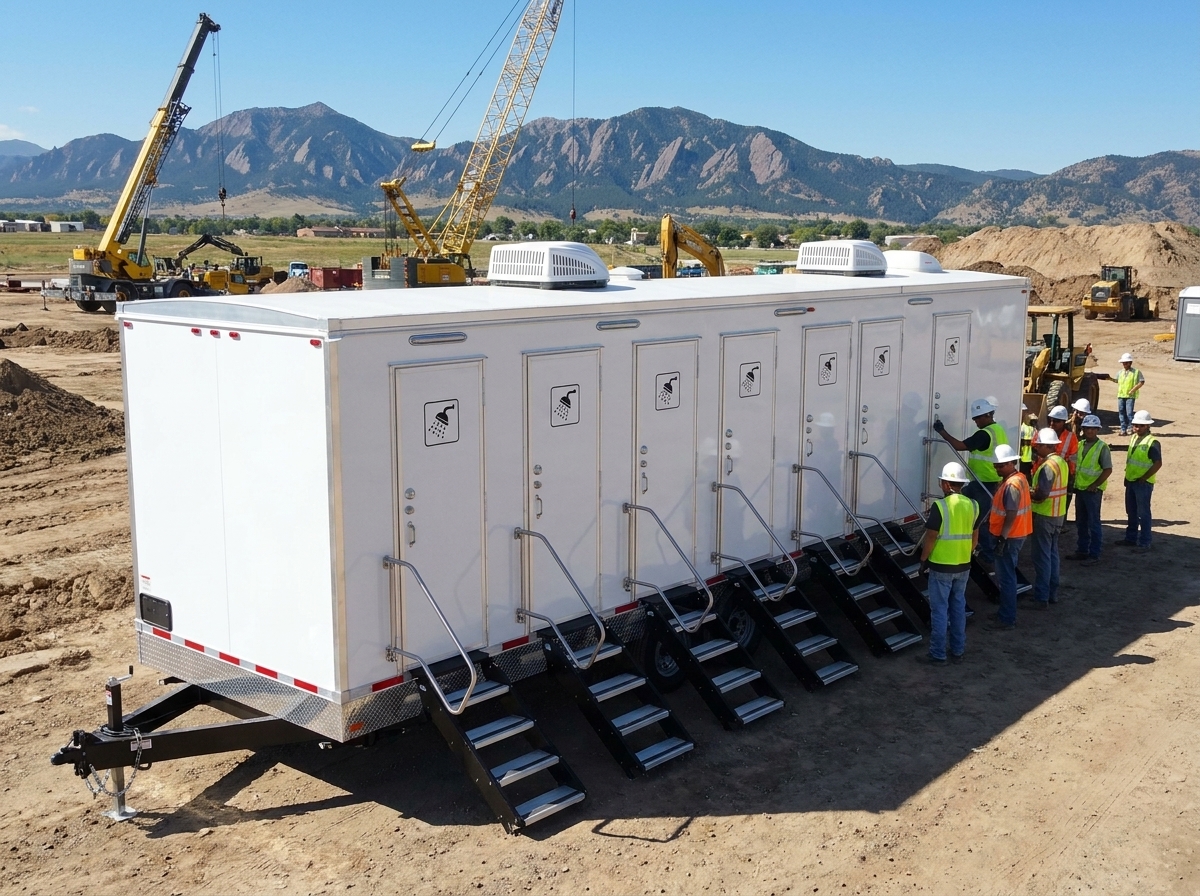
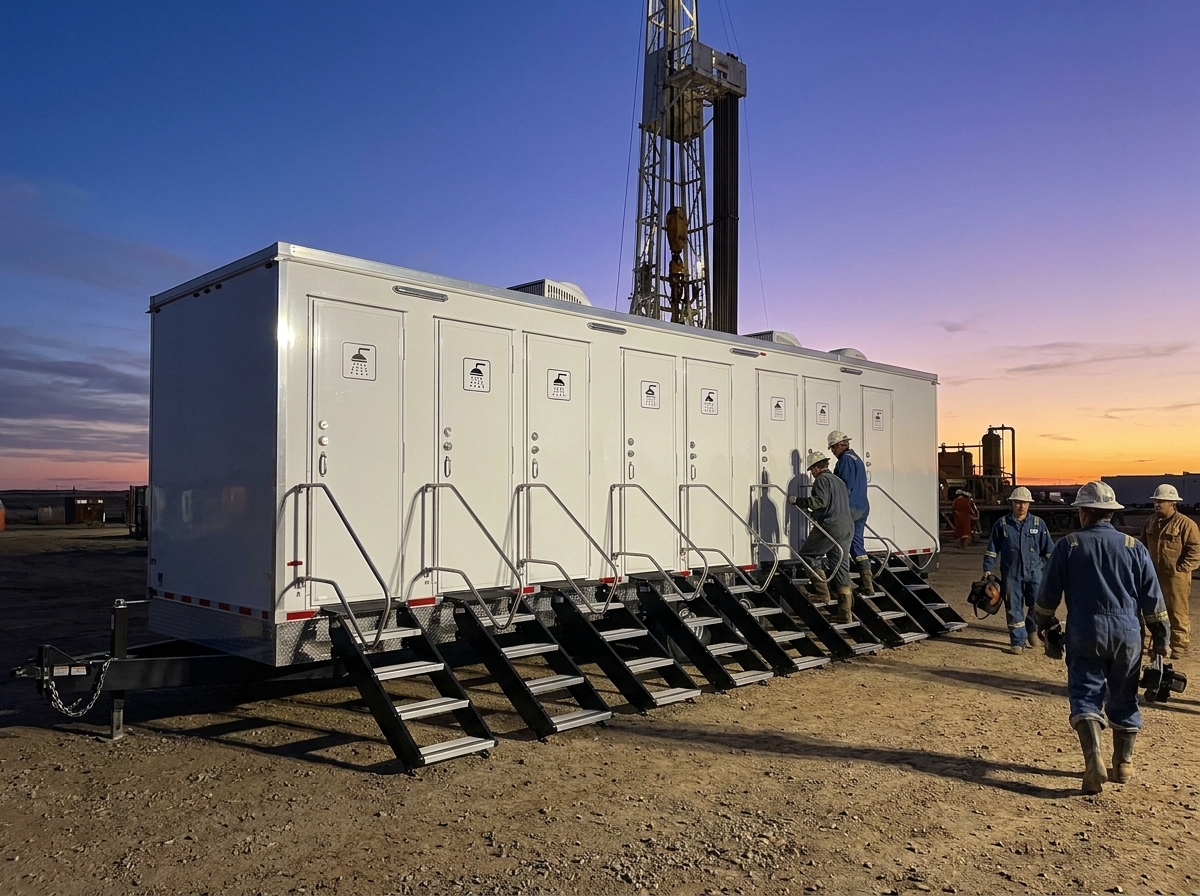
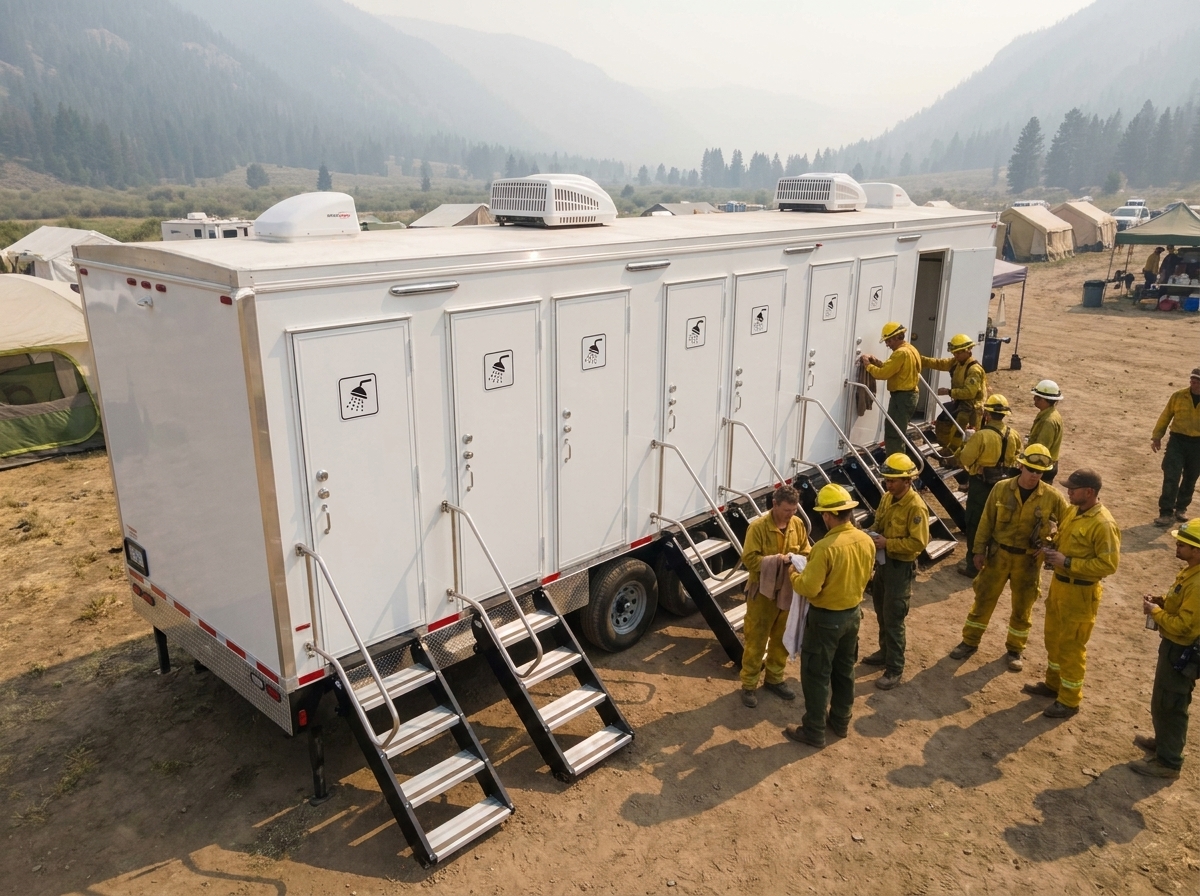
Picture a shift change. Sixty people come off a tour in a tight window, and the next crew is already staging. If the showers bottleneck, the whole rotation drags and people lose sleep instead of getting clean. Size the unit to the peak, not the average, and the line clears while there is still time to eat and rack out.
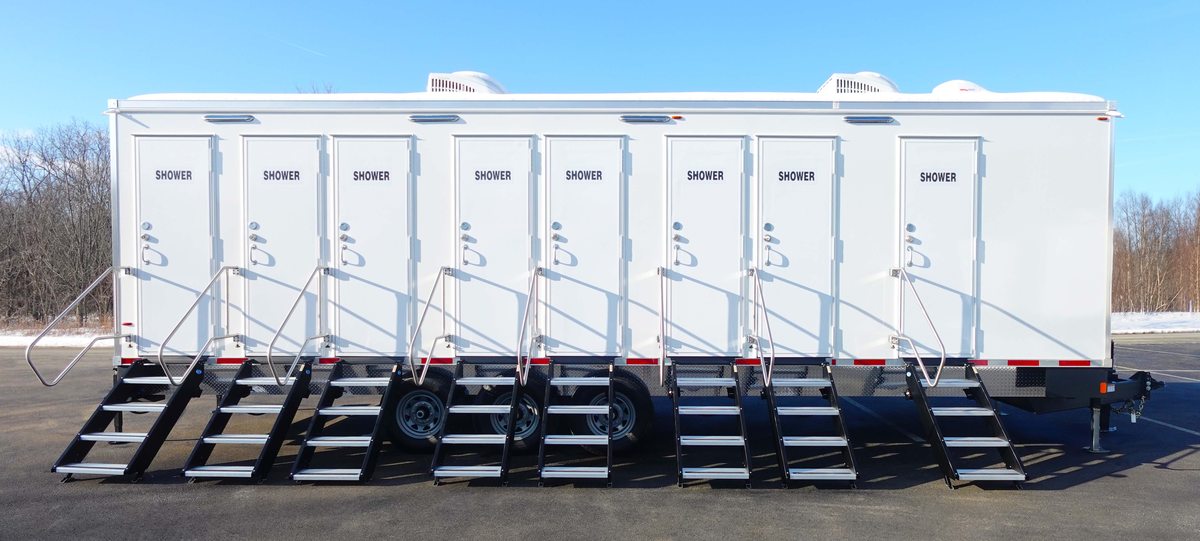
So our fleet runs a range. A single suite covers a small crew or a supervisor trailer. A multi-stall unit fits a mid-size site. An eight-stall trailer is for the pad or the camp where a full rotation has to clean up fast. Pick the one that matches the peak load, and if the crew grows we can add stalls rather than swap the whole setup.
Keep the accessible suite in the count while you plan. A private ADA stall with ramp entry, a roll-in threshold, a fold-down seat, and grab bars is part of the sizing, not something bolted on later. On a public site it is required, and on any site it is one more usable stall in the rotation.
Water and heat set a real ceiling too. A stall is only as good as the hot water behind it, so tank capacity and heater output have to match the draw you expect. On a remote site with no line to tie into, that means planning refills on a schedule that tracks how hard the crew uses the unit. We size the tanks and the service run together so the hot water does not run out mid-rotation.
And sizing is not only about showers. If the site also needs restrooms or laundry, a combo unit or a paired trailer can cover all of it in one footprint. That usually beats scattering separate rentals across the yard. It matters most where everything has to be trucked in and staged on tight ground.
The short version. Tell us the crew size, the rotation, and whether it is a one-hour crush or a slow trickle, and we will spec the unit to the peak. Get that right up front and nobody stands in line at the end of a twelve-hour day.
Sources: CDOT active construction projects · City of Colorado Springs projects
What to ask before you rent a shower trailer in Colorado
Not all shower rentals are the same, and the gap shows up on the worst day, not the first. Before you sign anything, a handful of questions will tell you whether a provider can actually hold up on a Colorado site. Ask them early. The answers sort the real operators from the ones who show up with a trailer and a shrug.
Start with the obvious one. Is the unit self-contained? A trailer that needs a sewer hookup is useless on a raw pad or a camp with no infrastructure. You want onboard water tanks, onboard heating, and full greywater capture, so the thing runs on day one wherever you set it.
Then ask about hot water, and be specific. Continuous, or tank-limited? A unit that runs out after a dozen showers will not survive a shift change. Ask how many showers it turns over in an hour, and match that number to your peak load rather than the brochure.
Ask what happens in the cold. A lot of units are spec'd for mild weather, and Colorado is not that. So ask whether the unit is winterized, whether the water lines are protected, and whether it holds hot water when the overnight low drops below freezing. If the answer is vague, that is your answer.
Ask about service, because a shower trailer is only as good as its day-two visit. Who restocks the soap, towels, and paper? How often do route techs come out? Who pumps and hauls the greywater, and where does it go? On a remote site, ask how far the service run is and whether the schedule holds when the weather turns.
And ask about the paperwork before it matters. On a public job, a government site, or an emergency activation, you want a provider that is SAM.gov registered. One that knows how to place a unit so it clears the local county permit office. Ask whether they carry ADA suites, because on a public placement that is not optional.
Ask what is actually included, in writing. Delivery, setup, daily service, restocking, greywater handling, and pickup should all be in the number. If some of those are add-ons, you want to know before the invoice, not after. The clean quote is the one that already has the logistics folded in.
One last question, and it is the real one. Who answers the phone at 2 a.m. when a unit goes down on a live site? Ask for the emergency line and ask whether a person picks up. That single answer tells you more about a provider than the rest of the sheet combined.
Sources: Weld County Oil and Gas Energy Department · CDPHE Regulation 86 Graywater Control
Keeping hot water running at altitude in a Colorado winter
Hot water is harder to hold at altitude than most people expect. Thin dry air, hard freezes, and long cold nights all work against a shower unit. A trailer that runs fine in a mild valley can quit on a ridge in January. So the build has to account for the elevation, not fight it after the fact.
Start with the freeze. Water lines are the weak point on any mobile unit, and once they freeze you have lost the morning at best. Our units get winterized before a cold deployment, with the lines and tanks protected so nothing seizes up overnight. Winterizing is the difference between a crew showering at 6 a.m. and a crew standing around while somebody thaws a pipe.
Then there is the heat itself. Cold incoming water and cold ambient air both pull against the heater. So a unit up high has to carry enough heating capacity to keep hot water flowing under load, not just trickle it out. When a full rotation hits the stalls at once, the heater has to keep up. Undersize it and the last person in line gets a cold rinse, which in a Colorado winter is worse than no shower at all.
Altitude changes the human side too. Crews high in the mountains dehydrate faster and work harder for the same output, and cold on top of that wears people down. A hot shower at the end of a shift is part of how a workforce stays healthy and shows up the next day. It is not comfort. It is keeping people functional through a hard stretch.
So placement matters more in winter. We set units where a service truck can still reach them after a storm. Where the wind is not driving straight at the door. And where a refill run is realistic when the roads get bad. A perfectly good unit parked somewhere a truck cannot reach in February is not much use.
Refills need a cold-weather plan of their own. On a remote site with no line to tie into, the tank has to be topped off on a schedule. And that schedule has to survive weather that closes passes and slows every drive. We plan the service run around the season, not around a clear day in June.
And the greywater side does not get a pass in the cold. It still has to be captured, held, and hauled to approved disposal, freezing weather or not. A closed system that keeps working at temperature is the whole point, because the alternative is a frozen tank and a unit down until it thaws.
None of this is glamorous. It just has to be right on the coldest morning of the job. When a crew is staging in the dark, the only question that matters is whether the water is hot. Build for that morning and the rest of the season sorts itself out.
Sources: Colorado DFPC historical wildfire information · Colorado Marshall Fire recovery (DR-4581)
Getting your site ready for a shower trailer, and what service looks like after
A shower trailer is easy to place if the site is ready for it, and a headache if it is not. Most of what makes a smooth drop happens before the truck arrives. So it is worth knowing what a unit actually needs from the ground, and what happens once it is set and running.
Start with access. The trailer comes in on a truck. So there has to be a way in that a truck can use, and room to maneuver and set the unit without threading it past a crane or a lay-down pile. Level ground matters. A reasonably firm, level pad keeps the unit sitting right and draining the way it should. Soft mud and a hard side-slope are the two things that turn a ten-minute set into an afternoon.
Then think about where it lives on the site. Close enough that people actually use it. Out of the equipment lanes, so it is not in the way. And reachable by a service truck without shutting down half the yard. On a tight site that placement is a real decision, and we would rather sort it before the drop than move a set unit later.
Utilities are a yes-or-no question, not a requirement. If site water and power are there, we tie in and the unit runs off the site. If they are not, it runs fully off-grid on its own tanks and heater, and we plan refills around that. The crew has hot water regardless. The hookups just change how we feed the unit, not whether it works.
Once it is set, service is the part that keeps it from becoming your problem. Route techs come out on a schedule. They restock the soap, towels, and paper, wipe the unit down, and check it over, so small issues get caught before they strand a crew. That daily attention is most of what separates a shower trailer that stays clean from one that turns into a complaint.
Greywater is handled on the same visit. Everything the unit uses is captured in onboard tanks, and we pump and haul it to approved disposal, so nothing gets discharged where you set the trailer. On a remote site, the service run is planned around the distance. The tank gets pumped and the water gets topped off before either one becomes an issue.
And the schedule flexes with the work. If usage climbs because the crew grew or the job intensified, we tighten the service interval to match. If a spec changes, we adjust. The idea is that the person running the site never has to think about the shower unit after the first conversation.
When the phase wraps or the site moves, we pull the trailer and haul it out. The ground is left clear, with no cleanup on your plate. So that is the arrangement. You point to the spot, we handle the rest, from the set to the last pickup.
Sources: Peterson Space Force Base overview · SAM.gov federal contractor registration