Home / Services / California
California

Mobile Shower Trailer Rentals for California

Mavirus Group runs mobile shower units across California, from Central Valley jobsites and Mojave training ranges to wildfire base camps in the Sierra and the coast ranges. We deliver private hot-water stalls, service them daily, and build them to hold up when hundreds of people need to clean up on the same shift.

California shower trailers

Why California job sites call us first for showers

California asks more of a shower fleet than any other state. Fire seasons that run most of the year, construction crews in the thousands, military rotations in the desert, and disasters that empty whole towns. Mavirus Group is built for that work. We are a national provider of shower, restroom, laundry, water, and support trailers for large-scale, government, disaster, construction, and commercial operations, and we are a SAM.gov registered federal contractor. When a job needs private hot showers that keep running through a shift change, we are the crew that shows up and stays running under load.

24/7emergency dispatch
SAM.govregistered federal contractor
Off-gridno hookups required
ADAaccessible suites available
Our Shower Trailer Fleet

Meet the private shower trailers we deliver to California

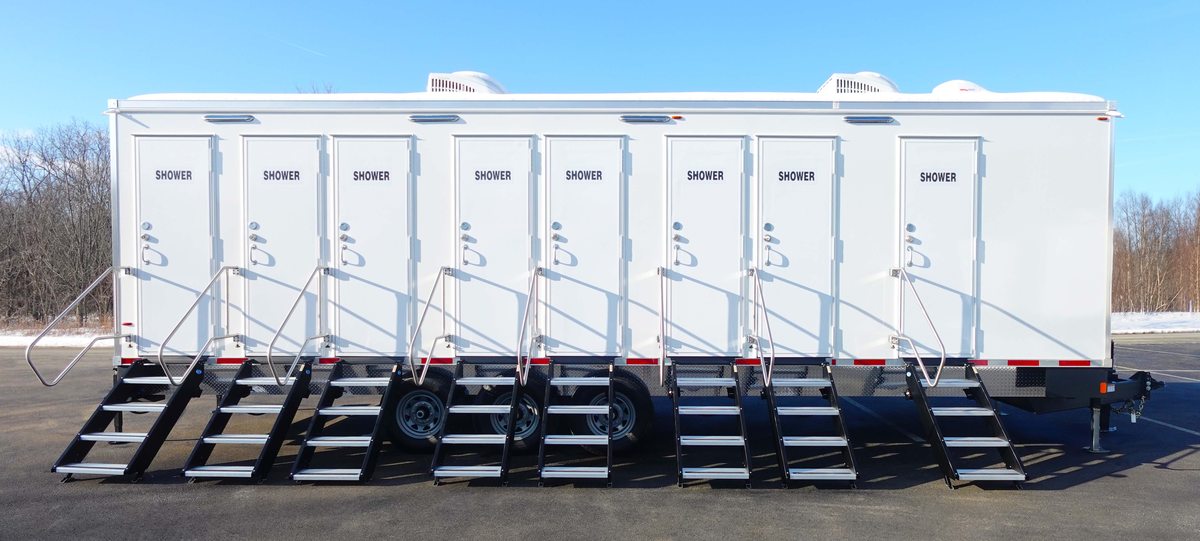
A Mavirus private shower trailer with individual locking stalls, ready for California delivery
A Mavirus private shower trailer, individual locking stalls with continuous hot water

Our shower trailers give every person a private, locking stall with a bench, hooks, ventilation, and continuous hot water. The fleet runs from a single accessible suite to an eight stall unit, plus combos that fold private showers in with restrooms or laundry. With disciplined flow a large unit turns over dozens of showers an hour, which is what a fire camp or a workforce site needs at shift change.

The trailers are self-contained. Continuous water heating, onboard tanks, and full greywater capture let a mobile shower unit run at a remote site with no hookups, and it connects to water and power when the site has them. We size the number of stalls to your crew so the line clears before the next shift rolls in.

Every stall is sanitized between rentals and serviced daily where the mission demands it. Delivery, setup, hot water, greywater handling, restocking, and pickup are all part of the rental, and an ADA-accessible shower suite with ramp entry and grab bars comes standard as an option. In California that usually means a deluxe eight-stall unit staged at a fire camp or a Central Valley jobsite, turning over dozens of showers an hour on continuous high-output hot water, with an ADA-accessible suite next to it for anyone who needs ramp entry and a roll-in stall.

Where we work

The core California work we show up for

Events are a small slice of what we do here. Most of our California work is the hard stuff: base camps for wildfire crews, hygiene for construction crews on long builds, and field support for military and disaster operations. Here is what that looks like on the ground.

Wildfire and disaster

Portable showers for California fire base camps

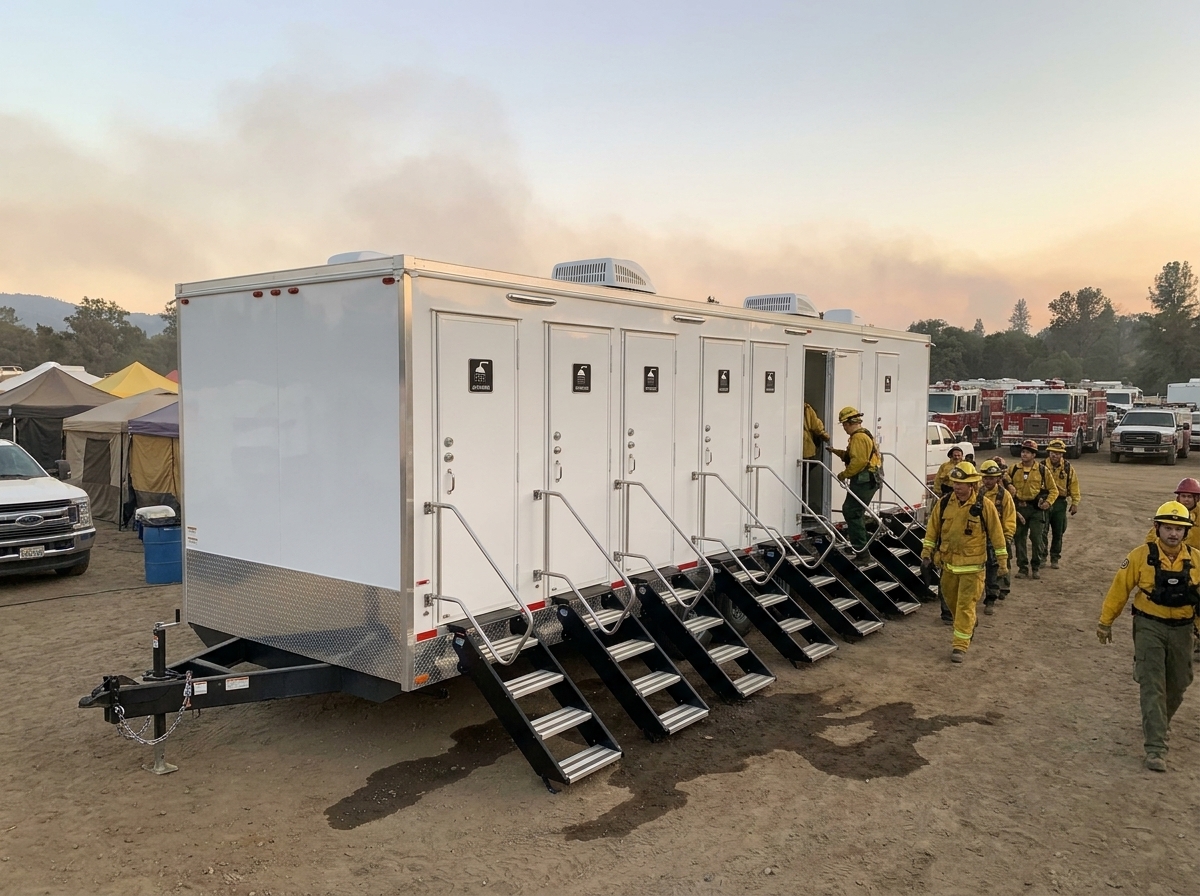
California runs the largest wildfire operation in the country. CAL FIRE, the US Forest Service, and the Governor's Office of Emergency Services stand up incident base camps across the state every season, and those camps run on the same basic needs a small town does. Hundreds of firefighters cycle off the line filthy, exhausted, and on a clock, and they need hot water fast. A single eight-stall shower unit can move dozens of crew members through a shift change without the line backing up, which is exactly what a spike camp in the Sierra or the Los Padres cannot do without.

The January 2025 fires in Los Angeles County show the scale California plans for. The Palisades and Eaton fires together burned more than 57,000 acres, destroyed over 14,000 structures, and pushed roughly 200,000 people out of their homes inside a few weeks. The California National Guard put hundreds of personnel on the ground. A response that size needs shower and sanitation support delivered and running the same day, not staged over a week.

Our units are self-contained for exactly that reason. Onboard water tanks, onboard water heating, and full greywater capture let a unit work off-grid on a fire road or a staging area with no hookups, then tie into site water and power the moment either shows up. Crews get privacy, a bench, hooks, ventilation, and hot water that does not run cold halfway through. We service daily and haul the greywater ourselves, so the camp command staff has one less thing to manage.

We work the way agency logistics works. SAM.gov registration, 24/7 dispatch, and delivery, setup, daily service, restocking, and pickup on every rental let a Cal OES coordinator or a Forest Service buying team move fast when the weather turns. When resources get prepositioned ahead of an elevated fire-weather window, we can stage temporary shower banks with them so the camp is ready before the first crew rolls in.

Firefighters in yellow Nomex lined up at a large mobile shower trailer at a dusty California wildfire base camp at dusk, tents and engines behind them
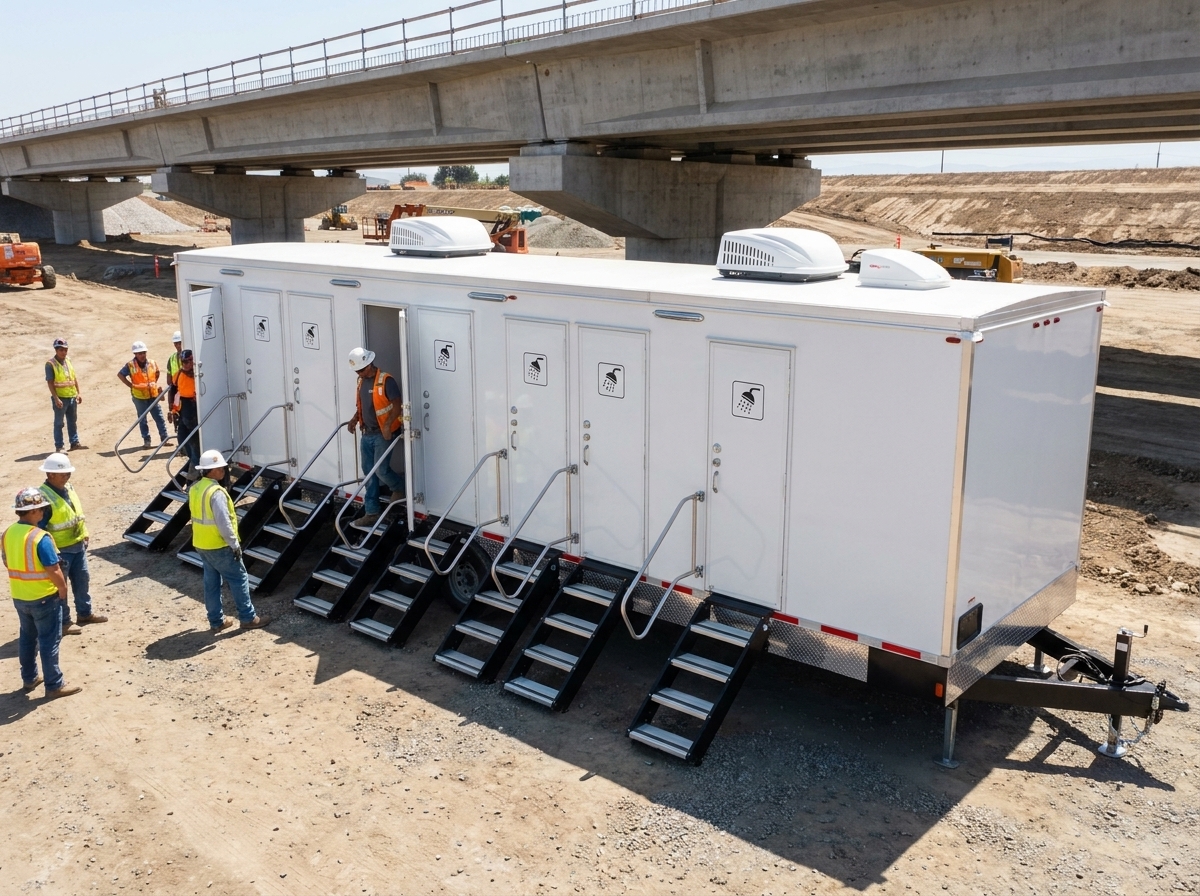
Construction workers in hard hats and hi-vis waiting outside a shower and restroom combo trailer on a wide Central Valley high-speed rail jobsite, guideway structure in the background
Commercial construction

Temporary showers for California's biggest builds

California's construction workforce is enormous, and a lot of it works far from any permanent building. The California High-Speed Rail project has around 119 miles under active construction through the Central Valley, with reported figures near 16,100 construction jobs and up to 1,700 workers on a jobsite on a peak day. Those viaduct and guideway segments run across open farmland in Madera, Fresno, Kings, Tulare, and Kern counties, where a crew's nearest real facility can be miles away.

General contractors on long builds treat hygiene as a retention and safety issue, not a luxury. On multi-year work like the San Diego International Airport New Terminal 1 program or the UC Davis medical center tower in Sacramento, a workforce base camp with real showers keeps trades on site, cuts drive time, and holds up under summer heat that regularly tops 100 degrees in the valley. We supply the showers, and we can pair them with restroom and laundry combos so a camp covers the full daily reset in one footprint.

The units are built for the load a jobsite puts on them. High-output hot water that keeps up through a full shift change, locking private stalls with a bench and hooks, and construction-grade service that restocks and handles greywater on every visit. When a site has water and power we tie in. When it does not, the onboard tanks and heater carry it. Either way the superintendent is not chasing a plumber.

We handle the compliance side California builds care about. Greywater gets captured and hauled to a permitted disposal site instead of dumped, which keeps a project clean with the Regional Water Quality Control Board and county environmental health. ADA-accessible shower suites are available for any placement, so a jobsite meets its accessibility obligations without a scramble.

Military and National Guard

Mobile showers for California field operations

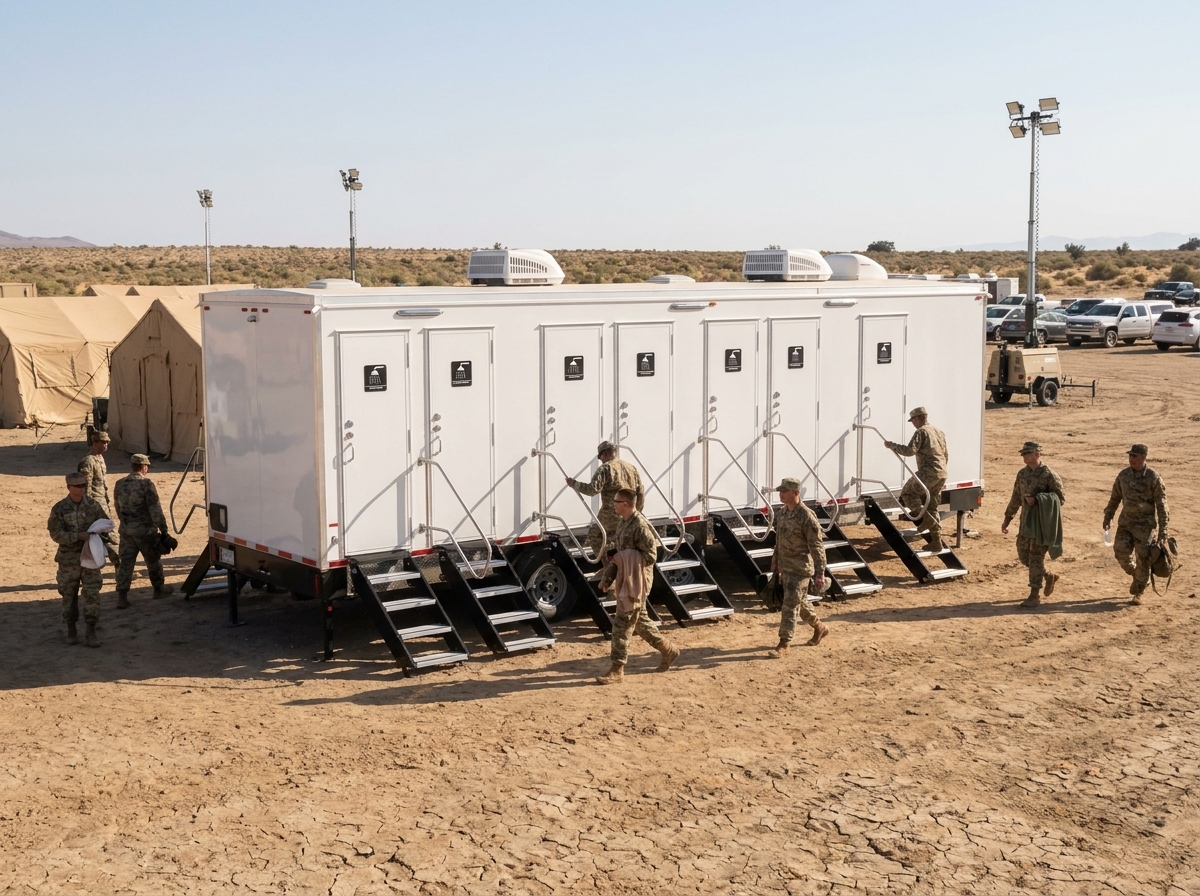
California carries one of the heaviest military footprints in the country, and a lot of that training happens in the field. Fort Irwin's National Training Center puts rotating brigades into the box in the Mojave Desert for weeks at a time, where visiting units like the Florida and New York Army National Guard have run force-on-force rotations with no fixed facilities where they operate. Camp Pendleton trains more than 40,000 Marines and Sailors across ranges and 17 miles of coastline. Field hygiene at that scale is a logistics problem, and portable showers solve it.

The requirement is throughput. When a company comes off a training lane or a Guard unit rotates through a staging area, everyone needs to clean up in a tight window. Our large units are built for that turnover, moving dozens of people an hour through private stalls on continuous hot water. Off-grid capability matters even more here than on a jobsite, because a desert range or a remote staging area often has no water or power at all until we bring it.

We support California National Guard missions beyond training too. Guard units deploy for wildfire, flood, and civil support across the state, and those deployments need the same fast shower and sanitation footprint a disaster shelter does. SAM.gov registration and 24/7 dispatch mean a unit tasked on short notice can get shower support moving without a long procurement cycle.

Every rental includes delivery, setup, daily service, restocking, greywater and waste handling, and pickup, so a unit's own personnel are not pulled off mission to run a shower point. We keep the trailers sanitized between rentals and serviced daily in the field, and we can add ADA-accessible suites and restroom or laundry combos where a longer deployment needs them.

Soldiers in fatigues walking to a large shower trailer at a dusty Mojave Desert training staging area near Fort Irwin, tan tents and light towers around them
More of what we cover

Other California operations we keep clean

Government and agency contracts

State and federal buying teams work with us because we are SAM.gov registered and set up for the paperwork. Cal OES, county emergency management, and federal agencies can task shower and sanitation trailers on 24/7 dispatch, with delivery, service, and pickup handled.

Schools and district projects

LAUSD and San Diego Unified are running billions in campus modernization, which takes classroom buildings offline for months. We stage temporary shower and restroom support for the crews on those rebuilds and for facility gaps during construction.

Energy, solar, and industrial sites

Kern County's solar buildout, including large centers like Aratina near Boron, puts hundreds of construction workers on remote high-desert land. Our off-grid, portable showers keep those crews clean where there is no building for miles.

Disaster shelters and recovery

When fires, floods, or earthquakes displace residents, evacuation centers and recovery staging need showers fast. We deliver and set up same-day where access allows, with ADA suites so shelters meet accessibility requirements.

Corporate campuses and ports

Long industrial and commercial builds, port operations, and large facility projects across the Bay Area and Southern California use our mobile units to give crews a real daily reset on site instead of sending them off property.

Large gatherings and events

We also support festivals, races, and large private gatherings that want real hot-water showers, not a rinse. It is a smaller part of our work, but the same clean, serviced units show up.

Construction workers in hard hats and hi-vis waiting outside a shower and restroom combo trailer on a wide Central Valley high-speed rail jobsite, guideway structure in the background
Why demand runs long here

Heat and fire stretch the California season

California does not have a short busy window. Central Valley summers regularly push past 100 degrees for weeks, which turns a shower on a jobsite from a comfort into a heat-safety measure. Crews that can rinse off and cool down at the end of a shift stay on the job and stay safe, and Cal/OSHA takes field sanitation seriously enough that real facilities on site are part of running a compliant operation.

The fire calendar is the other half. What used to be a summer-to-fall fire season now runs deep into winter, as the January 2025 Los Angeles fires made clear. Base-camp shower demand can spike in any month, and agencies preposition resources ahead of elevated fire-weather windows rather than waiting for a start. A fleet that only gears up for summer misses half of California's real need.

Put those together and California needs shower support that is ready year-round and can scale from a single ADA suite to a bank of deluxe eight-stall units on short notice. That is the fleet posture we keep here, because the state's work does not slow down and neither does the weather that drives it.

Scale of the work

California workforces that need daily showers

A rough look at the construction workforce tied to a few major California projects. Heights are illustrative of relative scale, and the labels are the real reported job figures. These are the crews a shower fleet has to keep clean.

Reported construction jobs by project
High-Speed Rail (Central Valley)16,100
Central Valley solar buildout6,000
Aratina Solar (Kern County)570
Camino Solar (Kern County)100+
Figures reported by the project sponsors and public agencies. Illustrative of relative workforce scale, not exact daily headcounts.
Why Choose Us

What sets our shower trailers apart

Built for agency-scale logistics

Most shower rental outfits are built for backyard parties. We are built for the opposite. SAM.gov registration, 24/7 emergency dispatch, off-grid units, and daily field service mean a fire camp, a federal buying team, or a megaproject superintendent gets a provider who can actually carry the load and the paperwork.

Private, individual stalls

Every person gets a locking stall with a bench, hooks, and working ventilation, not an open bay. A crew that showers in private tonight works tomorrow.

Hot water sized for shift change

Continuous, high output water heating means the last person in line gets the same hot shower as the first, so sixty crew clear through a bank of stalls without the water running cold.

Greywater handled completely

Onboard capture and managed disposal mean a shower line runs at a remote camp with no drain, and nobody on your team deals with wastewater.

Self-contained, goes anywhere

Onboard water tanks and heating let a mobile shower trailer run fully off grid at a fire camp or staging area, and it connects to hookups when the site has them.

Built for scale and agencies

From a small shelter to a large fire or disaster deployment, with a 24/7 line for emergencies. As a SAM.gov registered contractor we work with Cal Fire, the US Forest Service, FEMA, and other agencies.

ADA accessible

A wheelchair-accessible shower suite with ramp entry, a roll-in threshold, a fold-down seat, and grab bars is available for any placement, so shelters and public agencies clear inspection.

Customer Stories

A few California jobs we have handled

Base camp logistics lead, Sierra Nevada fire assignment

A logistics coordinator standing up a base camp for a Sierra fire needed showers for hundreds of crew before the first hand crews rotated off the line. We staged deluxe eight-stall units off-grid on ground with no hookups, ran continuous hot water through shift change, and serviced daily while handling all the greywater. The camp never had a shower line problem, and command could focus on the fire instead of the facilities.

Project superintendent, Central Valley infrastructure build

A superintendent on a long Central Valley build was losing time to crews driving off site to clean up in triple-digit heat. We set a shower and restroom combo on the jobsite, tied into site water where it existed and ran off tanks where it did not, and kept it restocked and serviced. Trades stayed on property, and the heat-safety box got checked without a headache.

County emergency manager, Southern California wildfire

During a fast-moving Southern California fire, a county emergency manager needed shower support at an evacuation and recovery staging area within hours. We delivered and set up same-day, added an ADA-accessible suite so the site met accessibility rules, and kept it serviced through the response. Displaced residents and responders both had somewhere real to clean up.

Around the Region

California regions we cover

Greater Los Angeles and the Southland

The densest mix of work in the state. Wildfire response in the surrounding hills, huge construction and school-modernization programs across LAUSD, ports, and disaster staging after events like the 2025 fires. We move shower fleets fast across the LA basin and the foothills.

San Francisco Bay Area

Long commercial and infrastructure builds, tech and industrial campuses, and dense urban jobsites where crews cannot easily leave to clean up. We fit private shower and restroom combos into tight Bay Area sites and keep them serviced through multi-year work.

San Diego County

Camp Pendleton field training, the New Terminal 1 airport build, hospital and school construction, and coastal wildfire risk. San Diego work spans military, megaproject, and disaster needs, and we cover all of them.

Sacramento and the Capital Region

State agency operations, the UC Davis medical campus expansion, and the northern edge of Central Valley heat. Summers here run hot and long, so jobsite shower demand stretches across most of the year.

Central Valley and the San Joaquin

The heart of our heavy work. High-Speed Rail construction, massive agricultural workforces under Cal/OSHA field sanitation rules, and triple-digit summers. Off-grid, portable showers are close to mandatory out here, and that is exactly what we build for.

Inland Empire and the High Desert

Fort Irwin training rotations, Kern and San Bernardino solar and industrial sites, warehouse and logistics buildouts, and the Mojave's remote staging areas. No hookups, long distances, real heat. Our self-contained, mobile units are made for it.

The compliance side

The compliance rules we handle for you

Greywater is the big one in California. Water that runs off showers has to be captured and hauled to a permitted disposal site, not discharged to the ground or a storm drain. The Regional Water Quality Control Boards and county environmental health departments enforce this, and violations get expensive. Every one of our units captures its own greywater in an onboard tank, and we haul it as part of the service so your site stays clean with the regulators.

Accessibility is the second. Public-facing placements and many jobsites fall under the Americans with Disabilities Act and the California Building Code accessibility standards. We keep ADA-accessible shower suites available for any placement, with ramp entry, a roll-in threshold, a fold-down seat, and grab bars, so you meet your obligations without a last-minute scramble.

Then there is worker sanitation. Cal/OSHA sets field and construction sanitation requirements, including potable water and handwashing, and agricultural operations carry their own field sanitation rules under Title 8. Real, serviced shower and restroom facilities on site are part of running a defensible operation. We deliver, set up, service daily, restock, and pick up, so the sanitation box stays checked the whole time we are there.

Service Area

Where we deliver across California

We deliver, set up, service, and haul across every major California market. From the coast to the desert and up through the valley, if a job needs showers we can get a unit there and keep it running.

Los AngelesSan DiegoSan JoseSan FranciscoFresnoSacramentoLong BeachOaklandBakersfieldAnaheimRiversideStocktonIrvineSanta AnaChula VistaFremontModestoFontanaBarstowPalm SpringsReddingSanta RosaVisaliaEl Centro
Reviews

What California crews say

Marcus D., logistics lead, Northern California
Marcus D.logistics lead, Northern California
★★★★★

We had them stage shower units at a base camp with zero hookups and they never gave us a problem. Hot water held through every shift change and the daily service was on time. That is all we needed.

Angela R., project superintendent, Central Valley
Angela R.project superintendent, Central Valley
★★★★★

Triple-digit heat and crews spread across a long site. The shower and restroom combo kept everyone on property. Restocking and greywater were handled every visit. Easy to work with.

Tom S., county emergency management, Southern California
Tom S.county emergency management, Southern California
★★★★★

They delivered same-day during a fast fire response and brought an ADA suite without me having to ask twice. Serviced the whole time. Exactly what a chaotic scene needs.

Priya N., facilities manager, San Diego County
Priya N.facilities manager, San Diego County
★★★★★

Long construction build near the coast and we needed real showers for the trades. The units were clean, private, and serviced daily. No complaints from the crews, which is rare.

Derek W., site manager, Kern County solar
Derek W.site manager, Kern County solar
★★★★★

Out in the high desert with nothing around. Their off-grid units just worked. Hot water, private stalls, hauled the greywater themselves. Made my job easier.

FAQ

Frequently asked questions

Do your portable showers work off-grid at a California fire camp or remote jobsite?
Yes. Every unit is self-contained with onboard water tanks, onboard water heating, and full greywater capture, so it runs with no hookups on a fire road, a desert staging area, or open farmland. When site water and power are available we tie in, but we do not need them. This is the standard setup for California base camps and Central Valley jobsites.
How many people can one shower unit handle during a shift change?
A large eight-stall unit turns over dozens of showers an hour, which is what a fire camp or a big jobsite needs when a whole crew comes off the line at once. Continuous high-output hot water is the key: the stalls stay hot and the line keeps moving instead of backing up. For smaller sites we scale down to a single suite or a compact unit.
Are you set up to work with government agencies like CAL FIRE, Cal OES, or federal buyers?
Yes. Mavirus Group is a SAM.gov registered federal contractor and we run a 24/7 booking and emergency dispatch line. State and federal buying teams can task shower and sanitation units quickly, and delivery, setup, daily service, restocking, greywater handling, and pickup are included on every rental. We are built for agency-scale logistics, not just events.
Do you handle the greywater, or is that on us?
We handle it. Every unit captures its own greywater in an onboard tank, and we haul it to a permitted disposal site as part of the service. California enforces greywater disposal through the Regional Water Quality Control Boards and county environmental health, so this keeps your site clean with the regulators and takes the problem off your plate entirely.
Do you offer ADA-accessible shower units in California?
Yes. We keep ADA-accessible shower suites available for any placement, with ramp entry, a roll-in threshold, a fold-down seat, and grab bars. Public-facing sites and many jobsites fall under the ADA and the California Building Code accessibility standards, so we make it easy to meet those requirements without a last-minute scramble.
How fast can you deliver during a wildfire or disaster response?
We run 24/7 emergency dispatch and can deliver and set up same-day where access allows. During fast-moving events we have staged shower and sanitation support at base camps and evacuation staging areas on short notice. When agencies preposition resources ahead of elevated fire weather, we can stage units with them so the camp is ready before crews arrive.
Can you support a multi-year construction project?
Yes, that is a core part of our work. On long California builds we place shower units, often paired with restroom or laundry combos, and keep them serviced, restocked, and clean for the length of the job. Off-grid capability, high-output hot water, and daily service mean the units hold up under the load a busy jobsite puts on them month after month.
Do you cover the Central Valley and the high desert, not just the big cities?
We cover the whole state, and the remote work is where we shine. High-Speed Rail segments across the San Joaquin, Kern County solar sites near Boron, Fort Irwin in the Mojave, and agricultural operations far from any building. Our self-contained units are made for exactly those places, where there are no hookups and the nearest facility is miles away.
What is included in a shower rental?
Delivery, setup, daily service, restocking, greywater and waste handling, and pickup are all included on every rental. The trailers are sanitized between rentals and serviced daily on site. You get private locking stalls with a bench, hooks, ventilation, and continuous hot water, and we handle the rest so your team can stay on mission.
Can you combine showers with restrooms or laundry in one unit?
Yes. Alongside dedicated shower units we offer combo units that pair showers with restrooms or with laundry, so a base camp or workforce site can cover the full daily reset in one footprint. For longer deployments this cuts the number of separate units you have to manage on a tight site.
Do you serve military and National Guard operations in California?
Yes. We support field training and deployments, including remote desert ranges around Fort Irwin and coastal training at Camp Pendleton, plus California National Guard wildfire and civil support missions. Our large units are built for the fast turnover a unit needs coming off a training lane, and off-grid capability matters most where there is no infrastructure at all.
How does summer heat affect shower demand on California jobsites?
It raises it. Central Valley and inland summers regularly top 100 degrees for long stretches, which makes end-of-shift showers a heat-safety measure, not just a comfort. Cal/OSHA field sanitation rules also expect real facilities on site. Crews that can rinse off and cool down stay safer and stay on the job, which is why demand here runs hot from late spring into fall.
Resource Library

California shower resource library

Portable showers for California wildfire base camps: what incident logistics actually needs

California runs the largest wildfire operation in the United States. CAL FIRE, the US Forest Service, and the Governor's Office of Emergency Services stand up incident base camps across the state through most of the year, and every one of those camps has to function like a small town for the crews working the fire. Food, sleep, communications, and hygiene all have to appear on remote ground within hours. Showers are not a luxury in that setting. Firefighters coming off the line covered in soot and ash need to get clean to stay healthy across a long assignment, and a camp that cannot deliver that loses effectiveness fast.

The defining requirement is throughput under a shift change. When a division of hand crews rotates off the line at the same time, hundreds of people need to shower inside a tight window before they eat and sleep. A single large unit with eight stalls and continuous high-output hot water can move dozens of people an hour, which is the difference between an orderly camp and a line that never clears. Water that runs cold halfway through a rotation is a real failure at a fire camp, so continuous heating is the feature that matters most.

Base camps almost never have hookups where they are staged. A spike camp on a fire road in the Sierra or a staging area in the Los Padres has no municipal water and no power drop. That is why self-contained units matter so much for wildfire work. Onboard water tanks, onboard heating, and full greywater capture let a portable shower run entirely off-grid, then tie into site water and power if and when a support line reaches the camp. The unit does not wait on infrastructure to be useful.

The scale California plans for is not hypothetical. The January 2025 fires in Los Angeles County, principally the Palisades and Eaton fires, together burned more than 57,000 acres, destroyed over 14,000 structures, and forced roughly 200,000 people to evacuate inside a few weeks. The California National Guard put hundreds of personnel on the ground. A response that size needs shower and sanitation support that scales quickly and arrives ready to run the same day, not staged over a week while crews go without.

Agency logistics have their own rhythm, and a shower provider has to fit into it. SAM.gov registration lets federal buying teams task a vendor without a long qualification cycle. A 24/7 dispatch line matters because fire weather does not keep business hours. And prepositioning is now standard practice, where Cal OES and local agencies stage resources ahead of an elevated fire-weather window rather than waiting for an ignition. A provider that can stage units with those prepositioned resources gets a camp ready before the first crew arrives.

Daily service is what keeps a camp shower point usable over a multi-week assignment. Restocking supplies, cleaning stalls, and hauling the captured greywater to a permitted disposal site all have to happen on a schedule, handled by the provider rather than pulled from camp staff who are already stretched. In California, greywater cannot simply be dumped, so a provider that captures and hauls it as part of the service keeps the camp compliant with the water boards without adding a task to the command staff's list.

Accessibility belongs in the plan too. Base camps and the recovery centers that follow a fire serve a wide range of people, and an ADA-accessible shower suite with ramp entry, a roll-in threshold, a fold-down seat, and grab bars should be available alongside the standard stalls. Building that in from the start avoids a scramble later and keeps the operation defensible.

For anyone standing up a California incident base camp, the takeaway is simple. You want a shower provider that treats this as core work, not a sideline: off-grid capability, high throughput, daily service, greywater handling, agency-ready paperwork, and a dispatch line that answers at 2 a.m. That is the difference between a camp that runs and one that fights its own facilities while it fights the fire.

Sanitation logistics for California's megaproject construction workforces

California builds at a scale few states match, and a large share of that construction happens far from any permanent building. The California High-Speed Rail project is the clearest example. Roughly 119 miles are under active construction through the Central Valley, with reported figures near 16,100 construction jobs to date and up to 1,700 workers on a jobsite on a peak day. Those guideway and viaduct segments cross open farmland in Madera, Fresno, Kings, Tulare, and Kern counties, where the nearest real facility can be miles from where a crew is working.

On builds like that, hygiene is a workforce and safety issue rather than a comfort. A superintendent who forces crews to drive off site to clean up loses hours every day and invites turnover on a labor market that is already tight. A workforce base camp with real showers keeps trades on property, shortens the daily reset, and holds up under Central Valley summers that regularly push past 100 degrees. When heat safety is on the line, an end-of-shift shower is part of a defensible operation, not an extra.

The same logic applies to the state's other big builds. The San Diego International Airport New Terminal 1 program, a multibillion-dollar expansion phased through the late 2020s, and the UC Davis medical center tower in Sacramento both run long enough that on-site hygiene pays for itself in retained labor and reduced drive time. School modernization under LAUSD and San Diego Unified, funded by multibillion-dollar bond programs, takes classroom buildings offline for months and puts crews on campus who need the same support.

These units have to be built for the load a jobsite puts on them. Continuous high-output hot water that keeps up through a full shift change, private locking stalls with a bench and hooks, and service that restocks and handles greywater on every visit. Where a site has water and power the unit ties in. Where it does not, onboard tanks and heating carry it. The point is that the superintendent is never chasing a plumber or babysitting a facility that cannot keep up.

Combos matter on tight or remote sites. Pairing showers with restrooms or laundry in a single unit lets a base camp cover the full daily reset in one footprint, which cuts the number of separate deliveries and service stops a busy site has to coordinate. On a multi-year build, fewer moving pieces on the sanitation side is a real operational win.

California's compliance environment shapes how this has to be done. Greywater from showers cannot be discharged to the ground or a storm drain. It has to be captured and hauled to a permitted disposal site, enforced by the Regional Water Quality Control Boards and county environmental health. A provider that captures greywater onboard and hauls it as part of the service keeps a project clean with the regulators. Cal/OSHA also sets construction sanitation requirements, so real serviced facilities on site are part of meeting the standard.

Accessibility is part of the specification. Many jobsites and any public-facing placement fall under the ADA and the California Building Code accessibility standards, so ADA-accessible shower suites with ramp entry, a roll-in threshold, a fold-down seat, and grab bars should be available for any placement. Building that in avoids a compliance gap surfacing at an inspection.

For a general contractor running a long California build, the checklist is straightforward. You want a provider who can deliver off-grid, keep hot water flowing through shift change, service daily, handle greywater to code, and scale from a single suite to a full workforce base camp as the job grows. Get that right and hygiene stops being a daily headache and turns into one of the quiet reasons crews stay on the job.

California greywater, ADA, and worker sanitation rules for portable showers

Running portable showers in California means running into three sets of rules that matter more here than in most states: greywater disposal, accessibility, and worker sanitation. Getting them straight up front is the difference between a clean operation and an expensive problem. A shower unit generates wastewater, serves the public and workers, and sits on jobsites and event grounds that regulators watch, so all three come into play on a typical placement.

Greywater is the first and often the most misunderstood. The water that drains from a shower is regulated wastewater in California, and it cannot be discharged to the ground, a gutter, or a storm drain. It has to be captured and hauled to a permitted disposal facility. The Regional Water Quality Control Boards oversee water quality across the state, and county environmental health departments enforce disposal at the local level. Improper discharge can bring real penalties, which is why serious providers capture greywater in an onboard tank and haul it as part of the service rather than leaving it to the client.

That capture-and-haul model is the standard a client should expect. A self-contained unit holds its greywater onboard and the provider removes it on a service schedule, hauling it to a permitted site. This keeps the burden off the client and keeps the placement compliant with the water boards. On a jobsite or a base camp, that means the superintendent or the command staff never has to think about where the shower water is going.

Accessibility is the second area. The Americans with Disabilities Act sets federal requirements for public-facing facilities, and California layers its own accessibility standards on top through the California Building Code, commonly referenced as Chapter 11B. For portable showers, meeting these standards means having an ADA-accessible suite available with ramp entry, a roll-in threshold, a fold-down seat, and grab bars. Any placement that serves the public, and many that serve workers, should include an accessible option, and it is far easier to plan for it than to retrofit it after an inspection flags a gap.

Worker sanitation is the third. Cal/OSHA, the state's occupational safety agency, sets sanitation requirements for construction and general industry, including potable water and handwashing access. Agriculture carries its own field sanitation rules under Title 8, which is directly relevant given the size of California's farm workforce and the heat those crews work in. While the specifics vary by operation, the through-line is that employers are expected to provide real, serviced sanitation facilities, and having proper shower and restroom units on site is part of meeting that expectation.

Heat ties these threads together in California. Long stretches above 100 degrees in the Central Valley and inland regions make end-of-shift showers a genuine heat-safety measure, and they raise the stakes on having compliant, well-serviced facilities available. A shower point that runs dry or backs up is not just an inconvenience in that climate, it is a safety gap.

The practical lesson for anyone renting portable showers in California is to treat compliance as part of the specification, not an afterthought. Ask how greywater is captured and disposed of, confirm an ADA-accessible suite is available, and make sure the provider services daily and can document it. A provider who builds all of this into a standard rental, with delivery, setup, daily service, restocking, greywater handling, and pickup included, takes the regulatory weight off the client entirely.

None of this is meant to be daunting. California's rules are demanding, but they are well established, and a provider who works at agency and megaproject scale handles them every day. The client's job is simply to choose a provider who treats greywater, accessibility, and sanitation as baseline requirements rather than upsells.

Field hygiene for California military training and National Guard deployments

California carries one of the heaviest military footprints in the country, and much of the activity that drives field hygiene demand happens away from any fixed facility. Fort Irwin's National Training Center, in the Mojave Desert near Barstow, puts rotating brigades into the box for weeks at a time, running force-on-force exercises across open desert. Visiting units, including Army National Guard brigades from other states, live and operate where there is no permanent infrastructure. Camp Pendleton in San Diego County trains more than 40,000 Marines and Sailors across its ranges and coastline. Both create a recurring need for shower support in the field.

The core requirement mirrors a fire camp: throughput under a tight window. When a company comes off a training lane or a unit rotates through a staging area, everyone needs to clean up at roughly the same time. Large units built for that turnover move dozens of people an hour through private stalls on continuous hot water. In a training environment where units are already carrying a heavy operational load, a shower point that clears quickly and does not run cold is a meaningful quality-of-life and readiness factor.

Off-grid capability is even more critical for military field work than for most construction. A desert range or a remote staging area frequently has no water and no power at all where units operate. A self-contained, mobile unit with onboard tanks, onboard heating, and full greywater capture can run entirely on its own resources, then connect to site water and power if a support line reaches the position. Without that independence, a shower is useless where the training actually happens.

The California National Guard adds another dimension beyond training. Guard units deploy across the state for wildfire, flood, and civil support missions, often on short notice. Those deployments need the same rapid shower and sanitation footprint that a disaster shelter does, staged quickly at an armory, a staging area, or an incident base. A provider with 24/7 dispatch and the ability to deliver and set up fast fits the tempo of a Guard activation far better than a vendor built for scheduled events.

Procurement realities favor providers built for government work. SAM.gov registration lets federal and defense buying teams task a vendor without a drawn-out qualification process, which matters when a requirement appears on short notice. Delivery, setup, daily service, restocking, greywater and waste handling, and pickup all being included means a unit's own personnel are not pulled off mission to run and maintain a shower point, which is exactly the kind of task commanders want off their plate.

Service in the field has to be reliable over the length of a rotation or deployment. Daily cleaning, restocking, and greywater hauling keep the facilities usable across weeks in harsh desert conditions where dust and heat are constant. Units sanitized between rentals and serviced daily hold up where a set-and-forget approach would fail within days.

Longer deployments benefit from combos and accessibility options. Pairing showers with restrooms or laundry in a single unit reduces the number of separate footprints a unit has to manage in the field, and ADA-accessible suites should be available where a deployment includes personnel or civilians who need them. Flexibility on configuration lets a provider match the specific shape of a training rotation or a civil-support mission.

For anyone responsible for field hygiene on a California military or Guard operation, the priorities are consistent: off-grid units that run where there is no infrastructure, high throughput for rapid turnover, government-ready procurement, and reliable daily service in tough conditions. A provider that treats these operations as core work, alongside its wildfire and construction support, brings the right posture to a mission where facilities cannot be an afterthought.

More Rentals

Other trailers we rent in California

We rent more than shower trailers. If you are setting up a base camp, a shelter, or a job site, we can bring the rest of the trailers too.

Get a Quote

Reserve your mobile shower trailer in California

We will size the number of stalls to your crew, deliver on your schedule, and service it daily for as long as the job runs. Call any time, day or night.

Get a Quote Call (855) 687-1887